Quality Engineering Services
Quality engineering across the software development lifecycle.
For 16 years, DeviQA has provided quality engineering services for web, mobile, cloud, SaaS, and enterprise applications. We integrate QA strategy, test automation, performance testing, security testing, CI/CD quality gates, and quality metrics across the software development lifecycle. DeviQA has completed 500+ QA projects across 40+ industries.


Trusted by






The problem with traditional QA –
and why it's costing you more than
you think
Traditional QA is a verification activity. It confirms whether the software works after it's been built. That model made sense when release cycles were measured in months. It doesn't survive in a world where teams ship weekly, or daily.
Here's what the data consistently shows:
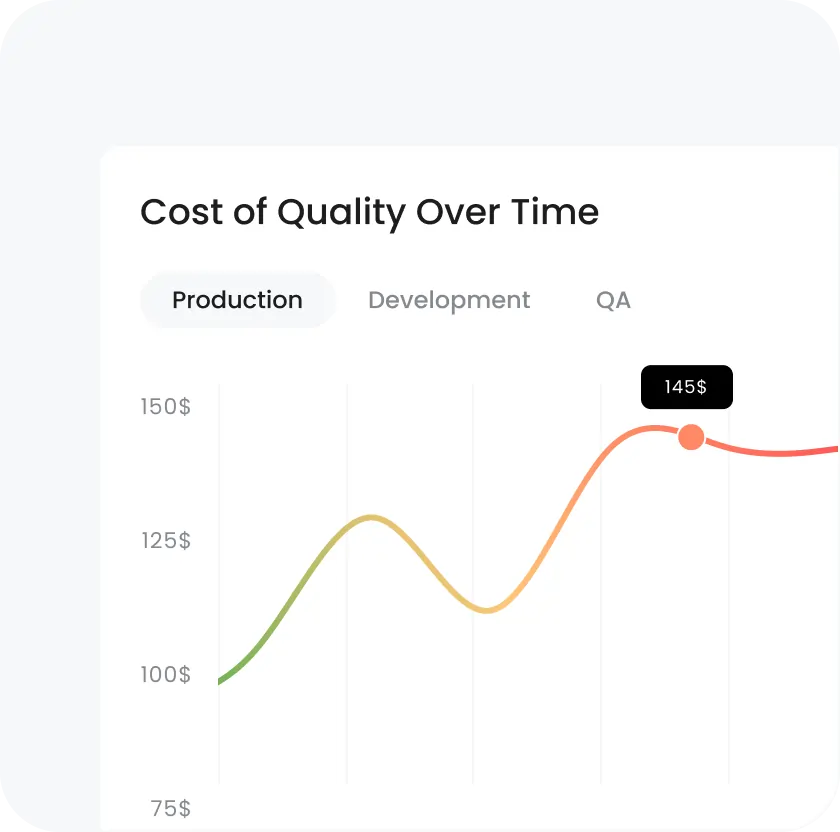
- A defect caught during requirements costs roughly $1 to fix.
- The same defect found during QA costs $10–$15 to fix.
- Found by a user in production? That figure reaches $100–$150, before you count reputational damage.
Traditional QA vendors catch that $150 problem after it's already happened. Software quality engineering prevents it from reaching that stage.
What quality engineering actually changes in your SDLC
Quality engineering is not another name for software testing. It integrates quality practices across requirements, development, CI/CD, release, and production to prevent defects earlier, automate repeatable validation, and use quality metrics in release decisions.
Dimension
Traditional QA
Quality engineering services provided by DeviQA
DeviQA provides six quality engineering services: shift-left testing, test automation engineering, continuous testing, performance and resilience testing, security testing, and QE process assessment.
DeviQA reviews requirements, user stories, acceptance criteria, and application architecture before development to identify testability gaps, conflicting logic, and missing edge cases.
- Review user stories, acceptance criteria, and technical requirements for testability.
- Prioritize testing around business-critical user flows and high-impact failure risks.
- Define quality gates and completion criteria for each sprint.
- Track requirement defects, escaped defects, rework, and unresolved risks during each cycle.
DeviQA designs, builds, and maintains test automation frameworks aligned with your application architecture, technology stack, and release process.
- Framework design with Playwright, Cypress, Selenium, Appium, or WebdriverIO based on the application and technology stack.
- Self-healing test architecture that adapts to UI changes, reducing flake rates by up to 70%
- Parallel test execution and environment configuration within CI/CD pipelines.
- Transfer of framework source code, pipeline configuration, documentation, and test results.
DeviQA integrates automated tests into CI/CD pipelines to validate selected code changes, pull requests, builds, and deployments.
- Integration with GitHub Actions, GitLab CI, Jenkins, CircleCI, and Azure DevOps.
- Automated smoke, regression, integration, and contract tests at defined pipeline stages.
- Test failure notifications and defect data sent to Slack, Jira, or existing reporting tools.
- Tracking of test failures, execution time, flaky tests, and coverage changes.
DeviQA tests application performance, capacity, and recovery behavior under expected, peak, and failure conditions.
- Load, stress, spike, and soak testing with k6, Gatling, or JMeter.
- Performance baselines and automated detection of response-time, throughput, and resource-usage regressions.
- Recovery-time measurement, dependency failure simulation, failover testing, and failure-impact analysis.
- Test results mapped to defined service-level objectives and service-level agreements.
DeviQA integrates automated and manual security testing into the software development lifecycle through SAST, DAST, dependency scanning, and risk-based security checks.
- Automated security checks mapped to applicable OWASP Top 10 risks.
- Authentication, authorization, input validation, and session management testing.
- Penetration testing, vulnerability reporting, and remediation verification where required.
- Testing of controls relevant to PCI DSS, HIPAA, SOC 2, and GDPR requirements.
DeviQA assesses the current QA process, automation, CI/CD integration, quality metrics, tools, and team responsibilities to produce a prioritized improvement roadmap.
- Audit of test coverage, automation ratio, escaped defects, pipeline integration, and release risks.
- Review of testing tools, duplicated functionality, infrastructure gaps, and technical debt.
- Maturity assessment across strategy, automation, integration, observability, and team capability.
- A prioritized 90-day roadmap with actions, owners, dependencies, and measurable milestones.
DeviQA’s quality engineering
delivery model
DeviQA integrates quality engineering throughout the software development lifecycle
through three operating principles: embedded QE leadership, risk-based automation, and
measurable quality metrics.
Embedded QE leads
A senior quality engineering lead works with your product and engineering teams, participates in sprint planning, reviews requirements and acceptance criteria, defines testing priorities, and reports quality risks.
Automation-first, judgment-led
We automate stable, repeatable, and business-critical test scenarios while using manual exploratory, usability, and risk-based testing for areas that require human judgment.
Observable quality metrics
We define and track relevant quality metrics, including escaped defect rate, automated test coverage, flaky test rate, mean time to detect, mean time to resolve, release cycle time, and rework by defect discovery stage.
Book a QA strategy call
30 minutes. We'll map your current process, identify the highest-risk gaps, and tell you what quality engineering would change for your team.

How quality engineering teams differ from traditional QA vendors
Traditional QA primarily validates software after development, while quality engineering integrates defect prevention, testing, automation, observability, and
quality metrics throughout the software development lifecycle. The difference is when quality work begins, who owns it, and how it affects release decisions.
Dimension
Traditional QA vendor

What quality engineering
actually delivers
These outcomes come from active DeviQA quality engineering solutions engagements across 40+ software verticals.
40%
Faster release cycles (vs. pre-engagement baseline)
60%
Fewer defects reaching production
50%
Reduction in rework cost via shift-left integration
70%
Reduction in manual intervention (self-healing automation)
87%
Avg. test automation coverage achieved
100%
Test repeatability rate across CI/CD pipeline runs

Quality engineering expertise across 40+ industries
DeviQA has completed 500+ QA projects across 40+ industries. We adapt each quality engineering strategy to the domain’s regulatory requirements, software risks, system architecture, data sensitivity, and release cadence.


Get your QE assessment
A structured review of your test coverage, automation maturity, and SDLC integration, with a prioritized roadmap to act on.