
DeviQA team
Posted: 24.09.2026
21 min read
AI-assisted development is doing what teams expected it to do: moving features through implementation faster. Nearly two-thirds of surveyed QA professionals said new functionality now reaches testing sooner, while almost half observed that defects are also fixed faster.
But development speed is only one part of software delivery.
Once AI-assisted functionality reaches QA, teams still need to determine what changed, which components may have been affected, whether the implementation matches the intended business logic, and how much regression testing is necessary. The survey results show that this work is becoming broader and, in many cases, less predictable.
Features may reach QA faster. The information required to verify them does not always arrive at the same speed.
Executive summary
Our previous report, State of AI-Generated Code 2026: The QA and Testing Gap, examined the difference between how developers experience AI-generated code and what QA teams encounter downstream.
This report looks more closely at the testing process itself, drawing on responses from 4,000 survey participants.
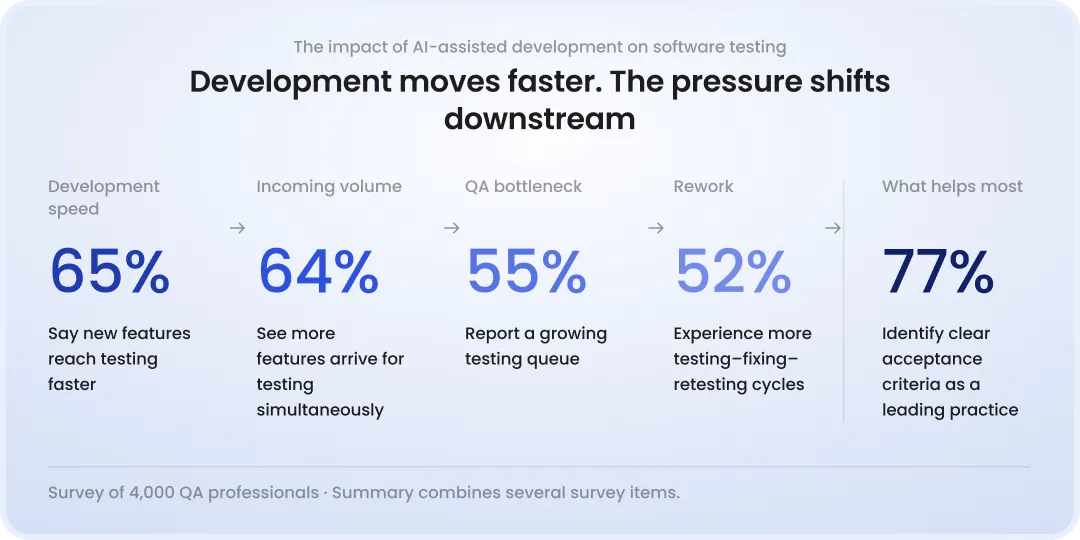
The findings show a mixed but consistent pattern. AI-assisted development creates visible speed gains, but it also changes the type and distribution of work performed by QA. Testers are spending more time understanding the impact of changes, validating related functionality, expanding regression coverage, and repeating checks after fixes.
Five findings stand out:
65% said new features reach testing faster.
64% reported that more features now arrive for testing simultaneously.
55% saw the QA testing queue grow.
52% experienced an increase in testing–fixing–retesting cycles.
77% identified clear acceptance criteria as one of the practices that helps most.
*Summary combines results from several survey items.
The central issue is not simply whether AI-assisted code contains more defects. It is whether development teams can explain and verify the full impact of a change before handing it to QA.
Development is moving faster — but the effect on testing is uneven
The most visible benefit of AI-assisted development is speed.
Sixty-five percent of respondents said new features reached testing faster when developers used AI. Almost half said defects were fixed faster. Others reported faster prototyping and better documentation.
Those gains are meaningful. Shorter implementation time can reduce waiting between product decisions and working software. Faster bug fixes can also shorten feedback loops between QA and development.
However, faster arrival in QA does not necessarily mean faster completion of testing.
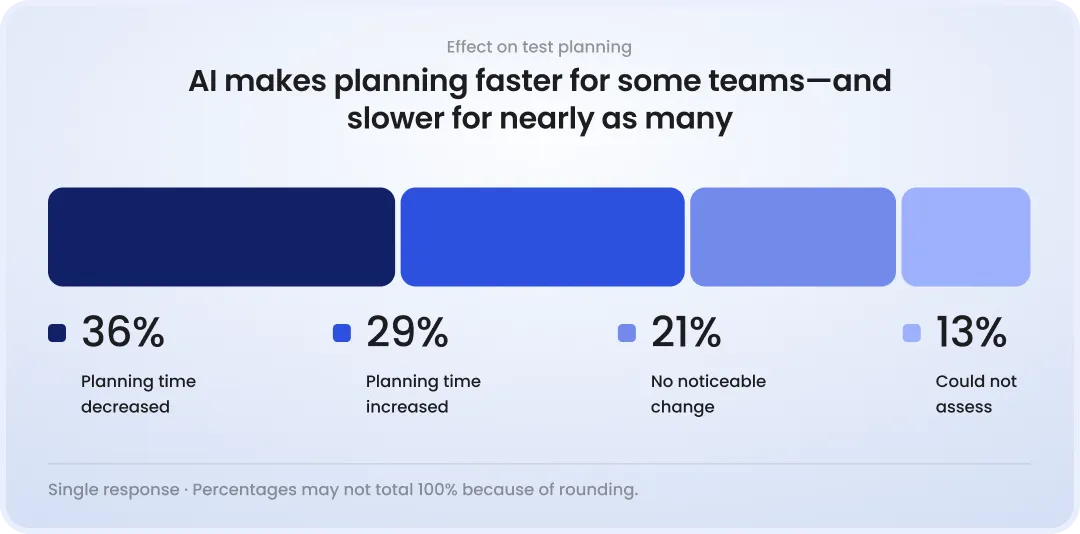
When asked how AI-assisted development affected test-planning time, responses were divided:
36% said planning time decreased;
29% said it increased;
22% saw no noticeable change;
13% could not assess the difference.
This split is one of the report's most important findings. AI assistance can make implementation faster while having a very different effect on the people responsible for verifying the result.
For some QA professionals, better documentation or quicker implementation makes planning easier. For others, the speed advantage is offset by uncertainty about the scope, dependencies, and intended behavior of the change.
The question is no longer only, "How quickly was this feature built?"
It is also, "How quickly can another person understand what was built well enough to test it?"
QA does not always receive a reliable map of the change
The most common testing difficulties were not limited to visible defects. Many were related to incomplete change context.
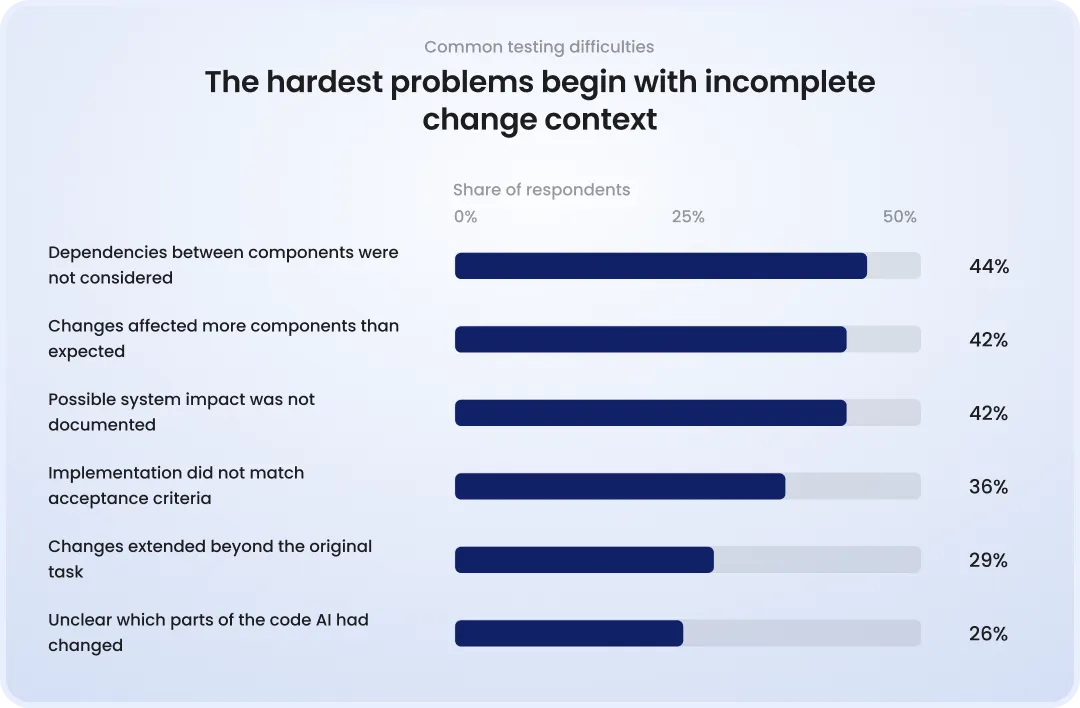
Respondents said testing became more difficult when:
dependencies between components were not considered — 44%;
changes affected more components than expected — 42%;
the possible impact on the system was not documented — 42%;
the implementation did not match the acceptance criteria — 36%;
changes extended beyond the original task — 29%;
it was unclear which parts of the code AI had changed — 26%.
*Multiple responses allowed.
These findings describe a change-visibility problem.
A feature can satisfy its primary requirement and still alter shared logic, data processing, permissions, integrations, or legacy behavior. If those connections are not identified before QA begins, testers must reconstruct the impact themselves.
That reconstruction takes time. It also makes the required testing scope harder to estimate.
"Review should not be removed; it should be moved earlier. If there are no clear acceptance criteria, the task should not move into development or testing."
— Manual QA Engineer, 5–7 years of experience
The missing information reported by QA reinforces the same point.
More than half wanted to know which product components could have been affected. The same proportion wanted a clearer explanation of how the change might influence existing functionality. Forty-four percent lacked sufficient context about the intended business logic.
Other missing details included:
which parts of the functionality were created or changed with AI — 36%;
what the developer had already tested — 26%;
what risks the developer had identified — 21%;
which unit tests had been added or updated — 12%.
Only 18% said the information they received was usually sufficient.
*Multiple responses allowed.
AI-assisted development therefore changes more than implementation speed. It increases the importance of explaining the change to the rest of the delivery team.
The primary flow may work while related functionality breaks
One of the clearest patterns in the responses was the difference between local correctness and system-level correctness.
Forty-seven percent said they had at least sometimes encountered AI-assisted functionality that completed its primary scenario but created problems elsewhere in the product. Another 29% said this happened rarely, while 23% could not assess it.
The most commonly reported defects were:
disruption of existing functionality — 44%;
incorrect business logic — 33%;
missed edge cases — 33%;
data-processing or validation errors — 33%;
incorrect error handling — 21%;
API or integration problems — 17%.
Twenty-one percent did not observe a characteristic defect pattern. This matters: the results do not suggest that every AI-assisted feature produces the same type of failure.
*Multiple responses allowed.
They do show, however, that the most visible risks extend beyond syntax or basic technical correctness. Business rules, edge cases, data behavior, and existing functionality require particular attention.
"AI writes code quickly, but a person is still responsible for it. The primary scenario may work while the business logic, edge cases, and related functionality break."
— Manual QA Engineer, 5–7 years of experience
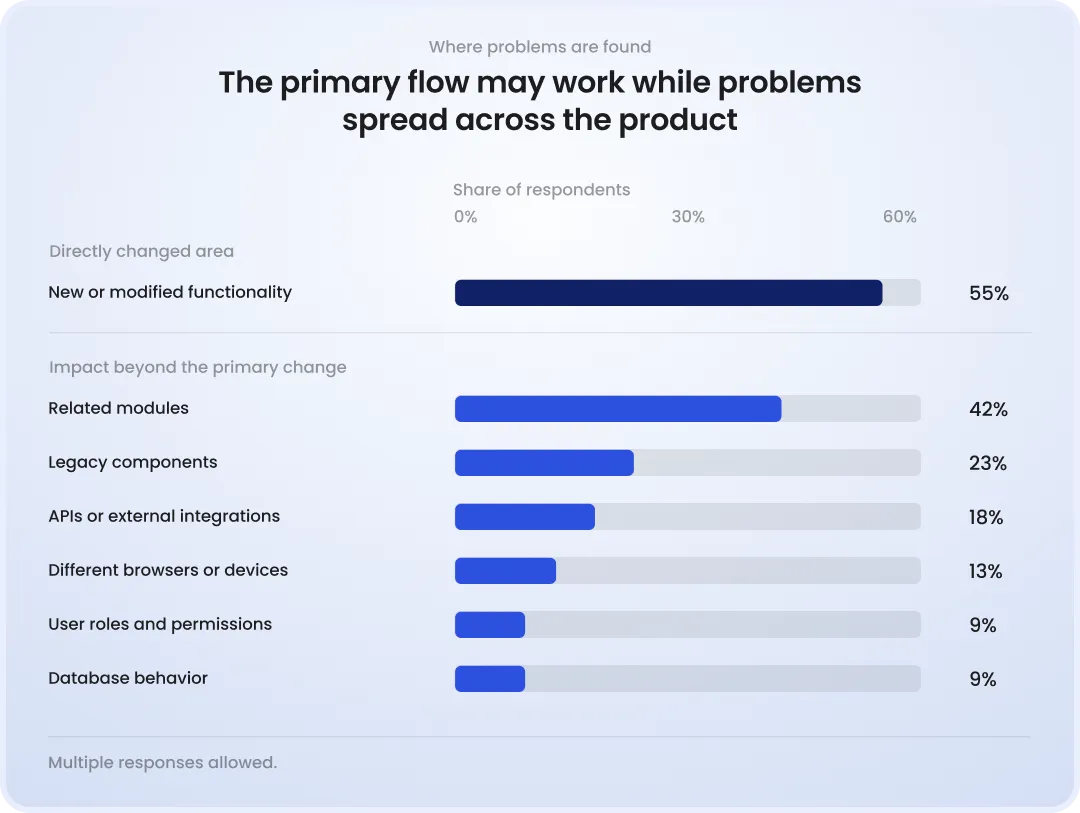
Problems were most often found in the new or modified functionality itself, reported by 55% of respondents. But the effects frequently spread further:
related modules — 42%;
legacy components — 23%;
APIs or external integrations — 18%;
different browsers or devices — 13%;
user roles and permissions — 9%;
database behavior — 9%.
*Multiple responses allowed.
This wider impact helps explain why testing effort can grow even when the feature reaches QA sooner. The visible change may be small, but the area that requires verification is not always equally small.
QA is expanding the testing surface
When development teams cannot fully describe the potential impact of a change, QA compensates by testing more broadly.
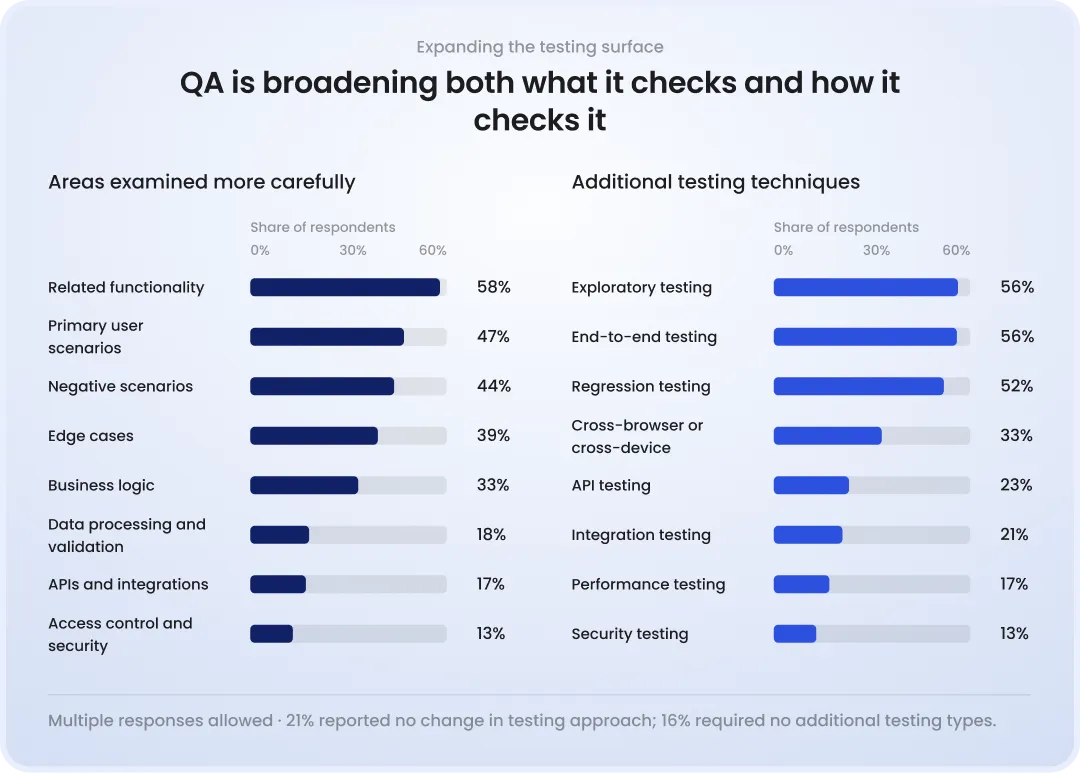
Respondents said they examined the following areas more carefully in AI-assisted functionality:
related functionality — 58%;
primary user scenarios — 47%;
negative scenarios — 44%;
edge cases — 39%;
business logic — 33%;
data processing and validation — 18%;
APIs and integrations — 17%;
access control and security — 13%.
Only 21% said their testing approach had not changed.
*Multiple responses allowed.
The additional testing techniques followed the same pattern:
exploratory testing — 56%;
end-to-end testing — 56%;
regression testing — 52%;
cross-browser or cross-device testing — 33%;
API testing — 23%;
integration testing — 21%;
performance testing — 17%;
security testing — 13%.
Sixteen percent said no additional testing types were required.
*Multiple responses allowed.
The strongest increases are in forms of testing that evaluate behavior across boundaries. Exploratory, end-to-end, and regression testing are designed to reveal outcomes that cannot always be predicted from the changed code alone.
This is the work required to answer questions such as:
What else could this feature affect?
Does it still work with existing workflows?
What happens outside the expected path?
Does the implementation behave correctly with unusual inputs?
Does the feature interact safely with older components?
Does the fix solve the reported problem without creating a new one?
"Shift the focus toward negative and boundary conditions. AI can produce code that works under ideal conditions, but QA needs more time for non-standard scenarios that reveal hidden crashes and side effects."
— Manual QA Engineer, 2–4 years of experience
The implication is not that QA should test every AI-assisted change indiscriminately. It is that the team needs enough change context to determine where deeper testing is justified.
Without that context, broader testing becomes a defensive response to uncertainty.
More work is being discovered after development is considered complete
Fifty-six percent of respondents said problems were commonly found during the first functional check.
That is not unusual by itself. Functional testing exists to identify differences between expected and actual behavior. The wider distribution of discovery points is more revealing:
during regression testing — 44%;
during exploratory testing — 39%;
after the change was combined with other work — 18%;
during requirements analysis — 13%;
during API testing — 12%;
during integration testing — 9%.
*Multiple responses allowed.
The presence of problems during requirements analysis suggests that some failures begin before code generation. If the requirement, user story, or acceptance criteria are incomplete, AI can implement the wrong interpretation quickly and convincingly.
The technology speeds up execution. It does not resolve ambiguity in the underlying task.
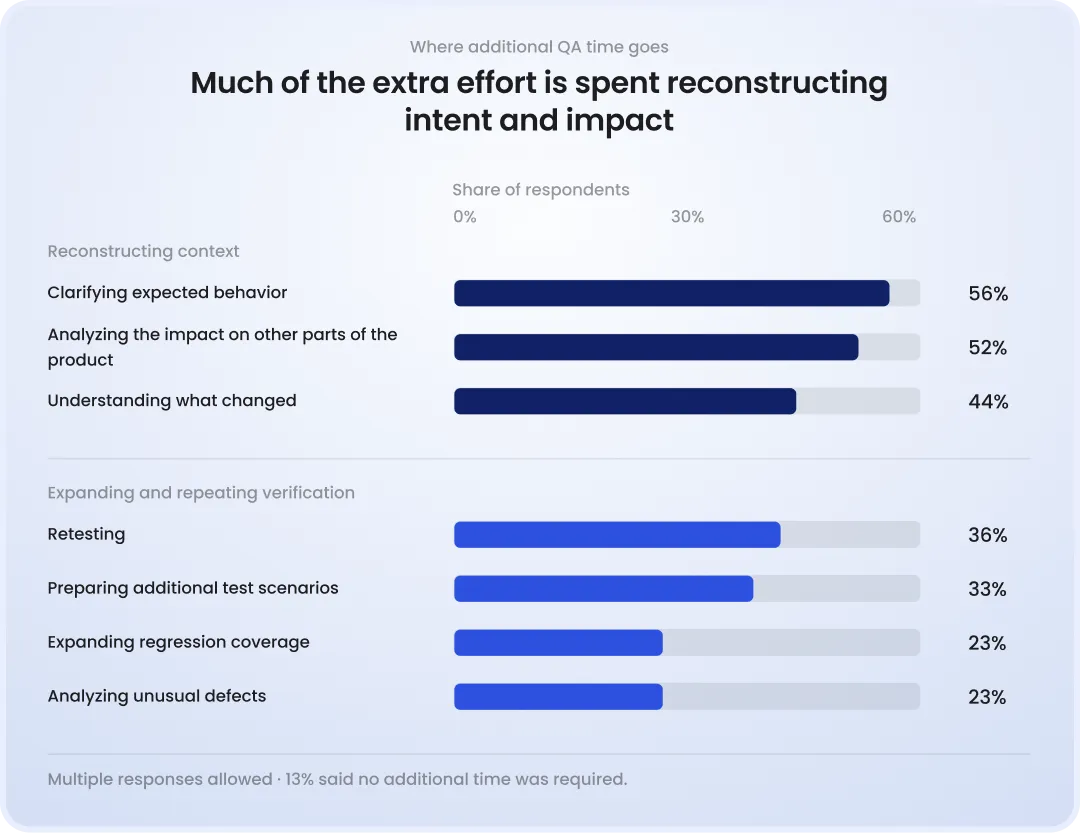
Respondents also identified where additional testing time was going:
clarifying expected behavior — 56%;
analyzing the impact on other parts of the product — 52%;
understanding what changed — 44%;
retesting — 36%;
preparing additional test scenarios — 33%;
expanding regression coverage — 23%;
analyzing unusual defects — 23%.
Only 13% said no additional time was required.
*Multiple responses allowed.
This is an important distinction. The extra effort is not concentrated exclusively in executing more tests. A significant part is spent reconstructing intent and scope.
In other words, some of the cost attributed to testing is actually the cost of incomplete communication between development and QA.
Retesting cycles are increasing
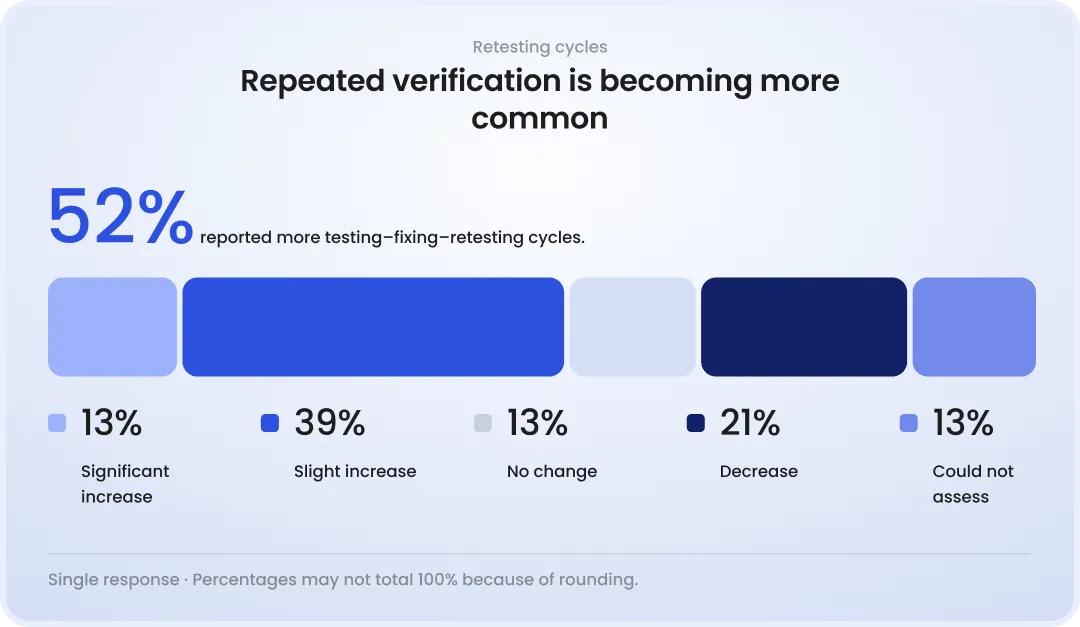
Fifty-two percent said the number of testing–fixing–retesting cycles had increased:
39% reported a slight increase;
13% reported a significant increase.
By comparison:
21% saw a decrease;
13% saw no change;
13% could not assess the effect.
The results do not support a universal claim that AI always creates more rework. Some teams are clearly using it to shorten defect-resolution cycles.
But the overall direction in this survey is toward more repeated verification.
One possible reason appears in the qualitative responses: the first implementation may satisfy the visible requirement without accounting for the broader behavior of the system. QA reports the defect, development produces another quick change, and the new version must be tested against both the original requirement and the surrounding functionality.
A fast fix is valuable. A sequence of fast but incomplete fixes is still rework.
"Use AI to accelerate development, but do not reduce the time allocated to developer testing, code review, or QA. The team still needs clear acceptance criteria and an understanding of how the change can affect the rest of the product."
— Manual QA Engineer, 5–7 years of experience
For bug fixes specifically, one respondent recommended that developers first reproduce the defect themselves, document the reproduction steps, and verify the fix before sending it to QA. This gives testers a reliable starting point and makes it easier to determine what additional regression work is necessary.
The volume reaching QA is changing
AI-assisted development does not only affect individual features. It changes the volume and timing of work entering the testing process.
Sixty-four percent said more features were arriving simultaneously. Fifty-five percent saw the testing queue grow.
Other signs of capacity pressure included:
more repeated checks — 39%;
a broader regression scope — 39%;
more unplanned testing — 29%;
testing taking longer — 26%;
less time for exploratory testing — 23%;
priorities changing more frequently — 21%.
*Multiple responses allowed.
Twenty-one percent said their teams had not encountered this type of capacity problem.
The results point to a delivery-system issue rather than an isolated testing issue. If development produces more work per sprint, downstream functions must either increase capacity, improve automation, reduce avoidable rework, or make harder decisions about test coverage.
Otherwise, the gain in implementation speed appears elsewhere as a queue.
"Do not reduce the QA team while increasing sprint velocity."
— Automation QA Engineer, 2–4 years of experience
The comment is blunt, but the underlying point is operational. Development throughput and QA capacity cannot be planned independently.
A team that measures only development completion may record an improvement while its overall lead time remains unchanged — or worsens — because work is waiting for verification.
Engineering leaders therefore need to distinguish between three separate events:
development started;
development completed;
the feature was verified and became ready for release.

AI may reduce the distance between the first two without reducing the distance between the second and third.
The most effective responses are not new
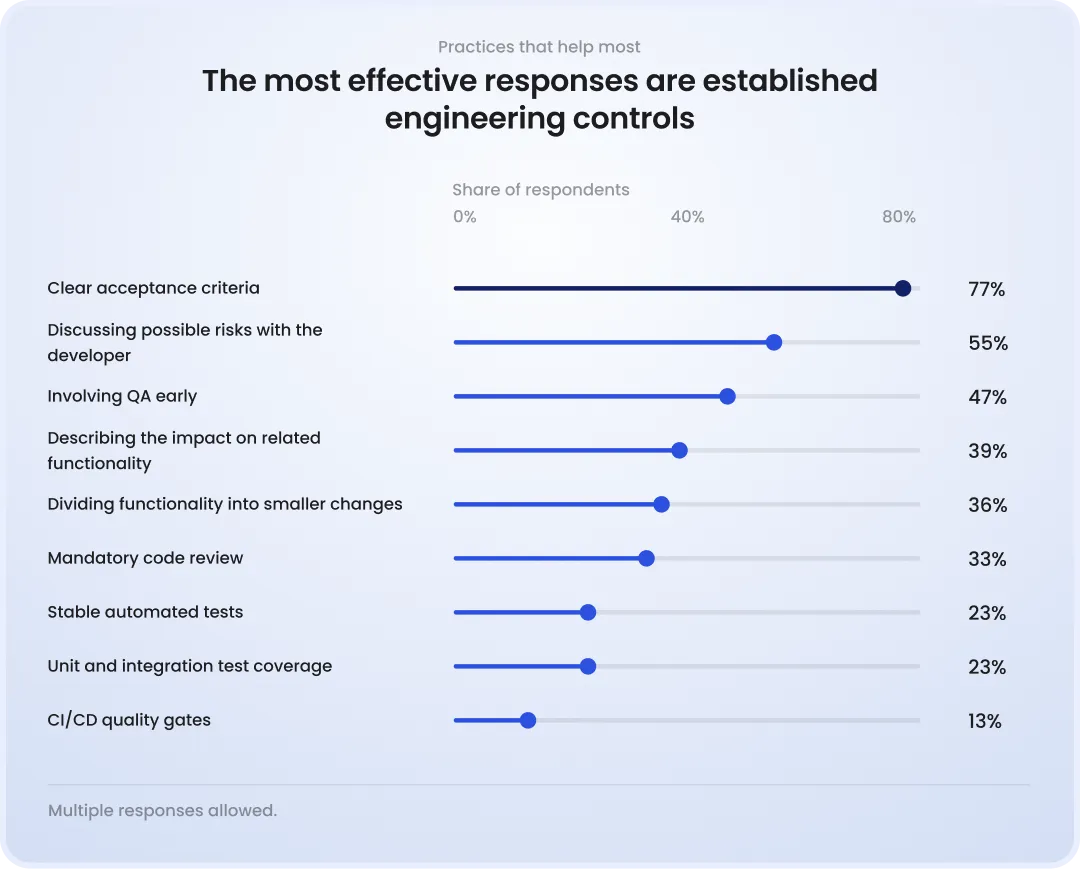
When respondents were asked which practices helped most, the leading answers were familiar engineering controls rather than new AI-specific tools:
clear acceptance criteria — 77%;
discussing possible risks with the developer — 55%;
involving QA early — 47%;
describing the impact on related functionality — 39%;
dividing functionality into smaller changes — 36%;
mandatory code review — 33%;
stable automated tests — 23%;
unit and integration test coverage — 23%;
CI/CD quality gates — 13%.
*Multiple responses allowed.
This does not mean AI-specific controls are unnecessary. It means that AI-assisted development makes established controls more important, not less.
Clear acceptance criteria reduce the risk of accelerating toward the wrong implementation. Smaller changes make the impact easier to understand. Human review creates an independent check between generated code and the production codebase. Early QA involvement exposes ambiguous requirements before they become working software.
"Focus on architecture, split work into smaller tasks, provide the agent with sufficient context, and require the generated code to be reviewed by the responsible specialist."
— Automation QA Engineer, 2–4 years of experience
The same pattern appeared when respondents were asked what developers should verify before sending AI-assisted functionality to QA:
compliance with acceptance criteria — 80%;
primary positive and negative scenarios — 58%;
impact on other product components — 58%;
related functionality — 39%;
APIs and integrations — 21%;
user roles and permissions — 17%;
security and static-analysis results — 17%;
edge cases — 13%.
*Multiple responses allowed.
The strongest message in the data is not "test more."
It is "complete more verification before the handoff."
An AI-ready definition of done
Teams do not necessarily need a separate development process for every AI-assisted change. They do need a definition of done that reflects how AI changes implementation speed and review risk.
Before AI-assisted functionality enters QA, the development handoff should answer seven questions.
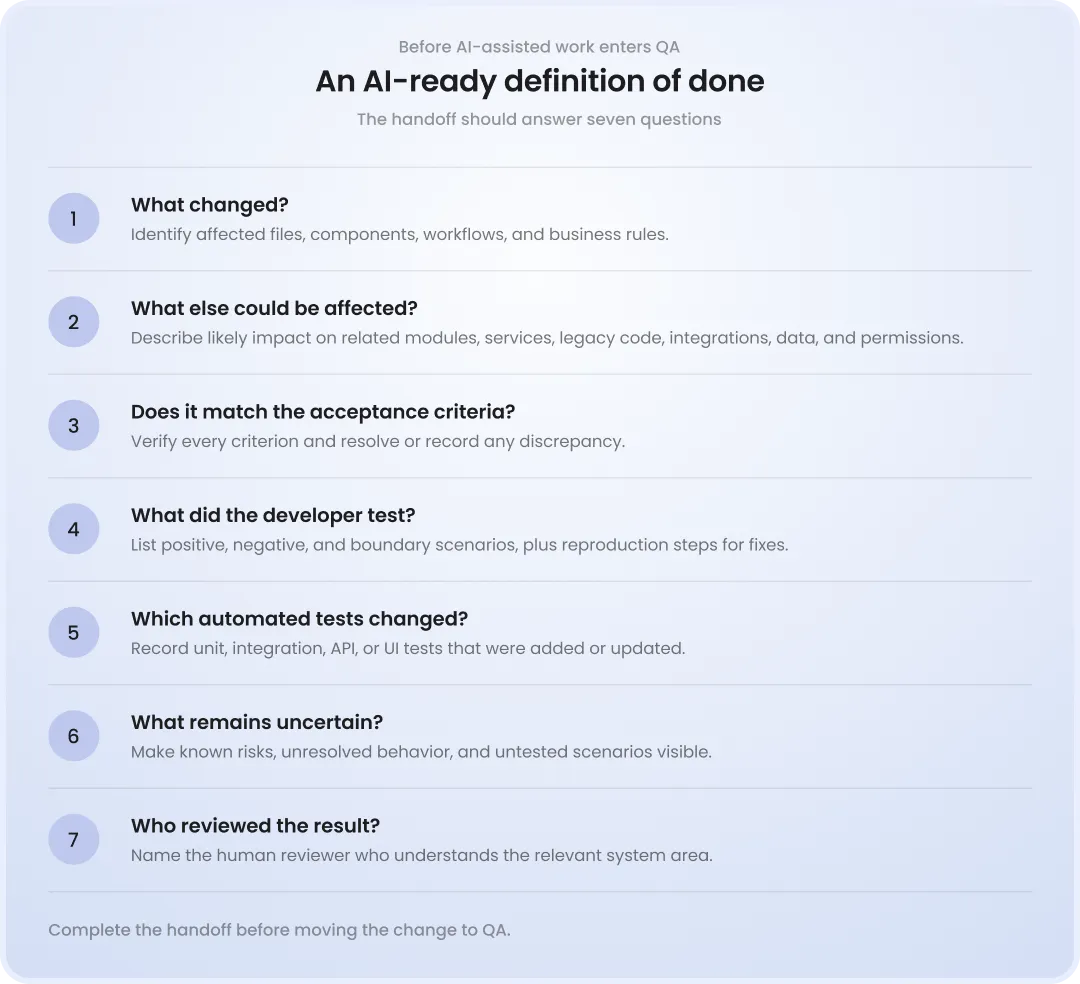
1. What changed?
Identify the files, components, workflows, and business rules affected by the implementation. If AI expanded the change beyond the original task, state that explicitly.
2. What else could be affected?
Document the likely impact on related modules, shared services, legacy components, integrations, data flows, and permissions.
This does not need to be an exhaustive architecture document. A short and accurate impact summary is more useful than a long AI-generated description that no one has reviewed.
3. Does the implementation match the acceptance criteria?
The developer should verify each acceptance criterion before the task moves to QA. If the implementation differs from the documented requirement, the discrepancy should be resolved or recorded.
4. What did the developer test?
The handoff should include the positive, negative, and boundary scenarios already checked by the developer, along with reproduction steps for bug fixes.
QA should not have to infer whether basic developer testing occurred.
5. Which automated tests changed?
List the unit, integration, API, or UI tests that were added or updated. If no automated tests were added, explain why.
Generated tests should still be reviewed independently. Tests created from the same context as the implementation may reproduce the same assumptions.
6. What remains uncertain?
Known risks, unclear behavior, architectural concerns, and untested scenarios should be visible at the handoff point.
An explicit uncertainty is easier to manage than an implicit one.
7. Who reviewed the result?
AI can assist with implementation and review, but accountability must remain with a named human reviewer who understands the relevant part of the system.
As one respondent put it:
"AI is a tool, not a full replacement for people. Every time someone failed to verify what AI produced, the result was a problem."
— Manual QA Engineer, 5–7 years of experience
What engineering leaders should measure next
AI-assisted development changes the economics of software delivery, but many teams still measure its effect primarily through developer activity: implementation time, completed tasks, pull requests, or code volume.
Those metrics do not show whether the full delivery system has become faster.
A more complete view should include:
time from development completion to QA start;
time from QA start to release readiness;
number of testing–fixing–retesting cycles;
regression scope per feature;
time spent clarifying requirements and expected behavior;
proportion of defects found outside the directly changed functionality;
queue size and waiting time for QA;
escaped defects associated with AI-assisted changes;
developer-test evidence provided at handoff;
percentage of changes with a documented impact assessment.
This report does not establish that AI-assisted development causes every increase in QA workload. The findings are based on the experiences reported by QA practitioners, not controlled comparisons between equivalent AI-assisted and fully human-written changes.
They do show where teams should look.
If feature implementation becomes faster while clarification time, regression work, and retesting increase, the organization has not eliminated delivery work. It has moved part of that work downstream.
Conclusion
AI-assisted development is producing real benefits. Features reach testing sooner. Defects can be fixed faster. Teams can prototype and iterate more quickly.
The challenge is ensuring that verification systems evolve at the same pace.
The survey results show that QA professionals are responding by examining related functionality more closely, running broader regression and exploratory tests, and spending more time understanding the impact of changes. At the same time, more features are arriving in parallel, testing queues are growing, and repeated verification is becoming more common.
The answer is not to slow down AI adoption. It is to prevent implementation speed from outrunning shared understanding.
That requires clear acceptance criteria, smaller and better-described changes, developer testing, independent code review, impact analysis, reliable automation, and enough QA capacity to evaluate the volume being produced.
The teams that benefit most from AI-assisted development will not simply be those that generate code fastest. They will be those that can explain, review, test, and release AI-assisted change without transferring unresolved risk to the next person in the delivery chain.
Methodology
Study design and fieldwork
This study surveyed 4,000 software quality professionals with direct, recent experience testing functionality built with AI coding tools. Fieldwork was conducted online from August 15 to September 15, 2026. The questionnaire contained 20 questions and took a median of 15 minutes to complete.
Sample composition
By role:
Manual QA Engineers — 34.0% (n=1,360);
Automation QA Engineers — 36.0% (n=1,440);
SDETs — 16.0% (n=640);
QA Leads and Test Leads — 9.0% (n=360);
mixed QA, quality engineering, and test architecture roles — 5.0% (n=200).
By years of professional experience:
under 2 years — 14.0% (n=560);
2–4 years — 31.0% (n=1,240);
5–7 years — 26.0% (n=1,040);
8–10 years — 16.0% (n=640);
more than 10 years — 13.0% (n=520).
Recruitment and screening
Participants were recruited from DeviQA's professional community of QA and quality engineering specialists. Participation was voluntary and not incentivized.
Role and experience distribution targets were monitored during fieldwork to avoid over-representation of any single group. Screening questions confirmed that every respondent had personally tested software functionality developed with AI coding assistants within the six months preceding the survey. Respondents who could not confirm this were excluded before the main questionnaire.
Languages and translation
The questionnaire was fielded in English, Ukrainian and Polish. 35% of respondents completed it in English, 37% in Ukrainian and 28% in Polish. Closed-question wording was translated by professional translators and back-checked against the English source before fieldwork. Open-ended responses submitted in Ukrainian or Polish were translated into English for analysis; quoted comments appear in translation and are attributed by role and experience rather than by name.
How the figures are reported
Percentages are reported to one decimal place. Each figure is calculated on the number of respondents who answered that specific question, not on the full sample of 4,000.
Questions that allowed multiple responses are marked "(multiple responses permitted)" at the point where their results appear. Totals for those questions exceed 100%. Questions without that marking were single-choice; where a single-choice distribution does not total exactly 100.0%, the difference is a rounding artifact at the first decimal place.
Response options selected by fewer than 1.0% of participants are excluded from the reported breakdowns. This applies to the "never encountered this" option in the question on AI-assisted functionality that completed its primary scenario while causing problems elsewhere in the product; all remaining options for that question are reported in full.
Results are reported for the full sample unless a breakdown is explicitly stated. Role and experience breakdowns are provided in the data appendix.
Sample limitations
Participants were recruited through professional community channels and chose to take part, so the findings describe the reported experience of these 4,000 QA practitioners rather than a statistically representative projection onto the global QA population. No margin of error is quoted, because margin-of-error calculations assume random selection from a defined population and that condition does not hold here.
Readers comparing individual figures should keep base sizes in view. Full-sample figures rest on substantially larger bases than subgroup figures, and subgroup differences are correspondingly less stable — a gap between two role segments is less reliable than the same gap in the full sample.
Two further limitations apply to interpretation. First, all data is self-reported: respondents describe their own perception of how testing has changed, not measured outcomes from their delivery systems. Second, the study contains no control group — respondents were not asked to compare equivalent AI-assisted and fully human-written changes under matched conditions. The findings therefore indicate where QA effort is reported to be shifting; they do not establish that AI-assisted development is the sole cause of that shift.