
Written by: Chief Operating Officer
Anastasiia SokolinskaPosted: 24.09.2026
13 min read
Your admin console shipped SSO last quarter. The login flow now redirects to an identity provider on another origin, opens a consent screen in a second tab, and drops the user back into an iframe-embedded billing widget.
Three specs went red and stayed red. That is usually the moment a team starts comparing frameworks, and it is also the moment most comparison articles stop being useful. Checklists do not tell you what the switch costs.
This one models it.
Your team builds the product. We'll build the test infrastructure.
Two architectures, and the one consequence that matters
Cypress runs your test code inside the browser, in the same event loop as the application under test. Playwright drives the browser from a separate Node process over CDP and the equivalent protocols for Firefox and WebKit. Every Playwright vs Cypress comparison opens here, and most of them stop here too.
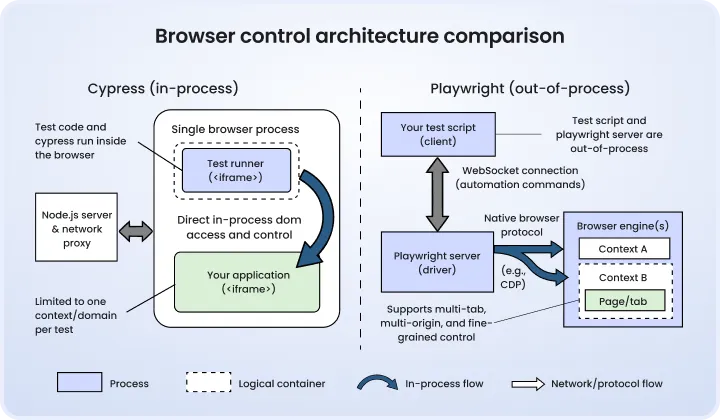
The consequence is scope. Code executing inside a page reaches only what that page reaches: one tab, one origin at a time, no second browser context, no native frame access without loosening web security. Code driving the browser from outside owns the browser itself, including contexts, tabs, popups, downloads, frames, and network interception at the protocol layer.
Everything below follows from that single boundary. The first place it shows up is your CI invoice.
What Cypress Cloud actually costs at three team sizes
Start by correcting a claim that most comparison content still repeats: Cypress does not paywall parallelization. The free Starter tier on the Cypress pricing page includes parallelization, load balancing, and Test Replay. What it caps is volume, at 500 recorded test results per month.
That distinction matters because the meter is the thing that scales, not the feature. Cypress Cloud counts every it() execution recorded with --record as one test result, and paid tiers include 120,000 results per year. Team costs $799 per year and bills overage at $5.28 per 1,000. Business costs $3,199 per year at $4.40 per 1,000. Enterprise includes 1.8 million and bills $4.00 per 1,000 beyond it.
Now run that against three real workloads. Compute assumes Linux 2-core GitHub-hosted runners at $0.006 per minute, per the GitHub Actions runner pricing reference, 21 working days per month, and sharding tuned to hold wall-clock under 15 minutes. Both frameworks consume comparable runner minutes, so treat compute as common to both and Cypress Cloud as the delta.
10 engineers, 250 E2E tests, 8 recorded runs/day
504,000
Team
$2,827
$365
$3,192
$365
50 engineers, 900 tests, 25 recorded runs/day
5,670,000
Business
$27,619
$5,454
$33,073
$5,454
120 engineers, 2,000-test suite 10x/day plus 400-test smoke 60x/day
11,088,000
Enterprise
$37,152 in overage plus negotiated base
$7,649
$44,800+
$7,649
The Playwright vs Cypress crossover people look for does not exist as a headcount. It exists as a per-test unit rate. At Team pricing, 1,000 recorded test results cost $5.28. Executing those same 1,000 tests at roughly 5 tests per runner-minute costs $1.20 in GitHub Actions compute. You are paying about 4x your compute bill for the reporting layer, and that multiple holds at every tier.
Saleor hit this exact wall. Their QA team upgraded to the paid Cypress dashboard around 2022 specifically to unlock parallel runs, then found that running tests across many supported versions made the cost of Cypress Cloud prohibitive, which is what pushed the Playwright evaluation forward.
Self-hosted runners change the compute column, not the licensing one. GitHub's proposed $0.002 per minute platform charge on self-hosted minutes was postponed before it took effect, so self-hosted Playwright sharding on your own Kubernetes or EC2 capacity still costs only the underlying compute. The Cypress Cloud meter is unaffected either way, which is the point: it is the one line item that does not respond to infrastructure optimization.
One caveat worth naming: dropping Cloud drops flake analytics, spec prioritization, and auto-cancellation. Playwright's blob reporter and merge-reports give you consolidated results across shards, not trend analysis. Budget for a reporting layer or accept less visibility.
Match the framework to your application pattern, not your team's skill level
Cost tells you what a choice is worth. Architecture tells you whether the choice is available. Map the signals in your own application rather than scoring generic team-readiness criteria.
OAuth or SSO redirect across origins
Playwright
Browser contexts cross origins natively. Cypress needs cy.origin(), which runs an isolated callback with no closure access to outer variables
Third-party iframes (Stripe Elements, Intercom, embedded maps)
Playwright
frameLocator() is first-class. Cypress frame access needs plugins and chromeWebSecurity: false
Multi-tab or popup flows (checkout redirects, video calls, OAuth popups)
Playwright
context.waitForEvent('page') handles new tabs. Cypress has no multi-tab support at all
File download verification
Playwright
Native download events. Cypress needs a Node task plus filesystem assertions
Safari or WebKit coverage in the release gate
Playwright
WebKit is a first-class target. Cypress WebKit support remains experimental
Electron or desktop-hybrid apps
Playwright
Electron automation is built in. Cypress does not target it
Single-origin SPA, one tab, no third-party frames
Either
No architectural constraint applies. Decide on cost and team fit
Component-heavy design system work
Cypress
Its component runner left experimental status. Playwright's has not
Playwright vs Cypress decision table: read top to bottom and stop at your first match. If any of the first six rows describes a flow already in your product or on next quarter's roadmap, the decision is made and the rest of the comparison is noise.
When Cypress genuinely wins
Cypress remains the better call in four situations, and pretending otherwise costs credibility with your engineers.
Developers own the tests and debug them between feature work. The in-browser runner with DOM snapshots beats opening a trace file for someone who writes three tests a month.
Your recorded volume sits under 120,000 results per year, where Cloud costs $799 and the whole cost argument collapses.
Component testing is the primary layer, not E2E.
Your application is genuinely single-origin, single-tab, and frame-free, and your team already has years of Cypress muscle memory.
The debugging argument deserves precision, because it is the one place where the architectures produce genuinely different developer experiences rather than different capabilities. Cypress replays the run live in a browser you are already looking at, with DOM snapshots pinned to each command. Playwright's Trace Viewer gives you more, including network logs, console output, source, and a full action timeline, but it arrives as an artifact you open after the failure rather than a session you sit inside.
For an SDET triaging 40 CI failures a week, Trace Viewer wins on information density. For a product developer who broke a test at 6pm and wants it green before they log off, the Cypress runner wins on time to first insight. Decide which of those two people debugs your suite most often.
None of those hold once a payment iframe or an SSO redirect enters the flow.
Talk to a senior SDET at DeviQA
Component testing: both tools are less finished than the comparisons suggest
Every competing Playwright vs Cypress article gives this one sentence. It deserves more, because the maturity gap runs the opposite direction from the E2E gap.
Playwright component testing is still shipped as @playwright/experimental-ct-*, and the npm package warns that it does not respect semver. That is not a formality. Playwright 1.59, released in April 2026, removed the Svelte component-testing package outright with no deprecation warning, leaving teams to pin 1.58 or rebuild a mount helper on the standard runner.
Before you weigh either option, check whether component testing is the right layer at all. It earns its place when a component carries real browser-dependent behavior: focus management, IntersectionObserver, CSS-driven state, or layout that jsdom cannot reproduce. For prop-in, markup-out components, Vitest with Testing Library runs in a fraction of the time and gives you the same signal.
If you do need real-browser component tests today, Cypress has the more stable runner. That is the strongest remaining argument for keeping it.
What migrating from Cypress to Playwright actually costs
"Budget time to learn the idioms" is the standard advice, and it tells a VP Engineering nothing they can put in a plan. Here is what we budget, per 100 test files, based on migrations our test automation engineers have run.
Mechanical syntax port with AI assistance
10 to 16
Per 100 files
Custom command translation into fixtures
12 to 20
Per 100 files
Network stubbing rewrite (cy.intercept to page.route)
10 to 16
Per 100 files
Retry and assertion semantic audit
16 to 24
Per 100 files
Auth and session rebuild (cy.session to storageState)
6 to 10
One-time
Dual-suite maintenance during transition
4 to 8 per month
Duration of migration
Roughly 50 to 75 engineer-hours per 100 files, plus 30 to 50 hours of one-time infrastructure work. A 400-file suite therefore lands between 230 and 350 hours before anyone writes a new test. AI assistance compresses the first row and barely touches the fourth.
How to migrate from Cypress to Playwright. A complete step-by-step guide
The idiom mismatches that pass silently
The semantic audit is the row teams cut first and regret. Four mismatches produce tests that pass while asserting nothing.
cy.get() retries its query until the attached assertion succeeds. page.locator() is lazy and resolves only at action time, so a mechanically ported chain can assert against state that has already moved on.
Cypress .should() retries the entire chain. Porting it to expect(await locator.textContent()).toBe(...) removes retry behavior completely, because auto-retry in Playwright belongs to web-first assertions like toHaveText(), not to awaited values. These pass on a fast runner and fail on a loaded one.
cy.intercept() and page.route() use different pattern-matching rules. A route that never matches does not error. The real request goes through, the assertion runs against live data, and the test reports green.
Custom commands often carry implicit waits accumulated over years. Playwright fixtures carry none unless you write them.
Real timelines vary more than any of these estimates suggest. JetBase reported a working Playwright prototype within two days for a 148-test suite using Copilot-assisted conversion. Displate's team spent a year on the same transition because migration competed with daily delivery. Saleor began in mid-2023 and was still running both suites in late 2024 to support older product versions. Plan for the phased version.
The hiring question nobody puts in the comparison table
Cypress runs JavaScript and TypeScript. Playwright runs JavaScript, TypeScript, Python, Java, and .NET. Every article states this as a feature. Almost none state the staffing consequence.
On Cypress, your SDET hiring pool is people who write JavaScript. On Playwright, a Python data engineer or a .NET backend developer can contribute test code in the language they already work in, which changes both your candidate pool and your backfill exposure when an automation lead leaves. It also lets test code live next to the service it covers rather than in a separate JavaScript repo.
The tradeoff is fragmentation. A polyglot estate can end up with two languages, two CI configurations, and two sets of helpers that drift apart. Standardize on one language per repository and treat polyglot support as hiring flexibility rather than a license to mix.
Scale matters here. Hiring a strong QA automation engineer takes about 6 months. Our team of 300+ QA engineers runs at 96% retention, which is the number that actually protects a migration timeline when the person who wrote the fixtures moves on.
Book a test automation consultation
What teams get wrong when they switch
Five failure patterns account for most stalled migrations.
Porting one to one and calling it finished. A translated Cypress suite inherits its structure, its waits, and its flakiness, then adds unfamiliar syntax.
Expecting flakiness to disappear. Auto-waiting removes a class of timing flake. It does not fix shared test data, order dependence, or unstable selectors.
Migrating tests before proving the pipeline. Build sharding, the blob reporter, and merged reporting on 20 specs first. Discovering the CI model is wrong at spec 300 costs weeks.
Deleting the Cypress suite too early. Run both until the Playwright suite has caught a real regression in production traffic.
Choosing on published benchmarks. A suite that finishes in 3:20 instead of 3:45 on someone else's application tells you nothing about yours.
Decision checklist
Choose Playwright test automation if your application uses cross-origin auth redirects, third-party iframes, or multi-tab flows. Choose it if WebKit or Electron coverage is a release requirement, if you want SDETs from Python, Java, or .NET backgrounds, or if you record more than roughly 500,000 test results a year and want that spend to go to compute instead of licensing.
Choose Cypress test automation if your application is single-origin and single-tab, if developers own and debug the tests themselves, if component testing is your primary layer, or if your recorded volume stays inside the 120,000-result allowance.
Choose neither yet if you have not counted your recorded test results for the last 12 months. That number decides more of this than any feature comparison will.
Conclusion
The frameworks are close enough on speed that benchmarks have stopped being a tiebreaker. What separates them is whether your application's architecture fits inside a single browser tab, and whether you want your test budget going to runner minutes or to a per-result meter.
Count your test results. Map your flows. The answer usually falls out before you finish either exercise.
Not sure which framework fits your application's architecture? Book a technical assessment with a DeviQA automation engineer. We will map your flows against both frameworks, model your CI cost at your actual test volume, and give you a migration estimate in engineer-hours you can take to your leadership team.
Book a strategic QA consultation
About the author
Chief Operating Officer
Anastasiia Sokolinska is the Chief Operating Officer at DeviQA, responsible for operational strategy, delivery performance, and scaling QA services for complex software products.