
Written by: Senior AQA Engineer
Ievgen IevdokymovPosted: 19.05.2026
20 min read
How to build a testing strategy that matches your release velocity without sacrificing the compliance and security bar that regulators now apply to neobanks at the same standard as traditional banks.
The entire value proposition of a neobank is speed, faster onboarding, instant notifications, weekly feature releases. The entire regulatory expectation is rigor, the UK FCA fined a prominent neobank £28.9 million for AML failures that accumulated while the team was focused on growth. These two pressures don't resolve by choosing one.
They resolve by building a neobank QA strategy specifically designed for digital-first financial products, one that matches your release velocity without compromising the compliance and security bar that regulators now apply to neobanks with exactly the same rigor as traditional institutions, regardless of headcount or growth stage.
What makes neobank testing different from general fintech QA: the architecture is different (BaaS-dependent, API-assembled, microservice-native), the delivery model is different (weekly releases, CI/CD-native teams), and the risk profile is different. When your mobile app is the entire product, no branch, no web portal, no relationship manager, the consequence severity of a UX or performance defect has no equivalent in traditional banking.
This guide builds a neobank testing strategy around what actually makes digital-first financial products unique. Not a generic fintech checklist with 'neobank' substituted in, but a layer-by-layer approach grounded in how neobanks are actually built and what their specific failure modes look like in production.
Why neobank QA is a different problem than traditional banking QA
Traditional bank testing involves extensive legacy systems, quarterly release cycles, and dedicated QA departments with decades of institutional knowledge embedded in their test cases. Neobank testing involves cloud-native microservices, weekly releases, lean QA teams embedded in product squads, and core banking functionality outsourced to BaaS providers the team doesn't own or control.
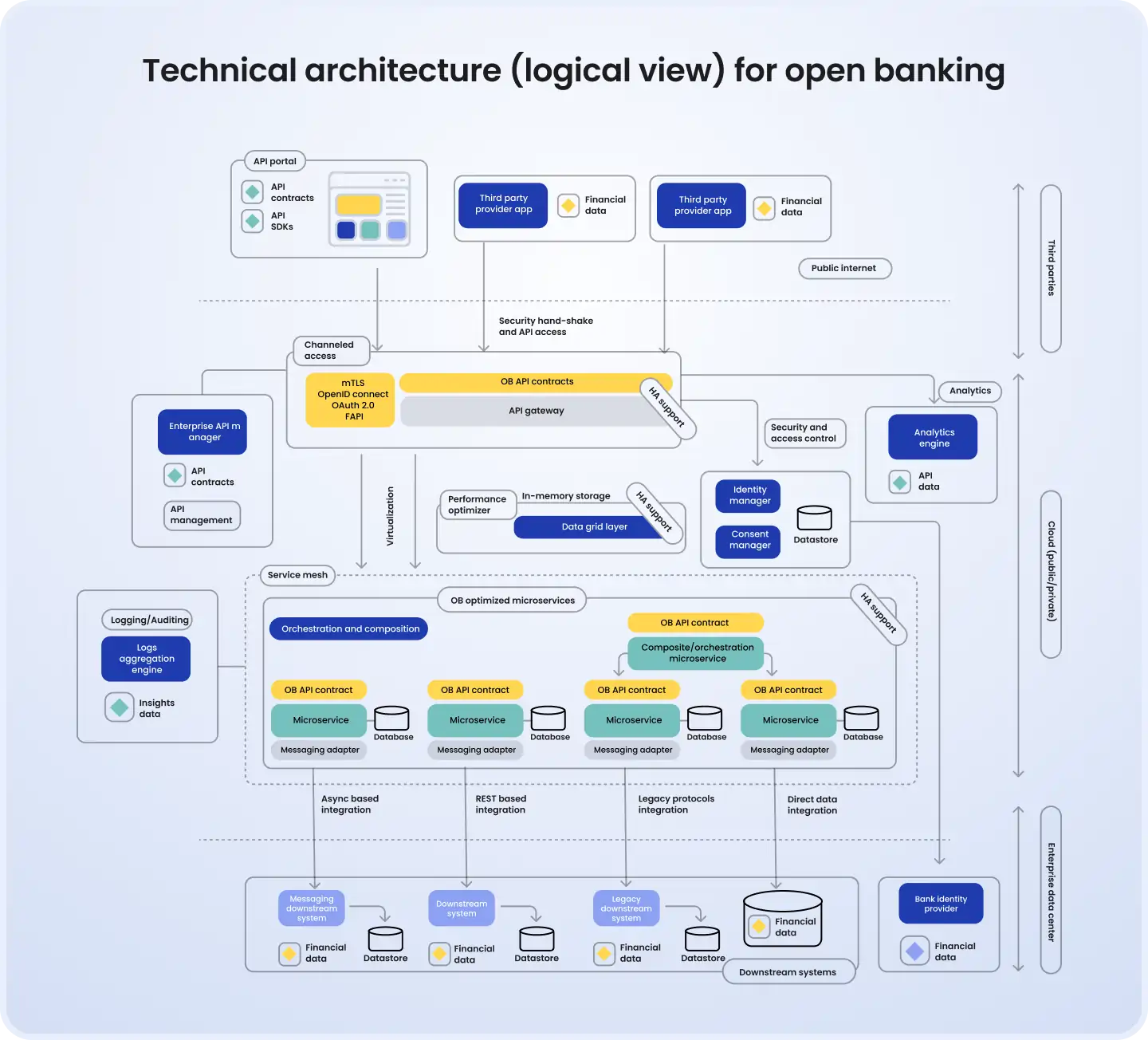
Three structural differences define the testing challenge:
The mobile app is the entire product. A broken push notification or failed biometric authentication in a traditional bank is a minor inconvenience, the customer can call support, use a branch, or access their account another way. In a neobank, the same defect removes a customer's access to their money. The consequence severity of mobile defects is categorically higher, and your test coverage needs to reflect that
Critical functionality lives in systems you don't build. Your KYC provider, BaaS platform, card processor, and fraud engine are all external services. Your QA must cover not just your application, but the behavior of every integration, the failure states when those integrations degrade, and the data accuracy when they don't. Third-party sandboxes often don't match production behavior, which means defects that pass all your integration tests can still surface the first time a real user hits a real edge case
Compliance must run at sprint velocity. A neobank shipping weekly releases cannot do quarterly compliance reviews against a product that's been modified fifty times since the last audit. Testing for KYC flow correctness, AML rule triggers, and GDPR consent handling must be automated and continuous, not periodic
The digital-first banking testing challenge in one sentence: you need to validate a product assembled from components you don't build, delivered to users on a device you don't control, at a release cadence that traditional compliance processes were never designed to accommodate.
Because one bug shouldn't cost your bank's reputation
Testing layer 1: Onboarding and KYC, your revenue-critical first impression
Onboarding is the most tested and simultaneously the most under-tested flow in most neobanks. Teams test that it works. They rarely test every way it can partially work, and partial completion is where most neobank onboarding revenue is lost and most compliance exposure is created.
A customer who gets stuck at document verification doesn't file a support ticket. They leave. A KYC check that passes synthetic test data but fails on a real document type with a non-standard MRZ format doesn't surface in your test suite, it surfaces in your activation rate metrics and, eventually, in your regulator's examination of your onboarding controls.
Document verification across the full ID matrix
Test document verification against every ID type and issuing country you accept, not a representative sample, every one. Include degraded image quality (compressed mobile photos, poor lighting, worn documents), documents photographed at oblique angles, and document expiry edge cases where the expiry date is visually present but the OCR extracts it incorrectly.
Your KYC provider's sandbox environment is optimized for clean, well-lit passport photos. Your users are photographing their documents in offices, kitchens, and cars. Test the conditions your users actually create, not the conditions your vendor's demo assumes.
Specifically test MRZ (Machine Readable Zone) consistency: the data in the MRZ at the bottom of a passport must match the visual inspection zone at the top. Test documents where these zones diverge, whether through legitimate OCR variation or forgery indicators, and confirm your system handles both correctly.
Biometric liveness in real-world conditions
Test liveness detection against passive spoofing, a printed photograph or a static image displayed on a screen, as a baseline requirement. If you're operating in markets with higher identity fraud risk, validate that your KYC vendor holds current iBeta Level 2 certification, which tests against 3D-printed masks, silicone masks, and AI-generated deepfake video. A liveness check that passes a printed photo isn't a minor gap in your UX, it's a KYC control failure.
Test liveness detection across demographic segments: accuracy rates vary by age, skin tone, and environmental lighting in ways that vendor demos don't show. Systematic rejection rate differences across customer segments are both a customer experience problem and a regulatory fairness concern.
Drop-off recovery and duplicate submission prevention
Test onboarding resume behavior: a customer who starts document upload, closes the app, and returns an hour later must be able to continue from where they left off, not restart from the beginning, not submit duplicate documents to your KYC provider. A duplicate submission creates double API charges, data duplication in your AML records, and a customer experience failure on the most important flow in your product.
Test network interruption recovery at every document capture step. Uploading a selfie on a 3G connection that drops mid-transmission must not leave the customer in a partial KYC state that silently blocks account activation. Define the expected behavior for every network failure scenario, retry with state preserved, explicit error with restart option, and test that each fires correctly.
AML and sanctions screening at onboarding
Test that your onboarding flow correctly triggers sanctions and PEP (Politically Exposed Person) checks. Specifically test near-match handling: a customer whose name has a common transliteration variant should trigger a review workflow, not a silent pass or a hard rejection. Your AML screening must distinguish between these cases, and your QA must confirm it does.
Test the Enhanced Due Diligence path: customers who trigger a risk flag must be routed to the correct review queue, have their documentation requirements clearly communicated, and have their case status visible through the app if you've promised a timeline. Test the EDD workflow end-to-end, not just the initial flag trigger.
Testing layer 2: BaaS and third-party integrations, the layer most teams undertest
This is the most distinctive and most consistently undertested layer in neobank QA. Your product is an orchestration layer over services you don't build. The gap between how those services behave in their sandbox environment and how they behave in production is where the most expensive production incidents come from.
Third-party providers make changes without warning. Their sandbox environments don't always replicate those changes. A provider that updates their API response format, adds a new required field, or changes their error code structure creates a defect in your integration that your existing tests won't catch, because those tests are validating against the old behavior. This isn't a hypothetical; it's the most common root cause of neobank production incidents that QA teams weren't responsible for creating but are held accountable for not catching.
Contract testing for every integration
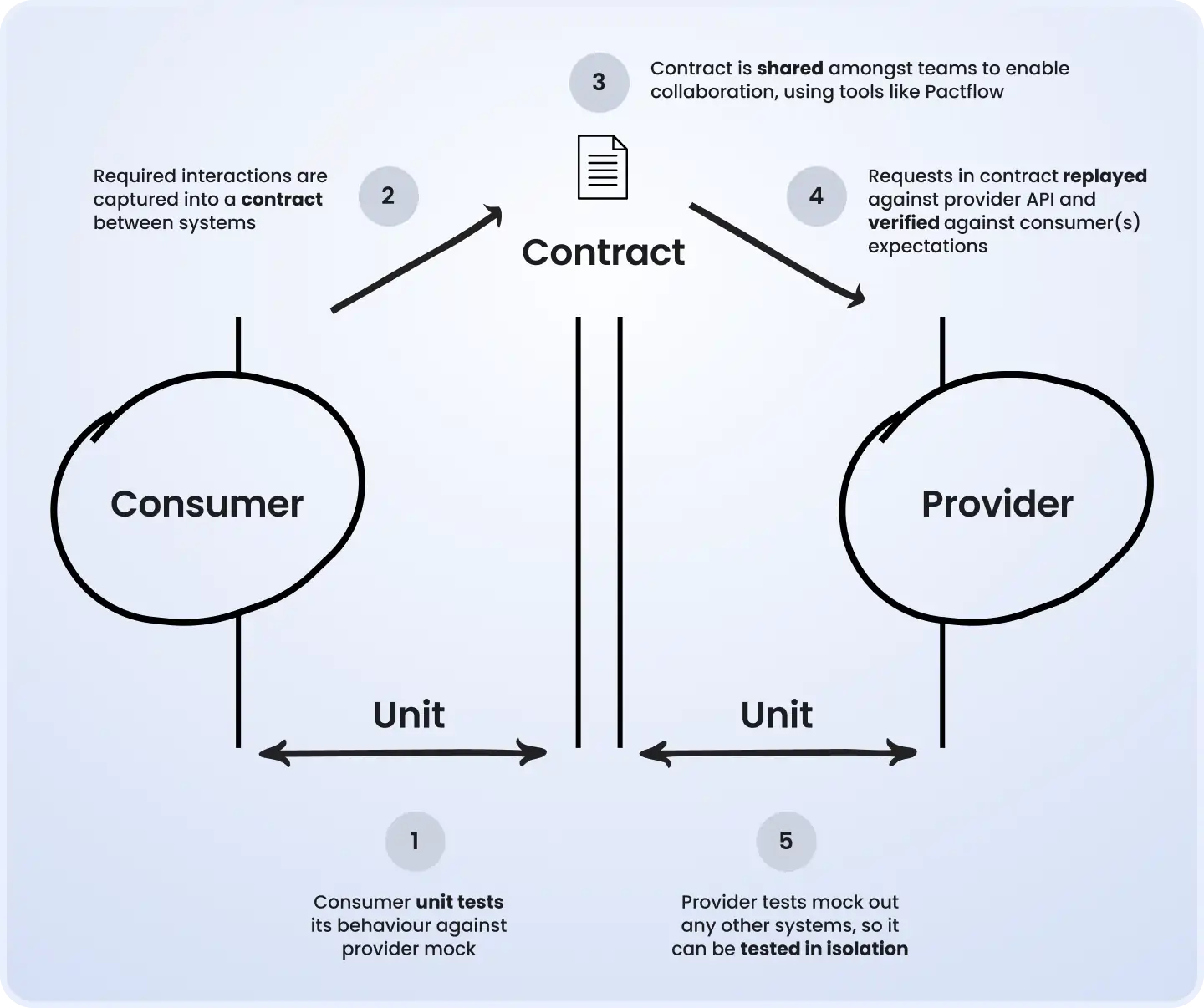
For every API integration, BaaS provider, card processor, KYC vendor, fraud engine, maintain consumer-driven contract tests that validate the response structure your application depends on. When a third party silently changes their API, your contract tests catch the divergence before your users do.
Contract testing isn't a replacement for integration testing; it's a separate layer that specifically validates the interface between your application and external services. It runs faster than full integration tests and catches a different category of defects, schema changes, field removals, new required fields, that full integration tests often miss because the tests were written against the version of the API that existed when they were written.
Failure mode coverage for every dependency
Define and test the failure state for every integration on your critical path. What does your app do when the BaaS ledger API returns a 504 during a transaction? When the card processor returns an undocumented decline code? When the fraud engine times out and returns no decision?
Each of these scenarios must have a documented expected behavior, and a test that confirms that behavior executes correctly. A BaaS timeout that leaves a transaction in an ambiguous state, shows the user a success message, and later reverses the transaction is a far worse outcome than a clear error message that lets the user retry. Define the correct behavior, test it, and confirm it's what your users actually experience.
Data integrity across integration boundaries
Test that transaction amounts, currencies, account references, and IDs are consistent across every system that touches a transaction. An amount that converts correctly in your application layer but mutates in the BaaS ledger due to floating-point arithmetic or currency rounding creates a reconciliation failure that surfaces days later, when the finance team, not the QA team, finds it.
Test balance consistency specifically: after every transaction type (incoming transfer, card authorization, fee, refund, reversal), the balance displayed in your app must match the ledger balance in your BaaS provider within your stated latency SLA. A balance display that's 30 seconds behind a card authorization is one of the highest drivers of neobank support tickets and is entirely testable with the right monitoring in your test suite.
Testing layer 3: Mobile-first UX, where your brand lives or dies
In a traditional bank, a broken feature in the mobile app is inconvenient. In a neobank, a broken feature in the mobile app is the entire product failing. Your mobile app isn't a channel, it's the product. Every customer interaction, every trust-building moment, every regulatory disclosure happens in one interface. This isn't a slight difference in degree from traditional banking; it's a categorical one.
Real device coverage that reflects your user base
Test on the actual device distribution of your user base, not a representative sample chosen for convenience. For neobanks targeting emerging markets or financially underserved segments, this often means low-RAM Android devices running older OS versions that your engineering team doesn't use. Application performance on those devices isn't a nice-to-have, it's market access. A checkout flow that runs smoothly on a Pixel 9 and hangs for 8 seconds on a mid-range Android with 3GB RAM is a product that works for some customers and doesn't work for others.
Invest in a real device lab or cloud device testing infrastructure that covers your actual user base distribution. Test on the bottom quartile of device performance in your target market, not just the devices your team happens to have available.
Push notification accuracy and reliability
Push notifications are your real-time trust mechanism. When a user receives an instant notification confirming a transaction, that confirmation is a core part of the product's value, it's why they chose a neobank over a traditional institution. A notification that arrives 20 minutes late, shows an incorrect amount, or fails to deliver entirely erodes that value proposition more directly than almost any other single defect.
Test notification delivery timing under normal conditions (target latency against your stated SLA), notification content accuracy (amount, merchant name, currency formatting correct across all transaction types), and deep-link behavior (notification tap opens the correct transaction detail, not just the app home screen). Test notifications across iOS and Android background states, background, killed process, low-power mode, because notification delivery behavior differs across these states and your users encounter all of them.
Offline and degraded connectivity behavior
Define what your app should do when a transaction attempt fails due to a network drop, and then test that it does exactly that. A spinner that never resolves is a worse user experience than a clear error message. A message that says 'payment sent' when the network cut before the gateway confirmed the transaction creates genuine financial confusion, and a support ticket that takes time to resolve because neither the user nor the support agent can tell from the app state whether the payment went through.
Test network interruption recovery at every transaction confirmation step. Test the re-connection behavior: when a user submits a payment, their connection drops for 10 seconds, and then recovers, does the app correctly determine whether the transaction was processed or not, and does it communicate that determination clearly? This scenario is not an edge case in mobile banking; it's a routine event that happens every time a user is in an elevator, a car park, or a tube station.
Biometric authentication state transitions
Test the authentication edge cases that functional testing misses because they require specific device states. Biometric re-enrollment after a device OS update is a common source of user lockouts, the updated OS changes the biometric API version, invalidates stored biometric templates, and the app doesn't handle the transition gracefully. Test that your authentication fallback path is reachable and functional in this scenario.
Test what happens when Face ID or fingerprint authentication fails three consecutive times, when biometrics are disabled at the OS level by the user, and when the app is used on a new device before the user has set up biometrics. Each of these creates a session state that your app must navigate cleanly, with a clear fallback to PIN or password authentication, not a dead end that requires a support call.
Testing layer 4: Compliance-as-code, running at sprint velocity
The compliance testing challenge for neobanks isn't that it's technically harder than for traditional banks, it's that it needs to happen significantly faster. A neobank shipping weekly releases cannot run quarterly compliance reviews against a product that's been modified fifty times since the last one. By the time the review completes, it's validating a version of the product that no longer exists.
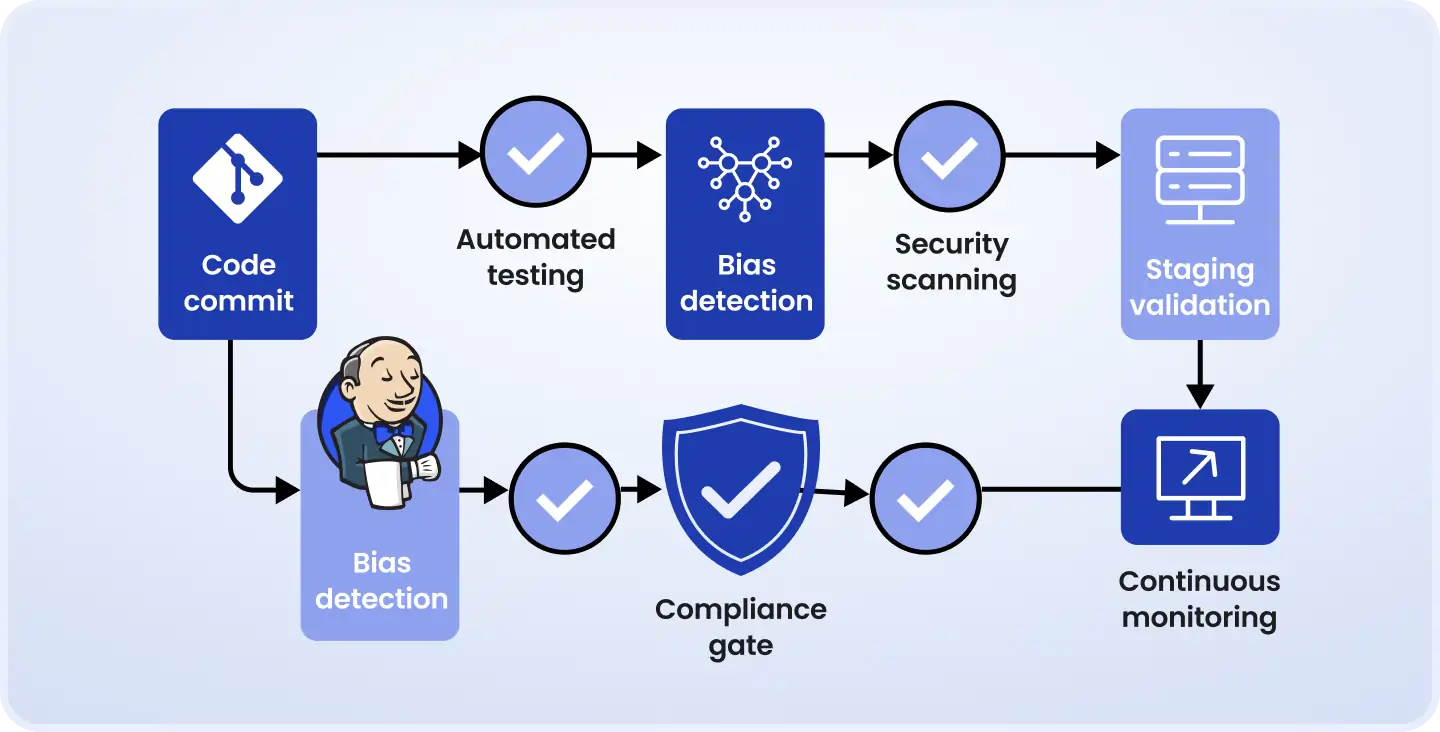
The architecture that solves this is compliance-as-code: automated tests that validate compliance-critical behaviors are embedded in the CI/CD pipeline, running on every merge. Not as a compliance team gate, but as a development team feedback loop, the same way unit tests and integration tests run. When a new feature breaks an AML rule threshold or removes a required GDPR consent field, the team finds out before the code ships, not after the regulator does.
AML and transaction monitoring rule validation in CI/CD
Build automated tests that confirm your AML rules fire at the correct thresholds and that suspicious activity workflows trigger correctly. These tests validate the logic you've built, if a customer makes five transfers under £500 within an hour, does the rule fire? Does the investigation workflow create the right alert? Does the SAR (Suspicious Activity Report) path trigger correctly at the mandated threshold?
Run these on every merge to main. AML rule logic is exactly the kind of change that a developer can break unintentionally while modifying adjacent functionality, and the kind of break that a manual QA reviewer is unlikely to catch because it requires simulating specific transaction sequence patterns. Automate the simulation; run it continuously.
GDPR consent flow and data subject rights
Automate tests for consent recording (is every marketing consent event logged with the correct timestamp and channel?), consent withdrawal propagation (does a withdrawal in the app correctly update the CRM, the email platform, and every downstream processor within a defined time window?), and DSAR response workflow (does a data access request trigger the correct cross-system data collection within the 30-day deadline?).
A weekly release that accidentally removes a consent withdrawal handler or breaks a DSAR workflow has a 7-day window before the next sprint can fix it, during which every affected user interaction is a compliance event. Automating these tests means the break surfaces in CI/CD within minutes of the change being introduced, not after a user complaint triggers investigation.
PSD2 SCA and sanctions screening
Test that every transaction type requiring SCA correctly triggers an authentication challenge, that eligible exemptions are applied, and that exemption rejection by the issuer falls back to the challenge flow without failing the transaction. Changes to your payment initiation flow, adding a new payment type, modifying the transaction metadata, can silently break SCA triggering. Automate the validation so it runs on every change.
Automate sanctions screening coverage tests: confirm that every customer-facing transaction type screens all required party fields and that a change to the payment initiation payload doesn't inadvertently remove a field from the sanctions check. A payment flow modification that drops the beneficiary address from the screening payload creates a compliance gap that functional testing won't detect, because the transaction still completes, just without adequate screening.
Compliance testing that runs on release day is compliance testing that finds gaps when it's most expensive to fix them. Embedded CI/CD compliance checks find the same gap at commit time, when the developer who made the change is still in context and the fix takes minutes rather than days of coordinated rollback and remediation.
Testing layer 5: Performance, testing for your highest-stakes moments
Neobanks experience predictable peak load events: salary payment dates, public holidays before banking closures, product launches that generate media coverage, and viral moments on social media. Each creates a traffic spike whose shape and magnitude differ from generic '10x average' multipliers, and your digital banking quality assurance program must be built around the specific load profiles your product actually faces.
Salary date load simulation
Model the actual transaction volume increase on monthly salary payment dates and run load tests against that specific pattern. The transaction mix on salary day is different from average: significantly more incoming transfers, immediate bill payments, balance checks, and card activations as newly credited customers explore their account. Generic peak load testing that doesn't reflect this transaction mix will underestimate the stress on specific services, notably real-time balance updates and push notification throughput.
A payment platform that handles 1,000 transactions per hour without issue may produce visible latency on balance updates when 40,000 users all receive salary credits within a 30-minute window and immediately check their balance. Test that specific scenario, not a uniform load increase.
Real-time notification throughput
Push notifications under load are a frequently missed performance test scenario. When a batch direct debit run completes and 60,000 customers all receive an 'account debited' notification within the same minute, does your notification infrastructure deliver within your stated SLA? Test notification throughput independently from transaction throughput, they use different infrastructure and fail under load in different ways.
The specific scenario to test: a sudden large-volume notification event (salary credit, batch settlement) on a Saturday morning when background process activity coincides with users actively in the app checking balances. Notification latency under this condition determines whether your 'instant notification' value proposition holds at scale.
Third-party dependency latency under load
Your BaaS provider's transaction processing time, your KYC provider's verification latency, and your card processor's authorization response time all contribute to user-facing transaction completion time. Under normal load, these latencies are acceptable. Under peak load, each third-party service may slow independently, and the cumulative effect on the user experience can make your app feel broken even when every individual component is technically functioning.
Test your integration latency stack under load conditions. Specifically: what is the p99 transaction completion time from the user's perspective under salary-date load? Not average latency, p99. That's the experience your worst-affected 1% of users have, and at neobank scale, 1% is a large number of people.
How to structure your neobank QA process at different growth stages
The testing investments that make sense at 5,000 users are different from those that make sense at 500,000. Here's a practical framework for calibrating your neobank QA program to your current stage:
Pre-launch / MVP
Onboarding completeness, BaaS failure modes, core transaction flow
Automated regression for account → transaction → balance update
Manual compliance review; regulatory sandbox usage
Growth 10K–500K users
BaaS contract testing, device matrix expansion, AML rule regression
Compliance-as-code in CI/CD; self-healing UI regression
Automated AML, consent, and SCA tests on every merge
Scale 500K+ users
Multi-market jurisdiction coverage, performance at salary-date load
Full regression automation; anomaly detection on test outputs
Jurisdiction-specific compliance suites per market; third-party SLA monitoring
The pattern across stages: manual testing and regulatory sandboxes at MVP give way to compliance-as-code and contract testing at growth, which matures into full automation and multi-jurisdiction compliance suites at scale. The compliance testing investment comes earlier than most neobanks plan for, because the regulatory consequences of a compliance gap discovered at the scale stage are significantly larger than those discovered at the growth stage.
Regulatory sandboxes, available through the FCA, the EBA sandbox, and various national regulators, let you test compliance behaviors in a controlled environment before you're accountable to live regulatory oversight. Use them at the MVP and early growth stages. The insights about how your specific compliance implementation will be evaluated are not available through any other channel.
Building your neobank testing program: Where to start
If you're pre-launch, start with the onboarding flow, specifically the failure states that your KYC provider's sandbox doesn't test. Find a real document from every country you plan to accept and test it through your verification flow. The gaps you find there will be more valuable than any other testing investment at that stage.
If you're post-launch and growing, build compliance-as-code before you build anything else in the QA infrastructure. AML rule regression and SCA validation in CI/CD are the tests most likely to prevent the category of regulatory finding that costs £28.9 million, and they're achievable in a sprint with a QA engineer who understands both the technical implementation and the compliance requirement.
The neobanks that ship fast and pass audits aren't the ones who slow down for compliance. They're the ones who embedded neobank compliance testing into the cadence they were already running, making it a development feedback loop rather than a compliance gate. That architectural decision is available at any stage, and the earlier it's made, the less expensive the compliance program becomes at scale.
Building a neobank testing strategy that matches your release velocity and regulatory obligations? DeviQA works with digital-first financial teams on QA strategies built for neobank architecture, from BaaS integration and contract testing to compliance-as-code implementation and mobile-first performance testing. Get in touch to discuss your current setup.
Book a strategic QA consultation
About the author
Senior AQA engineer
Ievgen Ievdokymov is a Senior AQA Engineer at DeviQA, focused on building efficient, scalable testing processes for modern software products.