
Written by: Chief Operating Officer
Anastasiia SokolinskaPosted: 09.06.2026
16 min read
AccelQ was never designed for teams that outgrow it. When your test suite hits 200+ tests, your CI pipeline stalls waiting on cloud execution slots, and your engineers can't grep a failing assertion from a canvas-based model object — you've already made the decision. You just haven't executed it yet.
Replacing AccelQ with Playwright is not a one-weekend task, but it's also not the multi-month ordeal that platform switching usually implies — if you approach it correctly. The critical insight most migration guides miss: AccelQ exports nothing. There's no .spec.ts file sitting in your repo waiting to be ported. The migration starts from scratch, which means the order of operations matters more than it does for any Selenium or Cypress transition.
This guide covers what you're actually migrating, what to build first, and how to manage the transition without breaking ongoing releases.
Why teams start looking beyond AccelQ
Three specific triggers push SaaS engineering teams to re-evaluate AccelQ — and all three tend to show up at roughly the same growth stage.
Pricing opacity. AccelQ has no public pricing. Every expansion — additional users, execution minutes, environment slots — goes through a sales conversation. For a team running 300+ tests daily, unpredictable licensing cost is a structural risk, not an inconvenience. The moment your VP of Engineering has to justify a renewal quote they can't back-calculate, the conversation about alternatives starts.
Proprietary test representation. This is the part that most "vendor lock-in" articles describe too vaguely. AccelQ stores tests as canvas-based model objects tied to its App Universe abstraction layer — not as code files. There is no CLI export, no plain-text fallback, no git history. Your entire test library exists exclusively inside AccelQ's platform. If you cancel your subscription tomorrow, you lose everything. That's not lock-in as a concept — that's lock-in as an operational fact.
Customization ceiling. AccelQ works well for linear, happy-path flows. The moment your test logic requires conditional branching, custom OAuth flows, cookie manipulation, or non-standard DOM behavior, you hit a wall. Teams end up maintaining a parallel Selenium or Playwright suite for the edge cases AccelQ can't handle — which raises an obvious question about what the platform is actually worth.
Reviews on G2 and Capterra cluster around three complaints: reporting that doesn't integrate cleanly with existing dashboards, workarounds required for anything non-standard, and a support model that scales with your license tier rather than your actual needs. These are structural limitations, not configuration problems.
What you're actually migrating: understanding AccelQ's test artifacts
Before writing a single line of Playwright code, run an inventory of what you have — because what you have is not what you think you have.
AccelQ tests exist as visual model objects inside the platform. The closest analogy: imagine your test suite stored in a proprietary database that only one vendor can read. Your "tests" are a set of structured canvas flows that AccelQ's engine interprets at runtime. There's no portable representation.
This means your migration audit is not about converting files. It's about reconstructing business logic from visual models into code. Run that audit across four dimensions:
Test type: UI flow tests, API tests, and data-driven tests each have a different rewrite cost in Playwright. API tests are typically the fastest to recreate.
Business criticality: Which tests cover revenue-critical paths — checkout, onboarding, billing, auth? These migrate first, regardless of complexity.
AccelQ self-healing dependency: Tests that rely on AccelQ's AI self-healing are your highest-risk assets. In Playwright, there is no self-healing. Those tests need explicit locator strategies that AccelQ was papering over.
Maintenance history: Tests with frequent breakage in AccelQ are a signal — either the application UI changes often (which affects Playwright equally), or the test design was fragile to begin with (which Playwright's explicit locator model will expose faster).
Map each test on a 2×2 matrix: business criticality on one axis, maintenance burden on the other. High criticality, high burden = rewrite with an improved architecture. High criticality, low burden = rewrite and maintain parity. Low criticality = evaluate whether the test is worth recreating at all.
A 300-test AccelQ suite typically shrinks by 15–20% through this audit — which is actually good news, because you're not porting redundancy.
AccelQ vs. Playwright — the honest trade-off
Most comparison articles are written by a vendor. This one isn't, so here's what you're actually getting into.
Pricing
Custom/opaque, per-seat + usage
Free, open-source (Apache 2.0)
Code ownership
None — proprietary model objects
Full — git-versioned TypeScript
Self-healing
AI-powered, built-in
None — requires explicit locators
CI/CD integration
Cloud-based execution; limited CLI control
Native — runs anywhere Node.js runs
Debugging tooling
Limited visibility into failures
Trace Viewer, Inspector, video recording, screenshots
Parallel execution
Cloud slots (license-gated)
Unlimited local workers via playwright.config.ts
Browser support
Chromium-based, limited cross-browser
Chromium, Firefox, WebKit — all three
Language support
No-code / proprietary
TypeScript, JavaScript, Python, Java, C#
Community & ecosystem
Proprietary, vendor-dependent
~72.9K GitHub stars, 6.5M+ weekly npm downloads
Non-technical team access
Strong — no coding required
Weak — requires engineers
Salesforce/Oracle support
Strong — purpose-built
Manual configuration required
The summary: AccelQ genuinely serves teams where non-technical stakeholders own test authoring, or where the application stack is Salesforce, Oracle, or another CRM platform. For SaaS teams with code-capable QA, the trade-offs flip sharply in Playwright's favor — full code ownership, no licensing ceiling, and a debugging experience that AccelQ's platform cannot match.
Evaluating this migration for your team? DeviQA has run this process for SaaS engineering teams at multiple scales. Book a free 30-minute scoping call to get a realistic estimate for your specific suite size and team composition.
Book a strategic QA consultation
Migration strategy: why incremental is the only viable path
Selenium migration guides let you choose between big-bang and incremental approaches because Selenium produces exportable code — you can convert .java files in bulk.
AccelQ doesn't give you that option. Since there's nothing to export, every test is a net-new authoring effort in Playwright. Big-bang migration means your existing AccelQ tests cover production while your team rebuilds everything from scratch in parallel — and nothing validates the Playwright suite until you flip the switch. That's an unacceptable risk window for any team shipping regularly.
Incremental is not a preference here. It's the only architecture that works.
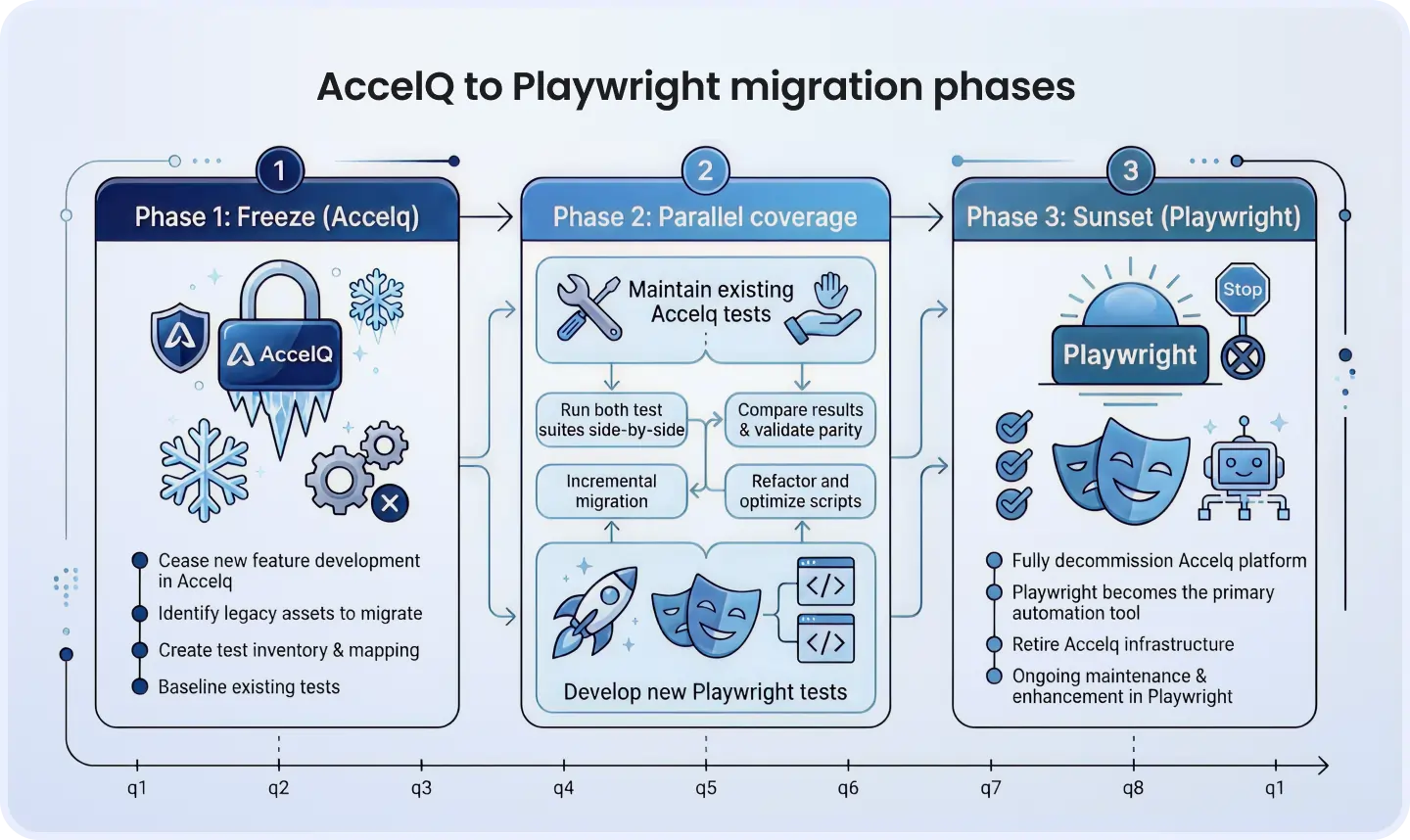
Phase 1 — Freeze (Day 1): Stop creating new tests in AccelQ immediately. All new test coverage goes to Playwright from day one. This is non-negotiable — every new AccelQ test you write during migration is a test you'll rewrite again.
Phase 2 — Parallel coverage (Weeks 2–8): Identify the top 20% of tests by business criticality. Rewrite them in Playwright first. Run both suites in CI during this phase — AccelQ for existing coverage, Playwright for the growing rebuilt suite. Use failures to validate parity. A failure that appears in Playwright but not AccelQ means either a locator issue or a genuinely new coverage gap. Both require investigation.
Phase 3 — Sunset (Weeks 8–16): Migrate the remaining AccelQ tests by priority tier. Once coverage parity is confirmed and the team's Playwright output velocity stabilizes, decommission AccelQ.
Expect 4–8 weeks of dual-framework CI overhead for a mid-sized suite of 200–400 tests. That overhead is real — account for it in your sprint velocity and make sure engineering leadership understands it's a temporary cost, not a permanent one.
Setting up your Playwright foundation before migrating a single test
The biggest mistake teams make during AccelQ migration: they start rewriting tests before the infrastructure exists to run them reliably. Don't.
Build the foundation first. The order matters.
playwright.config.ts — your execution contract
Every configuration decision you avoid now becomes a refactor later. Define these upfront:
import { defineConfig, devices } from '@playwright/test';

export default defineConfig({
  testDir: './tests',
  fullyParallel: true,
  retries: process.env.CI ? 2 : 0,
  workers: process.env.CI ? 4 : undefined,
  reporter: [['html'], ['allure-playwright']],
  use: {
    baseURL: process.env.BASE_URL || 'https://staging.yourapp.com',
    trace: 'on-first-retry',
    screenshot: 'only-on-failure',
    video: 'on-first-retry',
  },
  projects: [
    { name: 'chromium', use: { ...devices['Desktop Chrome'] } },
    { name: 'firefox', use: { ...devices['Desktop Firefox'] } },
    { name: 'webkit', use: { ...devices['Desktop Safari'] } },
  ],
});
Two decisions here that AccelQ users often miss: retries: 2 in CI (your new suite will be less forgiving on flaky elements than AccelQ's self-healing was), and fullyParallel: true (Playwright's parallel execution is what closes the speed gap with AccelQ cloud execution).
Auth state fixtures — replacing AccelQ's session management
AccelQ handled authentication state internally. Playwright doesn't. Build auth fixtures before any test hits a login wall:
// fixtures/auth.ts
import { test as base, Page } from '@playwright/test';

type AuthFixtures = { authenticatedPage: Page };

export const test = base.extend<AuthFixtures>({
  authenticatedPage: async ({ browser }, use) => {
    const context = await browser.newContext({
      storageState: 'playwright/.auth/user.json',
    });
    const page = await context.newPage();
    await use(page);
    await context.close();
  },
});
Generate the auth state once with a global setup script and reuse it across tests. This is the closest functional equivalent to AccelQ's built-in session management.
Page Object Model setup
AccelQ users have never needed a POM — the platform abstracts the DOM entirely. Building POM architecture is net-new work, not migration work. Treat it as infrastructure investment, not overhead. A well-structured POM cuts test maintenance cost by 40–60% once the suite scales past 150 tests.
CI pipeline configuration
# .github/workflows/playwright.yml
name: Playwright Tests
on: [push, pull_request]
jobs:
  test:
    runs-on: ubuntu-latest
    steps:
      - uses: actions/checkout@v4
      - uses: actions/setup-node@v4
        with:
          node-version: '20'
      - run: npm ci
      - run: npx playwright install --with-deps
      - run: npx playwright test
        env:
          BASE_URL: ${{ secrets.STAGING_URL }}
      - uses: actions/upload-artifact@v4
        if: always()
        with:
          name: playwright-report
          path: playwright-report/
This YAML runs in parallel across all browsers and captures the HTML report as an artifact on every run — including failures. AccelQ gave you this through its cloud dashboard. Playwright gives you full control over where and how it runs.
Handling what AccelQ did automatically
AccelQ's AI self-healing compensates for fragile element selectors. When an element moves or its attribute changes, AccelQ's engine attempts to relocate it. Playwright doesn't do this. The good news: Playwright's semantic locator strategy makes self-healing largely unnecessary if you get the locators right from the start.
Use semantic locators over XPaths or CSS selectors wherever possible:
// Instead of: page.locator('#submit-btn-v2')
// Instead of: page.locator('//button[@data-qa="submit"]')

await page.getByRole('button', { name: 'Submit' }).click();
await page.getByLabel('Email address').fill('user@example.com');
await page.getByTestId('checkout-confirm').click();
getByRole and getByLabel are resilient to DOM restructuring as long as the semantic meaning stays the same. getByTestId requires a data-testid attribute convention agreed on with your development team — a conversation AccelQ users have never needed to have. Have it now, before migration starts.
Centralize locators in dedicated files per page object. When an element changes, you update one file, not 40 tests.
Recreating AccelQ's API + UI combined flows in Playwright
AccelQ markets its integrated API + UI testing as a core differentiator — one tool for both layers, one unified report. This is the objection that kills more migrations than any other: "We'll lose our API test coverage."
You won't. Playwright handles this natively via its request context.
Here's the pattern: use request.post() to seed test data or establish application state before the UI test runs, then validate API state after a UI interaction completes. This covers the same testing surface AccelQ's combined flows target:
import { test, expect, request } from '@playwright/test';

test('checkout flow creates order in backend', async ({ page }) => {
  // Seed test data via API before UI interaction
  const apiContext = await request.newContext({
    baseURL: 'https://api.yourapp.com',
    extraHTTPHeaders: {
      'Authorization': `Bearer ${process.env.API_TOKEN}`,
    },
  });

  const product = await apiContext.post('/products/reserve', {
    data: { productId: 'SKU-001', quantity: 1 },
  });
  const { reservationId } = await product.json();

  // UI flow uses the seeded state
  await page.goto('/checkout');
  await page.getByTestId('reservation-id').fill(reservationId);
  await page.getByRole('button', { name: 'Confirm Order' }).click();

  // Validate API state after UI action
  const order = await apiContext.get(`/orders?reservationId=${reservationId}`);
  const orderData = await order.json();
  expect(orderData.status).toBe('confirmed');

  await apiContext.dispose();
});
This pattern — API setup, UI execution, API validation — covers the full stack in a single test with a single failure point. It's architecturally cleaner than AccelQ's combined flow model because the API calls are explicit, debuggable, and version-controlled.
What to do with your QA team during migration
This is the section that every migration guide skips — and the one that VP Engs and CTOs actually care about.
AccelQ was sold, in part, on lowering the coding barrier. Business analysts and manual testers could author tests without engineering involvement. Playwright inverts that entirely. Every test is TypeScript code, in a git repo, reviewed like production code.
Not everyone on an AccelQ team makes that transition, and pretending otherwise creates a harder conversation six weeks into migration when productivity hasn't recovered.
A realistic team model for the transition period:
Who writes Playwright tests: SDETs and developers with TypeScript experience. If your current QA team has manual testers who authored AccelQ tests with no coding background, expect a 6–8 week ramp before they're productive in Playwright — assuming they're willing and supported with training. The industry benchmark for an engineer already familiar with JavaScript: productive in Playwright in under 2 weeks.
Who owns test coverage strategy: QA leads and product managers. Playwright doesn't change who decides what to test — it changes who can implement it.
Where manual testers fit: Test case design, exploratory testing, and test review are roles that don't require Playwright proficiency. Redirect manual testers toward exploratory sessions on new features while SDETs handle Playwright authoring. This is not a demotion — it's a role clarity that AccelQ's model obscured.
Plan for a 3–4 week productivity dip during active migration. That's not a failure; it's the honest cost of a tool transition of this scope. Frame it for stakeholders as an investment with a measurable payoff, not as disruption. The test automation ROI becomes concrete once the Playwright suite runs in parallel and execution times start dropping.
Measuring migration success — metrics that actually matter
Most migration guides end with "migration is complete." A VP of Engineering needs to know whether it worked. Define these metrics before you start and track them through all three phases.
Flakiness rate: Target under 2% false-positive failure rate in your Playwright suite. If you're above 5% after Phase 2, your locator strategy has gaps — revisit getByRole adoption and centralized locator files.
Suite execution time: Playwright's parallel execution with fullyParallel: true and 4 workers typically yields 20–40% faster wall-clock execution versus AccelQ cloud runs. Measure your AccelQ baseline now, before you start.
Maintenance hours per sprint: Track time spent updating broken tests in AccelQ now. That's your baseline. Post-migration, semantic locators and POM architecture should cut that figure by at least 30%.
Coverage delta: Test count in Playwright vs. test count that was in AccelQ at the point of sunset. Ensure you haven't dropped functional coverage during migration — even if the total count decreased (which it should, after eliminating redundant tests in your audit).
SDET onboarding time: New engineers productive in the Playwright suite in under 2 weeks. If it takes longer, the framework has complexity problems — usually an over-engineered fixture layer or poorly structured page objects.
A QA audit and test coverage analysis before migration gives you a reliable baseline for all five of these metrics. Without a baseline, "migration complete" is just a date, not a result.
Is this migration right for your team right now?
Not every team should do this. The cases where staying on AccelQ — or choosing a different path — makes more sense:
Your team has no engineers who can own TypeScript code. Playwright is not a no-code tool and has no roadmap to become one. If your QA function is entirely non-technical and you can't embed an SDET, a Playwright migration will stall in Phase 2.
Your application stack is primarily Salesforce or Oracle. AccelQ has deep purpose-built support for these platforms. Playwright requires significant manual configuration for Salesforce's Lightning components. The migration cost in this case is high, and the ROI case is weaker.
Your test suite is under 100 tests. The engineering investment to migrate a small suite, build Playwright infrastructure, and establish POM architecture rarely makes financial sense. The tipping point for positive ROI is typically around 150+ tests with active weekly maintenance.
For SaaS teams with code-capable QA — an SDET or two, developers involved in test review, and a suite that's grown past the point where AccelQ's pricing is predictable — the decision is clear. When AccelQ's annual licensing cost exceeds the engineering hours to complete Phase 1 and Phase 2 of this migration, the math already favors moving. 71% of testing teams evaluate multiple frameworks annually — most of them are doing it reactively. Running this calculation now, proactively, puts you ahead of the timeline.
What the migration actually looks like
A 12-person SaaS team — one SDET, two manual testers, a QA lead — running 300 AccelQ tests. Suite execution averages 47 minutes per run on AccelQ's cloud. Licensing renews annually at a cost that's difficult to justify against the team's actual usage.
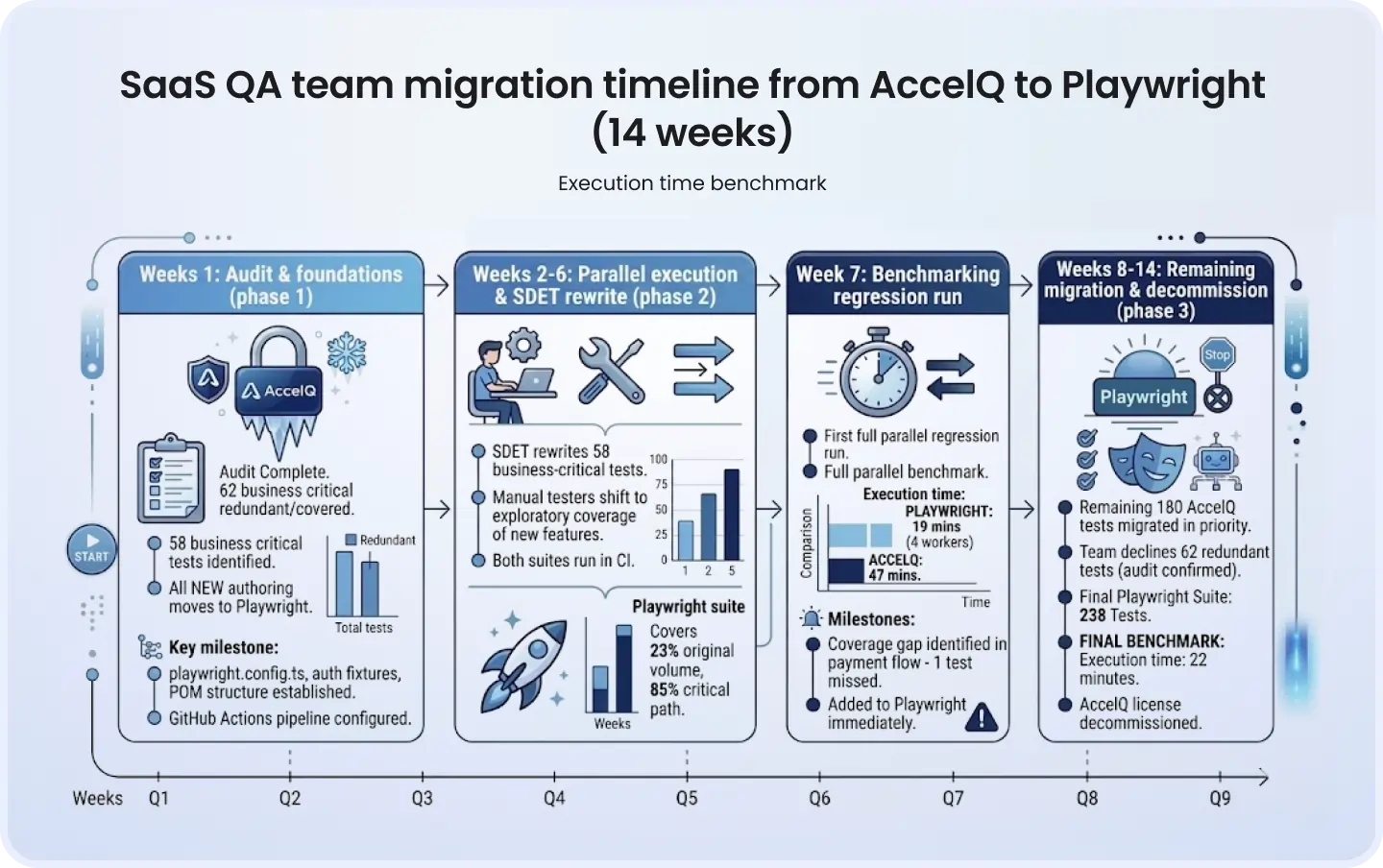
Week 1: Audit complete. 62 tests flagged as redundant or covered by other tests. 58 tests identified as business-critical. All new test authoring moves to Playwright. playwright.config.ts, auth fixtures, and basic POM structure established. GitHub Actions pipeline configured.
Weeks 2–6: The SDET rewrites the 58 business-critical tests. Manual testers shift to exploratory coverage of new features. Both suites run in CI. The Playwright suite at this point covers 23% of the original AccelQ volume but 85% of the critical path.
Week 7: First full regression run with the Playwright suite alongside AccelQ. Playwright total execution: 19 minutes with 4 workers. AccelQ: 47 minutes. Coverage gap identified in payment flow — one AccelQ test case missed during audit. Added to Playwright immediately.
Weeks 8–14: Remaining 180 AccelQ tests migrated in priority order. The team declines to recreate 62 tests identified in the audit — they were redundant. Final Playwright suite: 238 tests. Execution time: 22 minutes. AccelQ license decommissioned.
The productivity dip was real — sprint velocity dropped by roughly 20% during Phase 2. It recovered fully by Week 10. The engineering investment paid back within the first renewal cycle.
The teams that execute this migration well aren't the ones who move fastest. They're the ones who audit before they act, build infrastructure before they write tests, and manage the human side of the transition as carefully as the technical side.
Playwright doesn't replace AccelQ by being better at the same things. It replaces AccelQ by giving your team something AccelQ never offered: full ownership of your test suite, with no vendor standing between your tests and your CI pipeline.
Evaluating a migration from AccelQ? DeviQA's engineers have run this process for SaaS teams at multiple suite sizes and team compositions. Book a free 30-minute call to scope your migration — including a realistic timeline, team model, and infrastructure plan.
Book a strategic QA consultation
About the author
Chief Operating Officer
Anastasiia Sokolinska is the Chief Operating Officer at DeviQA, responsible for operational strategy, delivery performance, and scaling QA services for complex software products.