
Written by: Chief Operating Officer
Anastasiia SokolinskaPosted: 02.07.2026
10 min read
If you have shopped for a test automation tool in the last few years, you have been promised self-healing. It appears on every vendor landing page, usually next to a graph that only goes up and to the right. The pitch is appealing: your tests will automatically repair themselves when the UI changes, your maintenance burden will evaporate, and your suite will stay green forever.
Then you introduce the tool and, within a few sprints, notice something strange. The suite is green, yes. But it is green even when it shouldn't be. A button that vanished in a regression still "passes." A broken checkout flow still "passes." The tests have healed themselves right past the bugs they were supposed to catch.
This is the dirty secret of most self-healing automation solutions: they optimize for staying green, not for telling the truth. And a test that always passes is not a test at all, it is a screensaver.
We spent a long time wrestling with this and eventually built something reliable: a test framework powered by Claude agents that doesn't just patch failures but diagnoses them. It fixes what should be fixed, files bugs for what shouldn't, and clearly flags the cases it isn't sure about. This article is about why the usual approach falls short and how a smarter system is structured.
Consistent test automation services for reliable software releases
First, what "self-healing" actually promises
To understand why most implementations disappoint, it helps to be precise about the promise.
Test automation breaks for two very different reasons, which are constantly confused with each other:
Brittle or flaky tests. A test breaks even though the product is fine. A developer renamed an element ID, changed a CSS class, moved a button two pixels, or shipped a planned redesign. Nothing is wrong with the application — the test simply pointed at the old world.
Real defects. A test breaks because the product is really broken. A feature regresses, an API returns the wrong shape, or a flow no longer completes.
Self-healing was invented to address the first category. The whole point is to absorb harmless churn so engineers don't spend their mornings updating locators. That is a legitimate, valuable goal, as brittle tests are one of the main reasons automation initiatives quietly die.
The problem is that naive self-healing cannot distinguish the two categories. And once a tool starts "healing" the second category, it stops being a safety net and becomes a liability.
A self-healing test that can't differentiate a redesign from a regression isn't truly self-healing — it ends up masking the bug.
The hidden cost of healing everything
Traditional self-healing usually works on one mechanical assumption: if a locator no longer matches, search the DOM for the most similar element and rebind to it. It's fast, it's simple, and it keeps suites green. Yet, it's also exactly where the danger lives. Here is what is wrong with this approach:
1. It masks real regressions as successful runs
If a primary call-to-action button disappears because of a regression, a similarity-matching algorithm will happily find the "next closest" clickable element and continue execution. The test passes. The regression ships. The first person to notice is a customer — the most expensive way to find a defect.
2. It cannot read intent
A changed label might be an intentional rebrand, or it might be a broken localization string. A relocated field might be a UX improvement or a layout bug. Intent lives in the heads of people who made the change — it isn't encoded in the DOM. A tool that only looks at structure is guessing, and it always guesses in the direction of "keep going."
3. It quietly destroys trust
This is the subtle one. Once a team realizes that "self-healing" often means silently binding to the wrong elements, they stop trusting green runs. They re-verify critical paths by hand, "just to be safe." Now you pay for automation and do manual QA on top of it. The tool designed to save time has added a tax to every release.
4. It accumulates invisible debt
Every silent heal is an undocumented change in what the test actually means. Over time, the suite drifts away from describing how the product should behave and starts reflecting whatever the product currently does, including bugs. By the time anyone audits it, the tests have quietly rewritten themselves into agreement with reality, which is the opposite of their purpose.
The lesson across all four is the same. The goal was never "make tests stop failing." The goal is to make tests fix what should be fixed and surface what shouldn't. That single distinction is the entire difference between automation you can trust and automation you can't.
What we built instead: AI self-healing pipeline
Our framework runs on several AI agents working in parallel across multiple threads. The key shift is in the order of operations. Instead of "detect failure → substitute element → continue," the flow is "detect failure → understand it → decide what it deserves."
Every failed test falls into one of three categories, and the third one is what makes the whole system honest.
Healed
The framework identified the real change — a moved locator, a restyled button, a renamed label — and repaired the test automatically. The run continues green, with a record of exactly what was changed and why. Also, each self-healed test has a verification phase to confirm that the "heal" actually was successful and correct.
Bug
The failure is a real product defect. A Jira ticket is created automatically and linked to the failing test, so the bug is captured at the moment of detection, not hours later during triage.
Recheck
The agents cannot confidently decide whether the failure is a bug or an intended UI change. Instead of guessing, the test is parked in a review state and handed to a human. Uncertainty is treated as a first-class outcome, not a hidden one. The agent provides the user with initial triage and investigation steps, reducing the time required for failure investigation.
Most self-healing tools have only two states: pass or pass-anyway. By giving the system permission to say "I'm not sure," the Recheck state keeps a human in the loop at exactly the moment where automation shouldn't make the call alone. Uncertainty stops being something the tool hides and becomes something it reports.
How the flow works, step by step
Here is the lifecycle of failing tests inside the framework:
Detection: A test fails during a run, the same as in any suite.
Diagnosis: The agents analyze the failure in context. Is this a changed locator? A restyled or recolored button? A moved or renamed element? Or behavior that no longer works?
Classification: Based on the diagnosis, the failure is classified as Healed, Bug, or Recheck.
Acting on safe changes: If it is a harmless UI change, the agents repair the test automatically and record what they changed, so the heal is auditable rather than invisible.
Bug logging: If it is a real defect, the framework creates a Jira ticket through the MCP/API integration and links the failing test directly to the bug — no manual triage, no copy-pasting stack traces the next morning.
Escalation of uncertainty: If the agents cannot confidently classify the failure, it goes to Recheck for human review instead of being silently "fixed."
Because the Jira integration runs over MCP, the path from "this test failed because of a real bug" to "ticket created, linked, and assigned" happens inside the same automated run. The bug is captured at the moment of highest context — when the framework knows exactly which test failed, on which step, against which build.
Old approach vs. new approach, at a glance:
Chooses the closest matching element and moves on.
Diagnose the failure before deciding whether to touch it.
Can mask real regressions behind a green result.
Separate cosmetic UI change from real defect.
Two outcomes: pass or pass-anyway.
Three outcomes: Healed, Bug, or Recheck.
Bugs found later are logged manually.
Bugs are ticketed and linked automatically via MCP.
Static rules that drift over time.
Agents that learn from every correction. Fully configured and customisable for any specific needs and requirements.
Built for speed, not just safety
Honesty would be a hollow victory if it were slow. The reason the agents run in parallel across multiple threads is that healing should scale with the size of the failure, not buckle under it. When a shared component changes and forty tests light up at once, you don't want them processed one at a time.
In our strongest run so far, the framework repaired 90 tests in 5 minutes. That is the kind of change that lets you have everything resolved before the coffee gets cold, while normally it would swallow a QA engineer's entire afternoon with chasing locators, re-running, and re-checking. The point isn't the headline number on its own; it is that speed and correctness stopped being a trade-off.
Tests that keep learning
A static rule set decays. The web it was written against keeps moving, and yesterday's clever heuristic becomes today's flaky failure. The agents in our framework are built to avoid that fate.
Every correction feeds back in. When the agents heal a test automatically, and especially when a human resolves a Recheck item, confirming "yes, that was an intended change" or "no, that was a bug," that decision becomes a signal. The agents learn from those edits and get sharper at classifying the next failure of the same kind. The suite becomes more accurate over time instead of drifting out of alignment.
That is the real meaning of "smart tests." Not tests that never fail, but tests that understand why they failed, act correctly on that understanding, escalate honestly when they are uncertain, and improve with every single run.
What this means for your team
Step back from the mechanics, and the practical wins become straightforward.
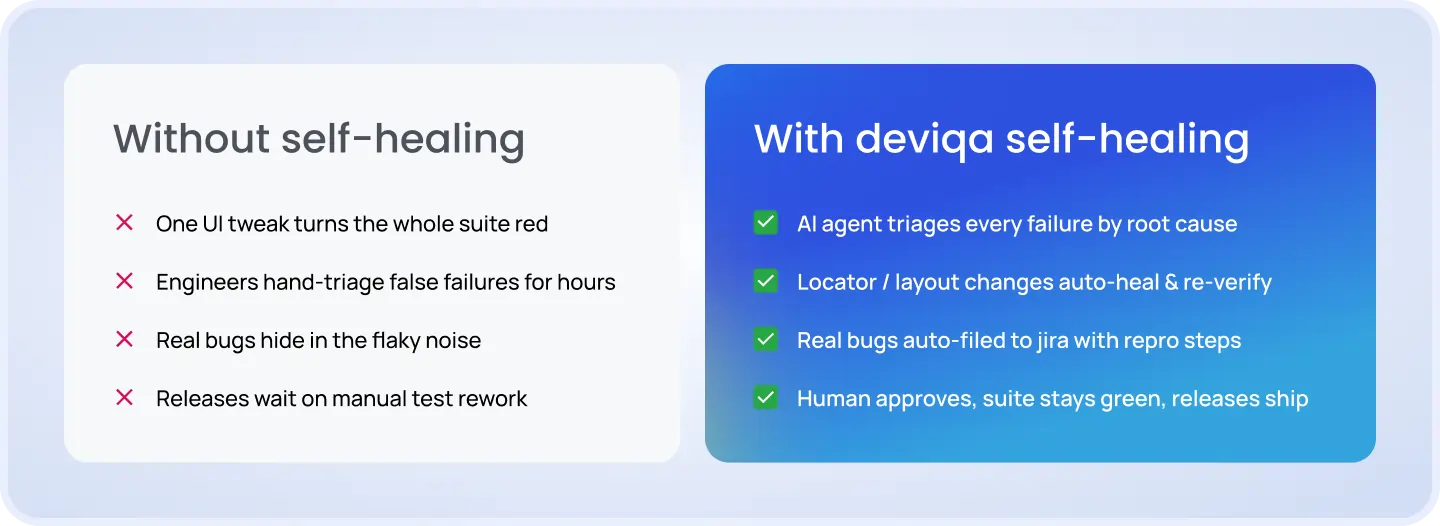
Less maintenance, without blind spots. Harmless churn is absorbed automatically, but not at the cost of hiding regressions.
Faster, richer bug reporting. Defects are ticketed and linked at the moment of detection, with full context attached.
Green you can trust again. Because the system tells you when it's unsure, a passing run goes back to meaning what it is supposed to mean.
A suite that improves itself. Every human decision makes the next automated decision better.
Takeaway
Self-healing, on its own, isn't a feature — it's a liability once it starts hiding defects. What QA teams actually need from self-healing frameworks is judgment: the ability to tell a cosmetic change from a real bug, to fix the first, report the second, and ask for help when the line between them is genuinely unclear.
That judgment is what we've implemented, enabling tests to be green and trustworthy at the same time, a combination the industry has spent years promising and rarely delivering. If your self-healing tests have ever "fixed" their way past a bug, you already know why that combination matters.
Curious how this would fit your suite? That's exactly the kind of conversation we like to have. Contact us to resolve your case efficiently.
Book a strategic QA consultation
About the author
Chief Operating Officer
Anastasiia Sokolinska is the Chief Operating Officer at DeviQA, responsible for operational strategy, delivery performance, and scaling QA services for complex software products.