
Written by: Chief Operating Officer
Anastasiia SokolinskaPosted: 11.06.2026
12 min read
Your Playwright suite exists. It runs nightly. And your team has quietly stopped trusting it.
If that sentence landed, you already know why you're reading this. You're not looking for a case that outsourcing is good in general — you're trying to figure out whether your specific situation calls for it, and what it actually looks like when it's done right. This article gives you the decision framework, the evaluation checklist, and the questions to ask before anyone signs anything.
The decision isn't about budget — it's about velocity and ownership
Most articles frame outsourcing as a cost conversation. That framing is wrong — or at least incomplete.
The real question is whether your team can build, maintain, and evolve a Playwright suite fast enough to keep pace with your release cadence without it becoming a full-time distraction for engineers who should be building products. Hiring a mid-level SDET in the US runs $130k-$165k annually. That's a real number. But the cost of a suite nobody trusts — one that delays releases, masks real failures, or sits unmaintained after a key hire leaves — is harder to put on a spreadsheet and usually larger.
Outsourcing Playwright test automation isn't a stopgap. It's a deliberate architectural decision about where your team's time goes. If a VP Engineering is seriously asking "should we hire offshore QA engineers for this?", there's almost always already a signal in the codebase or the CI pipeline that answers the question. The following sections help you read it.
When in-house Playwright makes sense (and when it doesn't)
Before reaching for an external team, it's worth being honest about what your current setup actually looks like — not what you planned it to be.
In-house Playwright works when:
You have at least one dedicated SDET on staff who owns the suite end-to-end, including CI config and fixture maintenance
Average test execution time in CI is under 800ms per test across the regression suite
You already have a working playwright.config.ts, a fixture library, and a structured page object layer
Flaky tests are quarantined within 48 hours and investigated within the same sprint
External QA makes more sense when:
Test coverage on critical user journeys sits between 0-20% and no one owns the automation backlog
Developers are writing E2E tests reactively — only after production bugs surface, not before features merge
Your Playwright suite runs, but 30%+ of CI runs produce non-deterministic failures
The SDET who built the suite has left or has given notice
You're in a regulated vertical — fintech, healthcare — and need audit-ready test artifacts and traceability matrices on a timeline your team can't absorb
Automation debt is compounding: three major features shipped in the last quarter, none with test coverage, the backlog item "add Playwright tests" has been in sprint planning for six weeks without moving
Dedicated SDET on staff, suite actively maintained
✅
—
No SDET, backlog growing, coverage < 20%
—
✅
Suite exists, key engineer departed
—
✅
Flakiness > 5% on stable features
—
✅
Regulated vertical requiring test traceability
—
✅
Pre-Series A, need speed without hiring overhead
—
✅
CI pipeline exists, Playwright configured, tests passing
✅
—
A flakiness rate above 5% on a stable, unchanged feature is not a Playwright problem. It's a process problem. Treating it as one will cost your team more time than the tests were ever supposed to save.
The 6 concrete signals your team is ready to outsource Playwright
These are engineering conditions, not budget constraints. If more than two apply to your situation, the answer is probably yes.
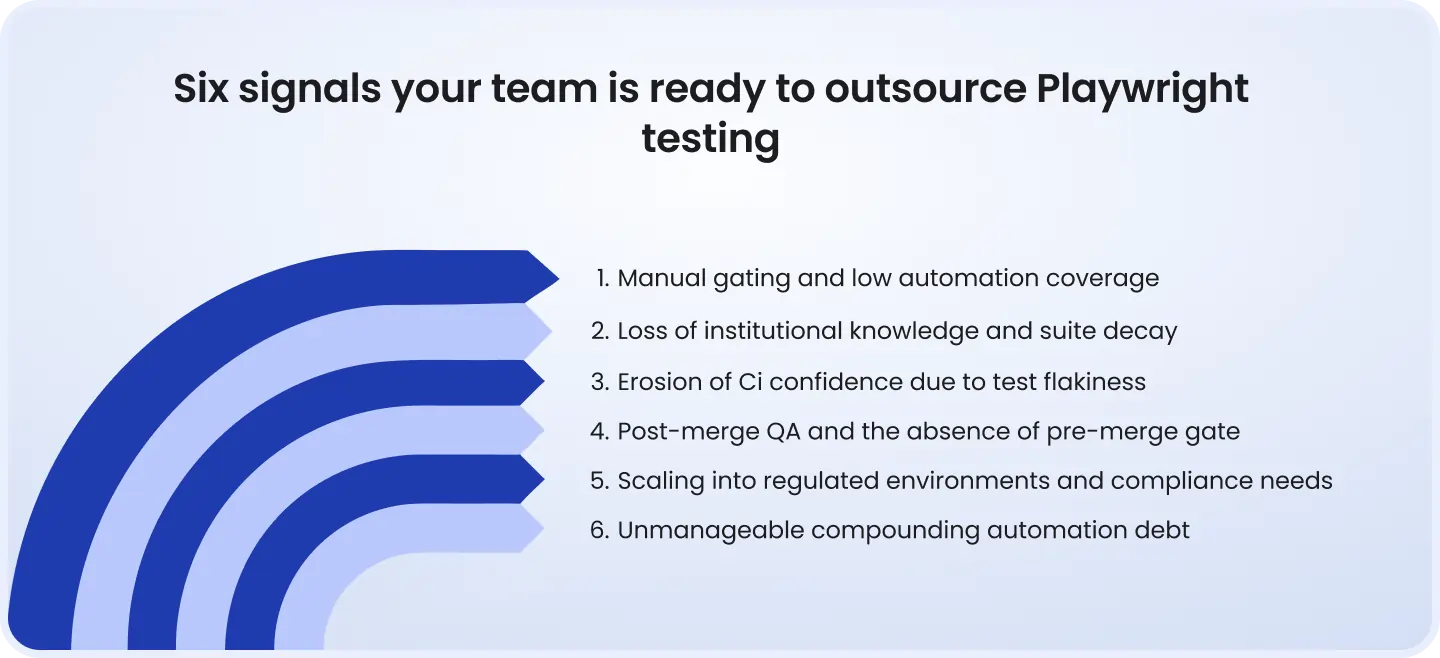
1. Your regression suite is manual. Releases are gated by 2-5 QA engineers clicking through flows. Playwright is installed — maybe there's even a /tests folder — but fewer than 15% of critical user paths have automated coverage. Every release is a negotiation between "ship now" and "wait for QA."
2. A senior engineer left and the test suite is a black box. The playwright.config.ts has hardcoded timeouts, no base URL abstraction, and no README explaining the fixture setup. Nobody currently on the team can describe how the auth state is shared between tests. The institutional knowledge walked out the door, and the suite is slowly rotting. This is one of the most common triggers for outsourcing — and one of the least-discussed.
3. Flaky tests are killing CI confidence. The team has started re-running pipelines manually instead of investigating failures. --retries=3 is masking real failures, not fixing them. Engineers treat a red build as noise. When that happens, your test suite has stopped protecting you — it's just adding latency to your deployments.
4. Your product ships to production but QA happens post-merge. There's no pre-merge E2E gate. Playwright runs nightly, not on every PR. Critical regressions are caught in staging — or worse, in production — rather than in the pipeline where they cost nothing to fix.
5. You're scaling into a regulated environment. You're entering fintech or healthcare and need structured test documentation, traceability matrices, and test run artifacts that satisfy compliance requirements. Your team has no experience designing for auditability, and there's no internal process for it. Getting this wrong isn't just a QA problem — it's a sales and legal problem.
6. Automation debt is compounding faster than your team can absorb it. Three major features shipped in Q2. None have Playwright coverage. The backlog item "E2E tests for onboarding flow" has been deprioritized in sprint planning for two months. The gap isn't closing — it's widening. At a certain point, catching up in-house requires either pulling engineers off product work or letting the debt compound until it becomes a release blocker.
What a good Playwright outsourcing engagement actually looks like
Most buyers never ask this question before signing. They should.
Here's what a well-structured engagement looks like at the timeline level — and what you should be reviewing at each stage.
Weeks 1-2: Access and environment audit. The external team should request: staging URL and auth documentation, your existing playwright.config.ts and any current specs, CI/CD pipeline access (GitHub Actions, GitLab CI, CircleCI — coordinated with your DevOps engineers), and a list of the 10-15 highest-traffic user journeys. A red flag at this stage: they ask for a requirements document instead of running your existing suite and reviewing the output themselves.
Weeks 3-4: Smoke suite against critical paths. 10-15 tests against your highest-traffic flows should be running in CI. Target execution time: under 3 minutes. These tests should have clean test.describe grouping, no page.waitForTimeout() calls (a sign of timeout-based stabilization rather than proper waiting), and failure messages that a developer can act on without reading the test code. By end of week 4, every member of your team should be able to read a failed test output and understand what broke.
Month 2: Regression expansion tied to your backlog. Coverage should map to your sprint work — new features get tests before they merge, not after. Playwright HTML reports or Allure dashboards should be published to your existing CI dashboard. You're no longer gating on manual QA for features that have automated coverage.
Month 3: Ownership handoff or maintenance cadence. If the engagement includes a handoff, the test suite should be readable by any senior engineer on your team without vendor assistance. No proprietary tooling. No black-box fixture abstractions. Full write access to your own repo, documented. If the engagement continues as managed QA, you should have an agreed SLA for test maintenance when product changes — typically 24-48 hours turnaround for suite updates after a significant UI change.
A competent external team should have smoke coverage running in your CI within 10 business days of access provisioning. If a vendor can't commit to that timeline, ask why.
How to evaluate a vendor's actual Playwright capability
Most buyers assess vendors on portfolio and pricing. That's insufficient. Proficiency in outsourced Playwright test automation is specific — and straightforward to verify if you know what to look for.
Ask for a code sample or a public GitHub repo. Then look for the following:
Green flags
page.getByRole()andpage.getByTestId()over CSS selectors. Signals awareness of maintainability best practices — role-based selectors survive UI refactors.page.locator('.btn-primary')does not.Fixture-based test setup over
beforeEachsoup. Fixtures are the correct pattern for shared state and authentication in Playwright at scale. AbeforeEachblock that logs in every test is a signal they haven't built large suites.page.route()for API-dependent flows. Network mocking means they can test UI behavior without requiring a live, seeded backend for every scenario. This keeps tests fast and deterministic.Parallel execution configured in
playwright.config.ts. Specifically:fullyParallel: true, worker count set appropriately, and test isolation handled through browser contexts, not test ordering.expect.soft()used where appropriate. This signals understanding of test granularity — capturing multiple assertion failures in a single run rather than failing fast on the first mismatch in a form validation flow.
Red flags
They quote a count of tests delivered, not coverage of user journeys. Test count is a vanity metric. A suite of 200 tests that doesn't cover your checkout flow is worthless.
They don't mention your CI/CD stack anywhere in their proposal.
They use "Selenium" and "Playwright" interchangeably. These are architecturally different tools with different mental models. Conflating them is a signal they're not working in Playwright regularly.
They propose a fixed-price project with no maintenance phase. A Playwright suite that's never updated after delivery will be flaky within 90 days of the next product sprint.
Their sample code uses
page.waitForTimeout(3000)to stabilize test steps. This is the single clearest sign of brittle automation — it's the test equivalent of adding a sleep statement and hoping the page has loaded.
If a vendor can't produce a code sample on request, that's your answer.
Code ownership and handoff — the question most teams don't ask until it's too late
This section covers what almost no vendor proposal addresses — and what you'll wish you'd asked before month three.
Who owns the repo? All test code should live in your version control, under your organization's GitHub or GitLab account, from day one. Not in a vendor-managed repo that gets transferred at end of engagement. Write access, CI secrets, environment configuration — all in your infrastructure.
What's the branching strategy? The external team should work in branches and submit PRs to your main or develop branch, following your team's review process. This keeps your engineers in the loop on what's being added and prevents a situation where the suite diverges from your codebase conventions.
What's the SLA for test maintenance? Your product will change. When it does, tests break — and that's expected. What you need to agree on upfront: how fast does the vendor update broken tests when you ship a UI change? A 48-hour SLA is reasonable for minor changes; larger refactors warrant a dedicated sprint. Get this in writing.
What does end-of-engagement look like? The test suite should be runnable by any competent engineer on your team without the vendor present. No proprietary wrapper libraries. No test runner config that requires vendor-specific credentials. No documentation that only the vendor's team understands. If the vendor's involvement is a prerequisite for running the suite, you've traded one dependency for another.
Verify the contract covers IP. All test code should be work-for-hire, assigned to your organization in full. This is standard — but get it stated explicitly, not implied.
If you're mid-engagement and can't answer where your test code lives — that's the first thing to fix.
The DeviQA approach to Playwright outsourcing
DeviQA structures Playwright engagements around one constraint: the test suite has to be yours to run on day one, not month six.
Every engagement starts with a discovery phase: we audit your existing automation state (or the absence of one), map coverage gaps against your highest-risk user journeys, and define a CI integration baseline before writing a single test. Coverage decisions are made against business-critical flows — not test count targets.
From there, the engagement runs in two-week cycles with weekly reporting: pass/fail trend data, new coverage added, flakiness delta, and any suite maintenance triggered by product changes. All tests are written in TypeScript with Playwright's recommended POM structure, fixture-based setup, and CI-ready parallel execution. Allure or Playwright's native HTML reporter publishes to your existing dashboard — GitHub Actions, GitLab CI, CircleCI, or whatever you're running.
We work across SaaS, fintech, and healthcare — including engagements where audit-readiness and compliance traceability were part of the scope from day one.
If you want to see what your current Playwright setup looks like against these criteria before committing to anything, that's a straightforward conversation.
The signals don't lie
If your regression suite is manual, your CI confidence is broken, or the engineer who built your Playwright setup is no longer there — the question isn't whether to outsource. It's how to do it without ending up more dependent than when you started.
The teams that get this right treat it as an engineering decision, not a procurement one. They ask for code samples. They define ownership upfront. They measure the engagement by coverage of user journeys, not by test count.
We'll review your current Playwright setup, or the absence of one, and deliver a coverage gap map within 5 business days. No commitments required. Talk to our Playwright engineers.
Book a strategic QA consultation
About the author
Chief Operating Officer
Anastasiia Sokolinska is the Chief Operating Officer at DeviQA, responsible for operational strategy, delivery performance, and scaling QA services for complex software products.