An independent review of what quality assurance costs across testing types, seniority levels, and global regions — compiled from labor statistics, salary platforms, and industry rate reports.
TL;DR
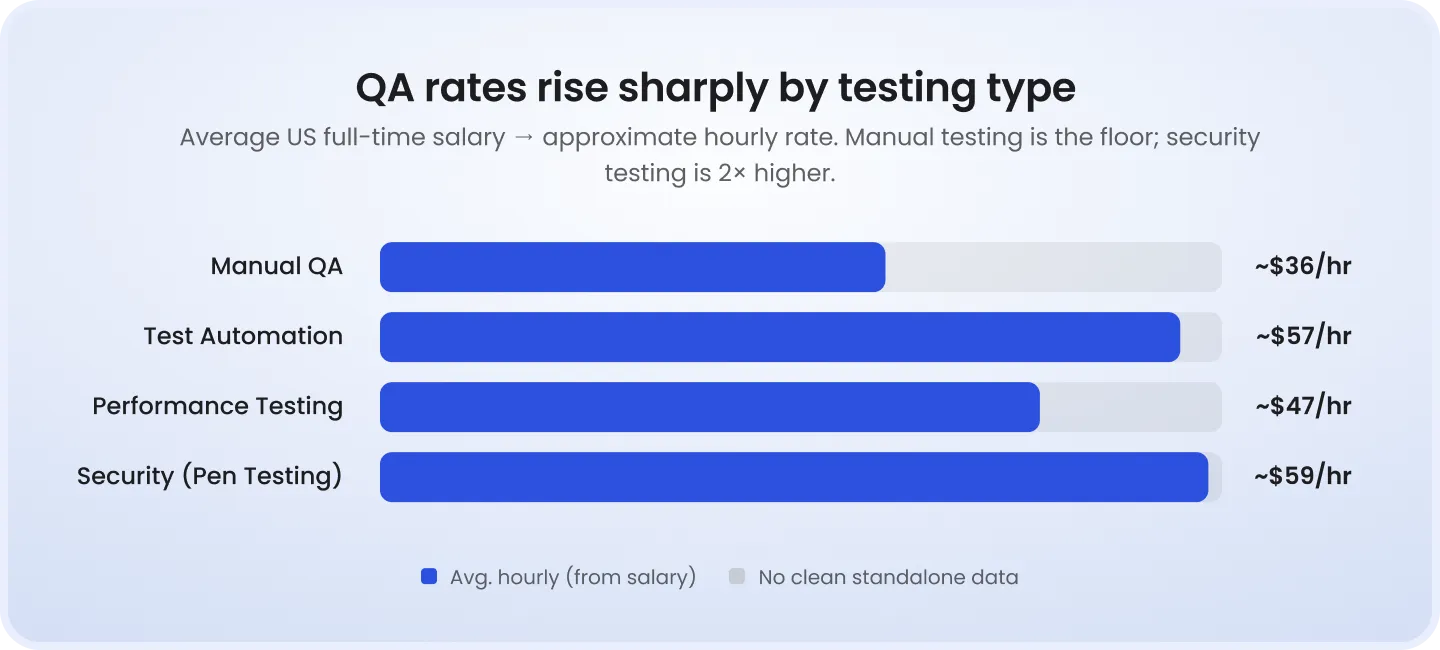
Testing type is the biggest driver of QA cost. US salaries run from ~$36/hr for manual QA up to ~$57/hr for test automation and ~$74/hr for security testing — test automation and security cost more because they require coding and specialized skills. (Glassdoor [4], Indeed [7], 2026)
The automation premium is real: automation testers earn $20K–40K more per year than manual testers at the same experience level [21], because they write code instead of executing scripts by hand.
Region sets the rate range. Billed outsourcing rates span ~$15–45/hr in Asia, $28–85/hr in Eastern Europe and Latin America, and $80–200/hr in North America and Western Europe. (SoftwareTestPilot, 2026 [9])
US full-time median is $102,610/yr (~$50/hr). (BLS, May 2024 [1])
Salary isn't the real cost. A US in-house hire actually costs 1.25–1.4× base salary [17] once benefits, recruiting, and ramp-up are loaded in — so outsourcing QA typically saves 40–70% all-in.
Seniority pricing tracks capability, not years — owning test strategy and framework architecture, not tenure, is what commands the premium.
Bottom line: the calculator above gives a directional rate; a scoped quote accounts for your real stack and coverage needs.
What Determines QA Testing Rates in 2026
Testing type is the single largest driver. A manual QA tester executing predefined test cases and a test automation engineer building CI-integrated frameworks are priced as distinct roles because the skill sets diverge — test automation demands the coding ability of a software developer. Specialized disciplines such as performance testing and security testing sit higher still, reflecting smaller talent pools and higher-stakes failure modes.
Seniority is the second driver, but the premium reflects capability rather than tenure. A senior QA engineer who can own test strategy, architect a test automation framework, and integrate it into a CI/CD pipeline commands more because that autonomy removes management overhead — not simply because they have logged more years.
Location is the third, and it remains one of the widest geographic wage gaps in tech. Because much QA work happens inside regulated industries where hybrid or on-site remains common, remote work has not flattened QA pay the way it has for some engineering roles. The same skill can cost two to four times more depending on region.
Manual QA
Manual testing is the entry point to the discipline and the lowest-priced specialization. Glassdoor (2026) [2] puts the average US manual QA tester at $74,281/year (about $36/hour), with a related "Manual Tester" title averaging $85,237 (Glassdoor, 2026) [3]. Offshore, manual QA is where the steepest savings appear, with rates starting as low as $15/hour.
Test Automation
Test automation carries a clear premium over manual work. Glassdoor (2026) [4] reports the average US QA automation engineer at $118,407/year (about $57/hour), with top earners above $187,000. The gap reflects the coding and framework skills the role requires — an overlap with developer skill sets that command higher pay.
Performance Testing
Performance and load testing sits between automation and security. Zippia (2025) [5] reports an average US performance test engineer salary of $97,965 ($47/hour), while Glassdoor (2026) [6] lists "Performance Testing Engineer" at $112,230 ($54/hour). The premium reflects specialized tooling (JMeter, k6, Gatling) and the skill to diagnose bottlenecks under scale.
Security Testing
Security testing is the highest-paid QA specialization by a wide margin. Indeed (2026) [7] reports an average US penetration tester salary of $122,423, while Glassdoor (2026) [8] puts it at $154,725 (about $74/hour). The gap reflects a documented cybersecurity talent shortage and the outsized cost of the failures this work prevents. The category spans automated vulnerability scanning through full red-team engagements, so the internal range is unusually wide.
QA Rates by Region
Methodology note: this section blends two different units. Full-time salary figures are take-home compensation. Outsourcing billed rates are higher because they include the vendor's overhead and margin. Each row below is labeled accordingly.
Eastern Europe
$35–85/hr
Billed
Western Europe (Germany)
€67,722/yr (~€33/hr)
Salary
North America (US)
$102,610/yr (~$50/hr)
Salary
North America
$80–180/hr
Billed
Latin America
$28–70/hr
Billed
Asia (India/Philippines)
$15–45/hr
Billed
Eastern Europe
Eastern Europe is the reference point for the nearshore-savings argument. Published 2026 outsourcing rates put the region at roughly $35–85/hour (SoftwareTestPilot, 2026) [9] depending on specialization. Full-time salary data sits lower — ERI SalaryExpert (2026) [11] puts the average QA engineer in Ukraine at the equivalent of a fraction of US pay — which illustrates the salary-vs-billed-rate distinction.
Western Europe
Western Europe prices above the East but below North America. In Germany, ERI SalaryExpert (2025) [10] puts the average QA engineer salary at €67,722/year (about €33/hour), rising to €76,000+ for senior engineers. In the UK, itjobswatch data cited by K&C gives a median around £55,500/year. As billed outsourcing, Western Europe runs roughly $90–200/hour (SoftwareTestPilot, 2026) [9].
North America
North America is the most expensive market. The authoritative anchor is the U.S. Bureau of Labor Statistics (May 2024) [1], which reported a median annual wage of $102,610 for software quality assurance analysts and testers — about $50/hour for a median full-timer. As a billed outsourcing rate, US onshore QA runs far higher, commonly quoted at $80–180/hour (SoftwareTestPilot, 2026) [9].
Latin America
Latin America has become the preferred nearshore option for US teams thanks to time-zone overlap. Published 2026 outsourcing rates put the region at roughly $28–70/hour (SoftwareTestPilot, 2026) [9]. On full-time salary, ERI SalaryExpert (2025) [12] puts the average QA tester in Brazil at R$145,681/year. Industry trackers noted LATAM saw the steepest rate decline of any major outsourcing region in 2025 — down about 7.1% year over year, per Accelerance data cited in a 2026 vendor guide [14].
Asia
Asia offers the lowest blended rates globally. Multiple 2026 guides converge on roughly $15–45/hour (SoftwareTestPilot, 2026) [9], with India typically $18–40/hour and the Philippines $15–35/hour (KoreBPO, 2026 [15]). The trade-off is the large time-zone gap with North America and Europe, which is why the region is often chosen for overnight test execution and high-volume manual testing rather than tightly collaborative work.
Senior vs. Middle QA Engineer Rates: What the Premium Buys You
The instinct is to read the senior premium as "more years, more money." In QA specifically, that framing is misleading. The meaningful line is not between middle and senior — those bands overlap heavily in most markets — but between an engineer who can execute a test plan and one who can own it. A senior QA engineer is priced higher because they can architect a test automation framework, make CI/CD integration decisions, define what to test and what to skip, and do it without a lead checking their work. That autonomy is the product.
This is why a mid-level engineer with strong framework and DevOps skills can bill at senior rates in a competitive market, while a tester with a decade of purely manual experience may plateau. The BLS percentile spread [1] — from $60,690 at the 10th percentile to $166,960 at the 90th (May 2024) — captures this capability gradient more than a simple tenure ladder. When budgeting, "we need a senior" should really mean "we need someone who can own this end to end"; if the work is well-defined execution, a mid-level engineer at a lower rate may be the better-value hire.
In-House QA Team vs. Outsourced QA: Cost Comparison
The most common budgeting mistake is comparing an in-house salary to an outsourced hourly rate as if they were the same unit. They are not. A US employer's true cost for an employee runs well above base salary once everything is loaded in.
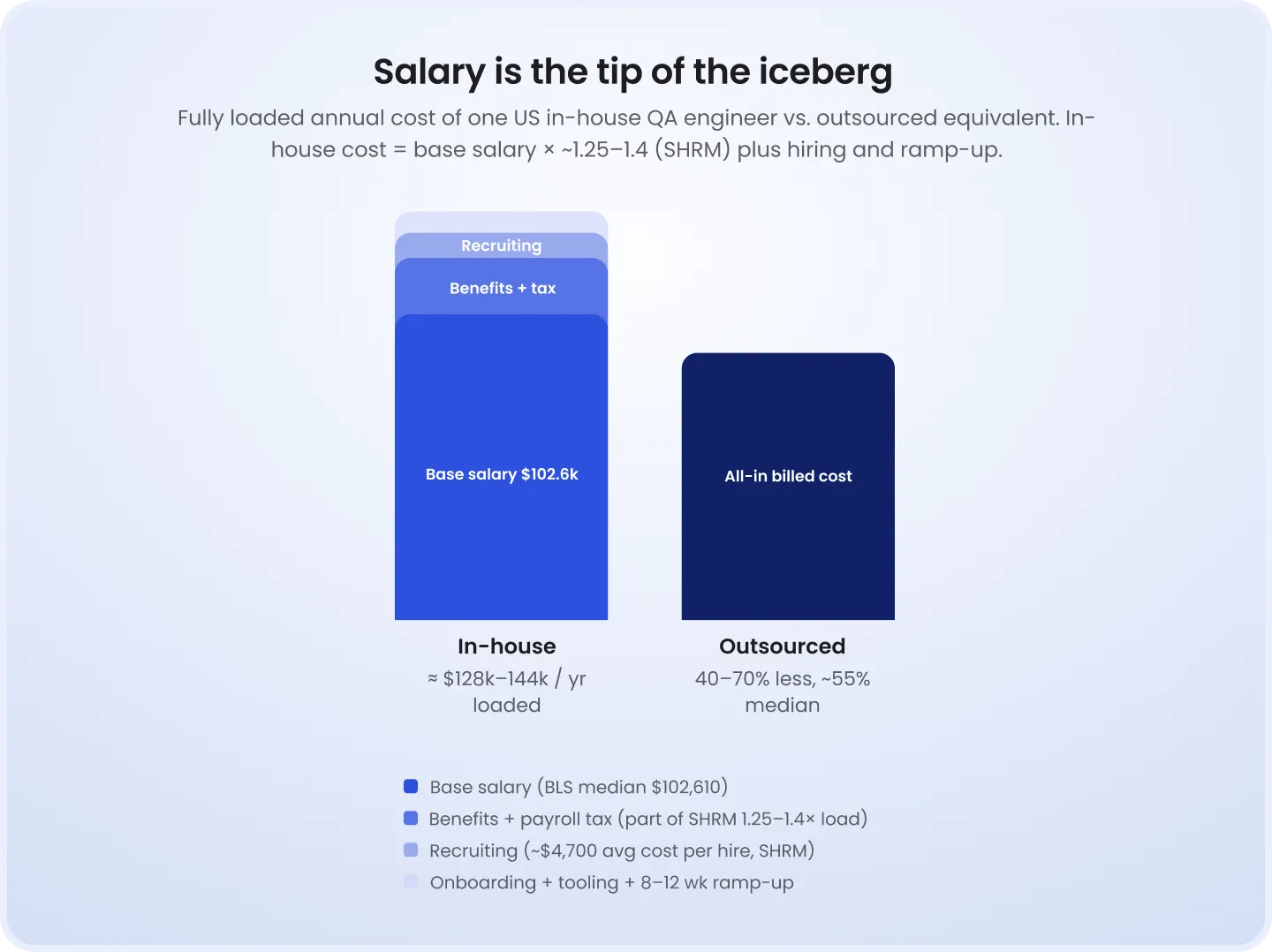
The widely used benchmark, attributed to SHRM, is that the fully loaded cost of an employee is 1.25 to 1.4 times base salary [17], covering payroll taxes and benefits. On top of that recurring load sit one-time and hidden costs: the average cost per hire is about $4,700 (SHRM, via Vena) [18], health insurance averages $8,435 for single coverage (Kaiser Family Foundation, via Valuefy) [19], and new hires take 8–12 weeks to reach full productivity [20].
Put concretely: a US QA engineer at the BLS median of ~$102,610 [1] base actually costs the business roughly $128,000–$144,000/year fully loaded — before counting weeks of ramp-up and tooling licenses. Against that, published data consistently puts realistic all-in savings from outsourced QA at 40–70%, with a median around 55% (SoftwareTestPilot, 2026) [9].
The honest caveat: the lowest hourly rate rarely represents the best value. Rate compression across offshore regions in 2026 benefits buyers, but total cost of ownership — onboarding time, communication overhead, and the automation maturity of the vendor — matters far more than the sticker rate.
Methodology & Data Sources
Figures in this report reflect publicly available salary and rate data from 2024–2026. Full-time salary benchmarks are drawn primarily from the U.S. Bureau of Labor Statistics [1] (OEWS, SOC 15-1253, May 2024), Glassdoor, Zippia, ERI SalaryExpert, and Indeed. Outsourcing billed-rate ranges are drawn from published 2026 vendor and industry guides, including data attributed to Accelerance [14]. Fully-loaded employment-cost figures come from SHRM [17] and the Kaiser Family Foundation [19].
Three limitations are worth stating plainly. First, salary data and outsourcing billed rates are different units — the former is take-home compensation, the latter includes vendor overhead and margin — and we have labeled which is which rather than blending them. Second, aggregators disagree, sometimes substantially, because their samples differ; where sources cluster we report the cluster. Actual project rates vary by scope, stack, seniority mix, and vendor.
FAQ
Get an accurate QA quote for your project
Sources
- 1.
U.S. Bureau of Labor Statistics — Occupational Outlook Handbook, Software Developers, QA Analysts, and Testers (SOC 15-1253), May 2024. https://www.bls.gov/ooh/computer-and-information-technology/software-developers.htm
- 2.
Glassdoor — QA Manual Tester Salary, 2026. https://www.glassdoor.com/Salaries/qa-manual-tester-salary-SRCH_KO0,16.htm
- 3.
Glassdoor — Manual Tester Salary, 2026. https://www.glassdoor.com/Salaries/manual-tester-salary-SRCH_KO0,13.htm
- 4.
Glassdoor — QA Automation Engineer Salary, 2026. https://www.glassdoor.com/Salaries/qa-automation-engineer-salary-SRCH_KO0,22.htm
- 5.
Zippia — Performance Test Engineer Salary, 2025. https://www.zippia.com/salaries/performance-test-engineer/
- 6.
Glassdoor — Performance Testing Engineer Salary, 2026. https://www.glassdoor.com/Salaries/performance-testing-engineer-salary-SRCH_KO0,28.htm
- 7.
Indeed — Penetration Tester Salary, 2026. https://www.indeed.com/career/penetration-tester/salaries
- 8.
Glassdoor — Penetration Tester Salary, 2026. https://www.glassdoor.com/Salaries/penetration-tester-salary-SRCH_KO0,18.htm
- 9.
SoftwareTestPilot — QA Outsourcing 2026 Pillar Guide (regional billed rates; savings figures), July 2026. https://softwaretestpilot.com/blog/career-interview-prep/qa-outsourcing
- 10.
ERI SalaryExpert — QA Engineer Salary, Germany, 2025. https://www.salaryexpert.com/salary/job/qa-engineer/germany
- 11.
ERI SalaryExpert — QA Engineer Salary, Ukraine, 2026. https://www.salaryexpert.com/salary/job/qa-engineer/ukraine
- 12.
ERI SalaryExpert — Software QA Tester Salary, Brazil, 2025. https://www.salaryexpert.com/salary/job/software-qa-tester/brazil
- 13.
Vervali — QA Outsourcing Guide 2026 (Accelerance rate-decline data), March 2026. https://www.vervali.com/blog/qa-outsourcing-guide-2026-how-to-choose-the-right-software-testing-partner/
- 14.
KoreBPO — Best QA Outsourcing Companies (India/Philippines rates), 2026. https://korebpo.com/best-qa-outsourcing-companies/
- 15.
KiwiQA — QA Outsourcing Models Guide (offshore manual rate floor), 2025. https://www.kiwiqa.io/qa-outsourcing-models-guide/
- 16.
SHRM (via ERI/vendor directory) — True Cost of an Employee, 1.25–1.4× multiplier, 2025. https://vendordirectory.shrm.org/company/293514/news/3616622/how-to-determine-the-true-cost-of-an-employee
- 17.
Vena Solutions — How Much Does an Employee Cost (SHRM cost-per-hire), 2026. https://www.venasolutions.com/blog/how-much-does-an-employee-cost
- 18.
Valuefy — Employee Cost Calculator (Kaiser Family Foundation health-insurance figure), 2026. https://valuefy.app/tools/employee-cost-calculator/
- 19.
WowRemoteTeams — Fully Loaded Cost of Hiring (ramp-up productivity), 2025. https://wowremoteteams.com/blog/what-is-the-fully-loaded-cost-of-hiring-a-new-employee/
- 20.
KORE1 — QA Engineer Salary Guide 2026 (automation premium, $20K–40K). https://www.kore1.com/qa-engineer-salary-guide/