Hire AI QA engineers
AI QA engineers for model evaluation, application testing, and regression coverage.
Schedule a call1. What's driving the need for QA people right now?
Trusted by






Why hire AI QA engineers from DeviQA?
DeviQA engineers combine model output evaluation with API, integration, and end-to-end testing. They define acceptance criteria, check responses against representative user requests, and trace failures through the application workflow so your team can prioritize fixes before release.
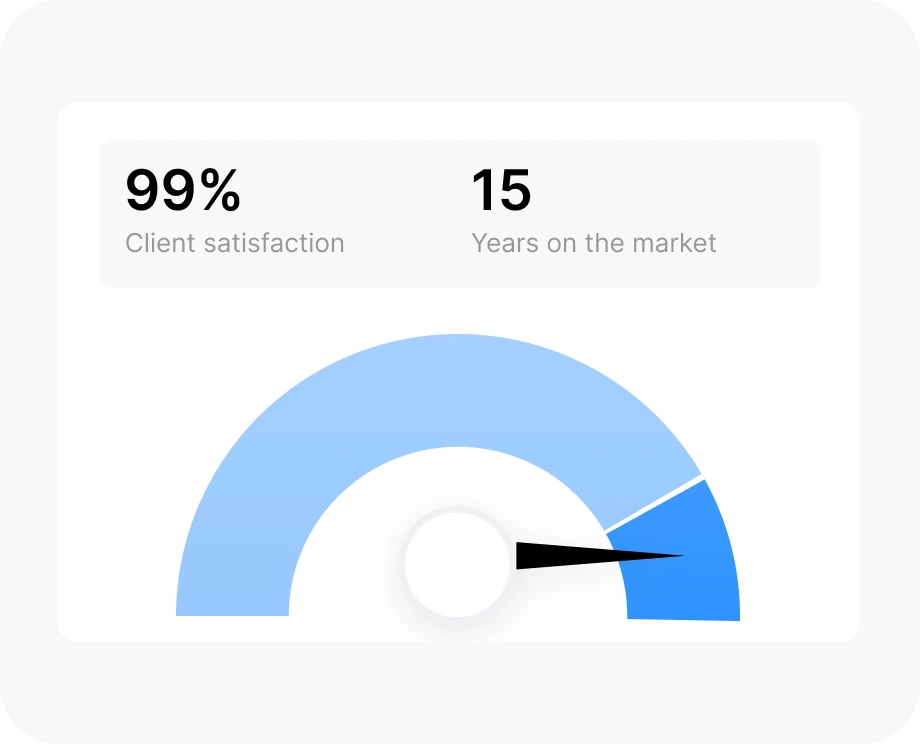
DeviQA assigns only middle and senior QA engineers to client projects.
Test leads have 8–12 years of experience managing QA teams, processes, and delivery.
DeviQA QA engineers have an average of six years of software testing experience.
All DeviQA QA engineers hold ISTQB Foundation Level certification.
Clients own all test cases, automation code, documentation, and other project IP created from the first day.
Rates, team costs, and invoicing terms are defined before the engagement begins.
Choose staff augmentation, a dedicated QA team, project-based delivery, or managed testing.
Written and spoken English proficiency is verified before an engineer joins the project.
14
DeviQA QA engineers work across 14 locations.
3+
Average employee tenure exceeds three years.
4.4%
DeviQA’s employee turnover rate is 4.4%, equivalent to approximately 96% employee retention.
3-7
Typical client projects last between three and seven years.
DeviQA’s AI QA competencies
you can rely on
DeviQA engineers evaluate model outputs, test API and application logic, validate data flows and integrations, and build regression tests for critical AI workflows.
Core responsibilities
Define acceptance criteria for AI outputs and user workflows
Build evaluation datasets with representative inputs and known failure cases
Test correctness, completeness, groundedness, and instruction adherence
Validate retrieval, citations, and missing-information handling
Test tool calls, permissions, approvals, and resulting system changes
Maintain regression coverage across model, prompt, and application updates
Investigate failures and document evidence for developers
Establish quality gates and release-readiness reports
Engineering capabilities
Python and TypeScript test automation
API, integration, and end-to-end testing
Automated evaluation runners and output validators
Repeat-run testing for variable model behavior
CI/CD integration and test artifact tracking
Load, latency, and failure-recovery testing
Log and trace analysis across AI workflows
Controlled adversarial testing for prompt injection and data exposure

DeviQA’s AI advantage
At DeviQA, we use AI to make testing smarter and simpler. Our ecosystem is built to deliver faster, smarter, and more cost-efficient results — so your team can do more in less time.
DeviQA AI ecosystem

AI-powered IDE assistant
Reduces test script writing time

QA companion
Provides suggestions for test optimization and addresses gaps

Automated code review
Flags unused variables, improper loops, and other common errors

AI for API testing in Postman
Streamlines API test case creation and response validation
Features
Test case creation
Code review
Exploratory planning
Log analysis
without AI
6 hrs
3 hrs
2 hrs
2 hrs

with DeviQA AI
4 hrs (33% saved)
2 hrs (33% saved)
45 min (60% saved)
1 hr (50% saved)


Hire AI test engineers to check the answer, the action, and the complete user workflow
Choose how to hire AI QA engineers from DeviQA
Dedicated QA team
A team focused on quality across your AI application. Engineers maintain evaluation datasets, automate regression checks, test integrations, and assess releases as your product evolves.
Best for:
Long-term ownership of AI testing
Establishing an evaluation process from scratch
Covering multiple models, integrations, and user workflows
QA staff augmentation
Add individual AI testing engineers to your existing team. They work within your process and address specific gaps in evaluation, automation, or release testing.
Best for:
Adding expertise in RAG, agents, or model evaluation
Extending existing automation with AI-specific checks
Supporting a defined release or testing initiative

Abbott Laboratories is a global healthcare giant

90%
Test coverage
1.6k+
Test cases created
X18
Faster regression testing run


Compass is the first modern real estate platform
85%
Test coverage
2k+
Test cases created
2.5x
Faster regression testing run

Arklign is a dental practice platform
95%
Test coverage
5k+
Test cases created
3k+
Number of critical bugs logged
Tipalti is a payment automation platform

12
Years of cooperation
100%
Covered performance
2x
Faster regression testing time


Xola is a booking system for tours and attractions

90%
Test coverage
3.2k+
Automation test scripts created
1-2h
Time of regression
How to hire AI QA engineers from DeviQA
Define the testing scope, meet suitable engineers, and establish ownership of the work.
Share your goals
Explain your application, architecture, known quality issues, and release requirements. Include examples of successful and failed outputs where available.
Choose the cooperation model
Select individual engineers to strengthen your team or a dedicated QA team to own a broader testing scope.
Interview and approve your AI QA engineers
Meet shortlisted candidates and discuss their approach to your specific evaluation and automation challenges.
Start working together
Your engineers join your workflow, review existing coverage, and agree on priorities, deliverables, and reporting.
Sample profiles of our AI QA engineers

Ivan
Senior AI QA Engineer
7+ years of QA experience
Tests AI-powered applications across model outputs, APIs, and user workflows. Builds evaluation datasets, automates regression checks, and investigates failures in retrieval and generation.
SENIOR AI QA ENGINEER
Built evaluation datasets for a knowledge assistant, covering answer correctness, source attribution, and handling of insufficient evidence;
Developed automated checks for structured outputs, required fields, and API responses using Python and pytest;
Tested retrieval and generation separately to distinguish missing source information from unsupported model claims;
Validated document permissions and checked that restricted content remained inaccessible through search and generated answers;
Compared prompt and model versions against a shared regression suite, documenting improvements and unresolved failures.
QA AUTOMATION ENGINEER
Developed API and end-to-end tests for document submission, background processing, and result review workflows;
Integrated regression suites into CI pipelines, attaching logs and test artifacts to failed runs;
Tested timeouts, retries, and interrupted requests to verify recovery without duplicate processing;
Created reusable fixtures and controlled test data for repeatable integration tests.
QA ENGINEER
Tested onboarding, account management, and document workflows across web applications;
Validated API responses and database records to investigate inconsistent application behavior;
Used exploratory testing to identify missing validation and unclear recovery paths;
Worked with developers and product managers to define acceptance criteria and reproduce defects.
B.S. in Computer Science
ISTQB Certified Tester Foundation Level
Training in Python test automation and machine learning evaluation
Programming languages:
Python, TypeScript, SQL
Automation frameworks:
pytest, Playwright
API testing:
Postman, REST APIs, OpenAPI
AI evaluation:
Dataset-based test runners, scoring rubrics, JSON Schema validation
CI/CD tools:
GitHub Actions, GitLab CI, Docker
Monitoring & reporting:
Grafana, Kibana, application logs and request traces
Test management:
TestRail, Jira, Confluence
Databases:
PostgreSQL, MongoDB
AI output evaluation
RAG and citation testing
API and end-to-end automation
Evaluation dataset design
Permission and negative testing
Regression analysis across model and prompt versions
Defect investigation and reproducible reporting

Oleksii
Lead AI QA Engineer
10+ years of QA experience
Defines test strategy for AI-enabled products and coordinates evaluation across engineering, product, and domain teams. Establishes release criteria, reviews coverage, and mentors engineers in AI testing and automation.
LEAD AI QA ENGINEER
Defined an AI testing strategy covering generated outputs, retrieval, tool execution, and application workflows;
Established scoring rubrics with domain reviewers and investigated disagreements between automated evaluations and human assessments;
Designed agent test scenarios for tool selection, argument validation, approval requirements, and execution limits;
Introduced release checks combining deterministic assertions with broader model evaluations;
Led failure reviews using retrieved passages, tool results, model configurations, and application traces;
Mentored QA engineers in evaluation design, test isolation, and documenting the limits of test results.
SENIOR QA AUTOMATION ENGINEER
Built API and integration suites for applications with asynchronous processing and external service dependencies;
Designed test environments with controlled service failures to verify timeout, retry, and fallback behavior;
Implemented load tests to measure response latency, error rates, and queue behavior under concurrent requests;
Standardized test data preparation and reporting across development and staging environments.
QA ENGINEER
Tested complex account, billing, and reporting workflows using functional, integration, and exploratory methods;
Validated backend operations through API requests and SQL queries;
Maintained regression suites and prioritized testing around business-critical scenarios;
Collaborated with engineering leads on defect investigation and release-readiness reviews.
M.S. in Software Engineering
ISTQB Certified Tester Foundation Level
Training in test automation architecture, performance testing, and AI evaluation
Programming languages:
Python, TypeScript, SQL
Automation frameworks:
pytest, Playwright, API test frameworks
AI evaluation:
Batch evaluation runners, rubric-based scoring, human-review workflows
Performance tools:
Locust, k6
API & integration testing:
Postman, OpenAPI, service mocks
CI/CD & infrastructure:
Jenkins, GitHub Actions, Docker
Monitoring & reporting:
Grafana, Kibana, OpenTelemetry traces
Test management:
Xray, Jira, Confluence
Databases:
PostgreSQL, Redis, MongoDB
AI test strategy and coverage planning
Evaluation methodology and reviewer calibration
Agent behavior and tool-use testing
Risk-based release assessment
Performance and failure-recovery testing
CI/CD quality gates
Cross-team coordination and QA mentoring
Hire AI testing specialists to turn quality requirements into repeatable release checks