
Written by: Senior QA Engineer
Mykhailo RalduhinPosted: 06.08.2026
15 min read
Healthcare data pipelines are the nervous system of modern care.
They move vital signals between EHRs, devices, labs, and billing systems. When one link fails, it's not a bug, it's a risk to patients, compliance, and revenue.
Whether it's three integrations or thirty, the rule is the same: data must be accurate, timely, and secure.
That's why data pipeline testing isn't optional. It's how healthcare software stays safe and reliable at scale.
Healthcare QA expertise you can build on
A brief outline of healthcare data pipelines
Data pipelines ensure the flow of crucial information across a medical ecosystem. They deliver data from source, EHRs, medical devices, lab systems, and patient apps — to end destinations.
These days, most data pipelines are based on the ETL, i.e., Extract, Transform, Load, process, which defines how data moves from collection to its final use. Here is a quick explanation of how it works:
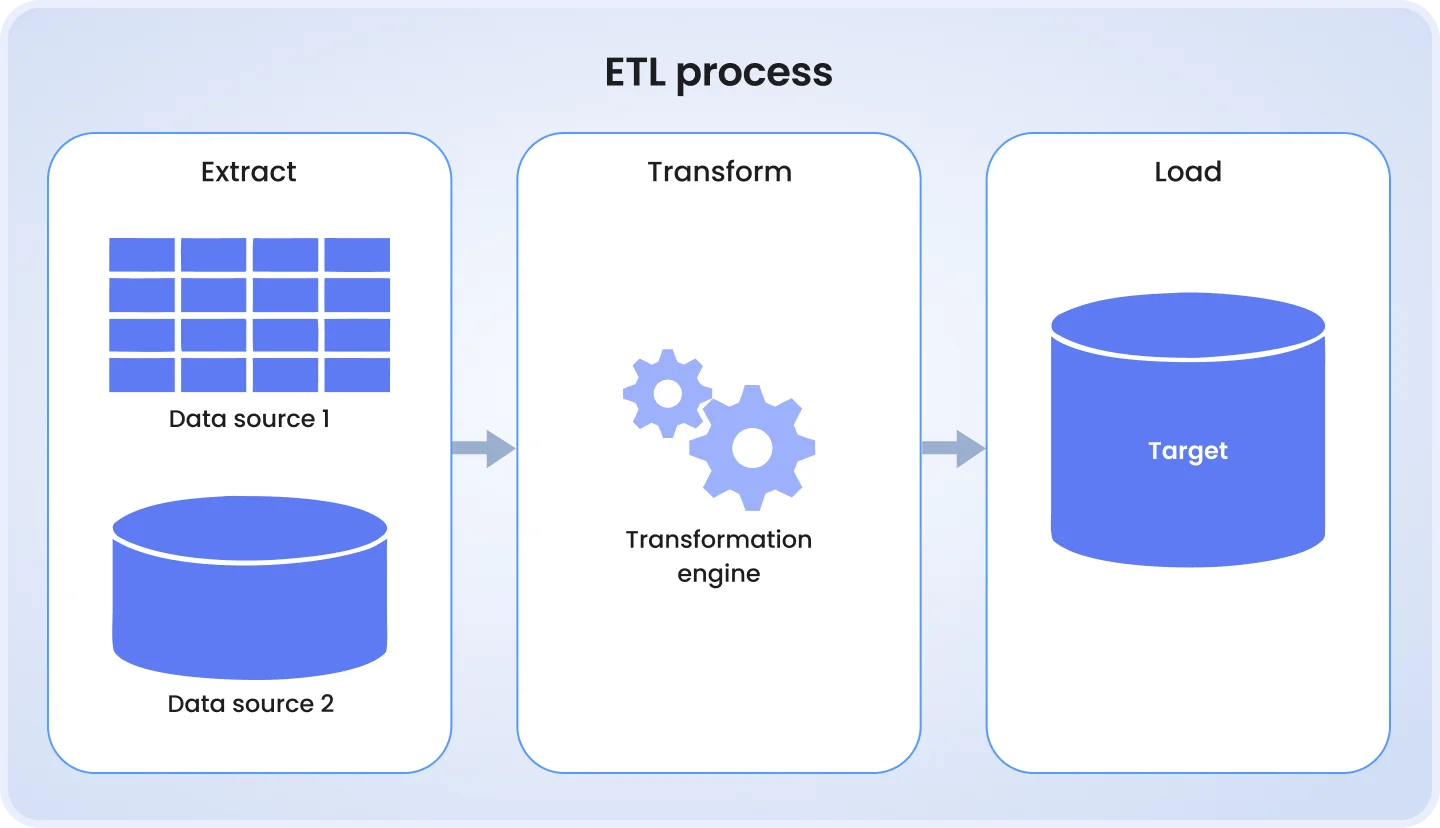
Source: Microsoft Learn
Data extraction
First of all, data is collected from different sources, irrespective of the format, protocol, or structure. This can be:
Patient vitals from monitoring devices
Lab results from pathology and radiology systems
Clinician notes and order entries from EHRs.
Data transformation
Raw data usually doesn't arrive in a standardized format. This is at the transformation stage, where the data from numerous sources is unified, enabling accurate reporting, analytics, and interoperability. Usually, transformation includes the following:
Standardizing clinical codes like ICD‐10 for diagnoses, LOINC for lab tests, SNOMED for clinical concepts, and RxNorm for medications.
Removing duplicates, fixing inconsistencies, and reconciling mismatched records.
Adding context, such as converting timestamps to local time.
In addition to transformation, many healthcare data pipelines also have built-in validation checks for corrupted messages, lacking fields, and mismatched patient IDs. This is super important, as the research shows that nearly 30% of medical errors happen because of inaccurate or poor data.
Data loading
At the last stage, the pipeline loads transformed and validated data into a final destination. For example, this can be:
Warehouses for long-term data storage.
Analytics platforms for predictive modeling, dashboards, or decision support.
Clinical systems for real-time alerts and care coordination.
Based on system requirements, ETL pipelines can operate in batch, streaming, or hybrid modes.
Batch ETL handles large, scheduled data sets with higher latency. It's valuable for historical analysis and large-scale reporting.
Streaming ETL offers real-time or near real-time processing and low latency. It works well for ICU dashboards, remote patient monitoring, and clinical alerting. In fact, in 2024, the healthcare domain reported over 9,400 installations of real-time solutions for patient monitoring and clinical alerting. This helped identify critical conditions with under 2-second data latency, impacting care outcomes.
The hybrid model balances timeliness with reliability, due to which it's the most prevalent setup in the healthcare domain.
An understanding of the data pipeline structure is the prerequisite for efficient testing. With profound knowledge about sources, transformations, validations, and endpoints, QA teams can spot weaknesses and adjust their testing accordingly.
Testing data pipelines at different levels
Healthcare app testing implies executing tests at three different levels. This works for both functionality and pipelines. Each level has a different scope and helps detect issues of various types. Therefore, it's needed to carry out testing on all of them to identify and remove all possible risks as early as possible.
Unit level
Here is a piece of wisdom: It's important to test all pipeline parts before they are combined. Each component, be it an ingestion API, transformation function, or validation script, should be checked in isolation to ensure that it works exactly as needed.
In the context of data pipelines, unit tests often focus on transformation logic, implemented in SQL, dbt, or Scala. While developers typically write these unit tests, QA teams can also contribute by adding assertions in dbt or creating automated checks with the help of tools like Great Expectations.
Spotting problems at this level doesn't allow them to turn into more serious and harder-to-fix issues. For example, a unit test may check that the function handling readings from a wearable heart rate monitor correctly converts the incoming values into the proper numerical format before they move further through the pipeline.
Integration level
Even if all pipeline components work adequately in isolation, it doesn't mean that you can be confident in the smooth operation when they are combined. Integration testing is carried out to ensure that multiple systems work together and that data remains accurate across the pipeline. It focuses on data flowing between APIs, file transfers, HL7/FHIR messaging, and streaming pipelines.
If we go back to the wearable heart rate monitor, integration testing can confirm that its readings make it to the clinician's dashboard without getting lost or messed up along the way. On this level, QA teams also check for duplicate records, protocol compliance, and proper error handling.
System level
Looking at the data pipeline as a whole is also useful and even essential. System or end-to-end testing simulates real-world scenarios to make sure data moves from start to end point correctly, on time, and in full volume.
For our wearable heart rate monitor, system-level testing would check how readings are ingested, transformed, stored in the EHR, reflected on clinician dashboards, and trigger alerts for abnormal heart rates.
By testing data pipelines at all of these levels, QA teams can see nuances and the big picture needed to ensure high quality.
Healthcare QA partner you can count on
Comprehensive data pipeline test strategy
Thorough planning is an essential component of healthcare application testing. That way, teams can be sure that every detail is considered. Therefore, before getting started testing data pipelines, you also need to have a comprehensive plan that covers every stage of the pipeline, involves all stakeholders, and ensures regulatory compliance.
Loaded with years of experience, the DeviQA team usually leverages the following strategy that you can implement as well.
1. Pipeline mapping
Outlining every component of your data pipeline is the first step. It helps you know exactly where your data comes from and where it goes, ensuring clear data lineage and traceability, which is so important for regulators.
Define:
Data sources (e.g., EHRs, medical devices, lab systems, billing platforms, patient apps)
Transformation stages (e.g., cleaning, normalization, mapping to standard codes, aggregation, and validation)
Destinations (e.g., data warehouses, analytics dashboards, clinical decision support tools).
Also, it makes sense to clarify who owns each part of the process. Developers, QA engineers, clinicians, compliance officers, and data analysts play their roles in ensuring the smooth work of the data pipeline. Early involvement of all stakeholders lets everyone clearly understand responsibilities and reveals blind spots.
2. Regulatory requirement definition
What really makes healthcare data pipelines special is the kind of data they handle. They deal with protected health information (PHI) that is confidential and highly regulated.
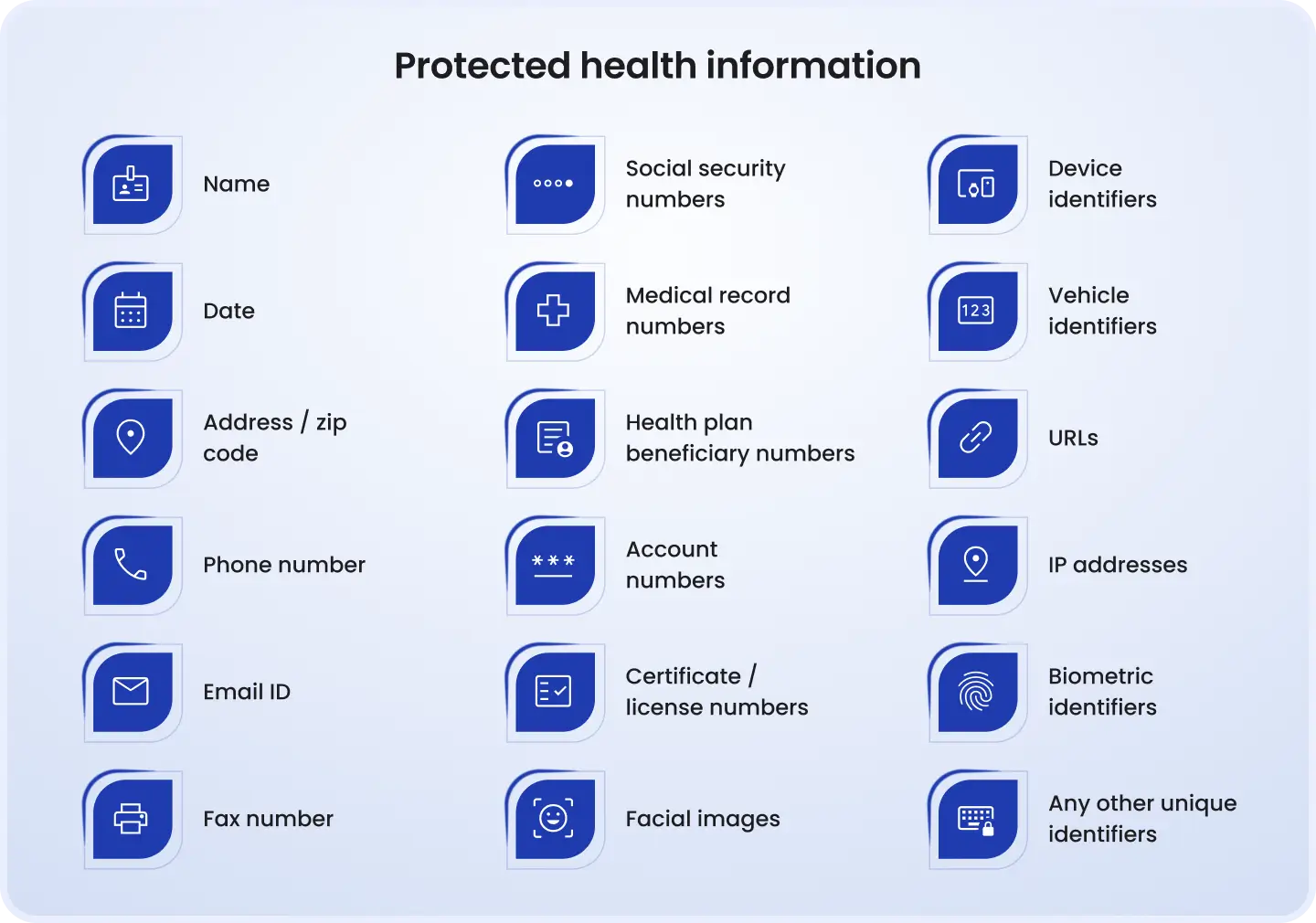
Source: Databrackets
To avoid any compliance troubles, define all applicable standards in advance. These may include:
HIPAA for patient privacy and data security in the U.S.
FDA 21 CFR Part 11 for electronic records and signatures in systems subject to FDA oversight.
GDPR for handling patient data of EU citizens.
UK GDPR and the Data Protection Act 2018 for managing health data within the United Kingdom.
PIPEDA for protecting patient information in Canada.
After that, turn applied regulations into testable compliance criteria. For example:
Data encryption in transit and at rest.
Role-based access controls and authentication.
Audit trails for every data transformation or access event.
Data retention and deletion policies.
Data protection and compliance with regulatory requirements are crucial in healthcare. According to the OCR breach portal, 725 healthcare data breaches were reported in 2024, which is the third year in a row with over 700 major incidents. So, take security and compliance really seriously.
3. Risk evaluation
As you might guess, some data flows are more critical than others. You need to analyze them and conduct a risk assessment:
Identify flows that have a huge impact on patient safety, for example, those that deliver lab results, vital signs, or medication data.
Pay attention to compliance- and finance-related flows — let's say insurance claims, billing, or audit logs that fall under HIPAA oversight.
Consider complexity and volume, as highly sophisticated integrations or large-scale streaming data usually carry a higher risk.
Knowledge of where the risks are can help you draft an appropriate testing strategy with a focus on the parts of the pipeline that require your particular attention.
4. Test plan and coverage matrix design
Different types of testing help catch various issues, so a proper mixture of tests ensures better effectiveness. Consider including:
Data quality checks
Data precision and completeness must be confirmed at every stage. Pay particular attention to schema integrity, data type alignment, and adherence to clinical coding standards.
Transformation validations
It's necessary to ensure the correct application of business logic in ETL processes. Testing of unit conversions, calculations, aggregations, and de-identification logic is the best way to confirm that transformed data still makes sense clinically and isn't messed up.
Integration checks
Your test strategy should also include checks of how connected components — APIs, EHRs, HL7/FHIR interfaces, laboratory systems, analytics platforms, etc — communicate. Message integrity, mapping accuracy, and error-handling mechanisms must also be tested to ensure data travels seamlessly across the pipeline.
End-to-end tests
To check that the whole pipeline works reliably and in alignment with clinical expectations, run full workflow tests based on real-world scenarios. Include data reconciliation checks, comparing row counts, sums, or hashes between source and target, to verify that nothing is lost or manipulated during processing. Also, confirm that clinical logic is correct and ensure data flows trigger downstream processes.
Performance tests
When it comes to healthcare, every second counts. Measure speed and responsiveness to understand if your pipeline can address huge volumes of real-time data. Let's say you can simulate peak loads from connected monitoring devices and check if alerts reach clinicians within defined time frames.
Security and compliance testing
Both security and compliance are paramount. Proper patient data protection can be assured by testing encryption, access controls, and regulatory compliance. Pen testing and vulnerability scans on APIs, storage, and integration endpoints can also be run where appropriate.
In addition, it makes sense to create a coverage matrix. It can optimize testing, enabling you to see which risks and requirements are covered by which tests. Besides, the matrix provides transparent reporting, showing auditors, regulators, or internal team members that your data pipeline has been properly tested.
5. Test data creation
The efficiency of your testing depends upon the quality of your testing data. That's why you need to cautiously prepare data for testing healthcare applications.
Create synthetic data to guarantee privacy and full compliance with HIPAA or GDPR requirements. According to a 2025 review in the International Journal of Medical Informatics, one of the five key drivers for harnessing synthetic data in healthcare is addressing privacy concerns and data scarcity. You can also anonymize real patient data, but note that de-identification isn't the same thing. Under HIPAA, data can be de-identified through Safe Harbor, which removes a set list of identifiers, or Expert Determination, where a specialist ensures the low possibility of identifying individuals.
Include edge cases, abnormal ranges, and missing values to cover all possible real-world data scenarios.
Make sure your test data stays accurate and consistent across all environments so you don't run into environment-specific issues and can easily reproduce your results.
Introduce clear data refreshing and versioning, using DVC, LakeFS, or other solutions. This simplifies tracking changes in validation results over time. Also, it supports regression testing.
6. Implementation, review, and improvement
Rolling out your plan isn't the finish line but the beginning of a continuous improvement.
Run your tests, monitoring every stage of testing. By tracking test coverage, failure rates, and other metrics, you can more quickly recognize weaknesses and vulnerabilities. Advanced monitoring systems can be of great help here, spotting data drift, latency spikes, and unexpected schema changes that can influence downstream systems or analytics accuracy.
Also, carefully analyze test outcomes and align them with recent changes. In healthcare, things change really quickly — new compliance requirements, evolving clinical workflows, and emerging interoperability standards require regular reassessment.
Last but not least: refine your tests based on lessons learned from test findings and incidents. Ongoing review and fine-tuning help keep your data pipelines in shape.
Leading data pipeline testing tools
To test your healthcare data pipelines in the right way, you need to have a mix of tools. Moreover, those tools must operate within a HIPAA-compliant infrastructure, whether it's AWS HealthLake, Azure Health Data Services, or an on-prem environment with strict access controls and encryption. The goal is to create a reliable and compliant testing ecosystem.
Take a look at the top tools used for testing data pipelines in healthcare:
Data quality testing tools
Great Expectations checks data quality using automated 'expectations' for schema, range, etc. It's suitable for ETL pipelines and healthcare analytics platforms.
Soda Core / Soda Cloud monitors data quality and integrates with data warehouses and streaming systems.
Telmai is a no-code platform for anomaly detection and drift monitoring in healthcare data pipelines.
Deequ (by AWS) is a lib that helps with defining data quality metrics and running automated validations on large datasets in Spark environments.
ETL and transformation testing tools
QuerySurge automates source-to-target ETL testing and data warehouse validation. It also supports healthcare data formats and large-scale testing.
dbt (Data Build Tool) enables modular testing of SQL transformations. It's particularly useful for testing logic in data warehouses or analytics layers.
Datafold is leveraged for catching data quality regressions introduced by changes in transformation code.
Integration and workflow orchestration testing tools
Apache Airflow checks DAGs and dependencies between tasks in a pipeline and can run data validation tests as part of the workflow.
Prefect tracks and tests data flow orchestration in hybrid and cloud setups.
Dagster has built-in asset checks that verify correctness across data dependencies.
End-to-end testing tools
The combination of Great Expectations and Airflow/Prefect works well for automated end-to-end checks.
DataKitchen manages continuous testing across multiple pipeline environments.
Monitoring and observability tools
Datadog monitors the performance and latency of data jobs and APIs.
Prometheus, in combination with Grafana, visualizes metrics from ETL pipelines or integration layers.
Monte Carlo / Telmai spots and alerts on data quality incidents. Moreover, it provides automated root-cause analysis.
CI/CD and orchestration tools
GitHub Actions, Jenkins, and GitLab CI/CD automate the testing pipeline, collect results, and trigger alerts on failures, ensuring that every change is tested before deployment.
Cloud-native orchestration services like AWS Step Functions, Azure Data Factory, and GCP Cloud Composer manage workflow execution, monitor pipeline health, and integrate tests at each stage of ETL.
Best practices for testing data pipelines
At DeviQA, we worked on a lot of healthcare projects, and in each of them, data pipelines were the center of attention. This let us define the best practices, which we are delighted to share with you.
Promote a culture of quality
We risk sounding trite, but real quality is a mindset. Encourage every team member, from developers to clinicians, to take ownership of data quality. Celebrate catching issues early before a false heart rate reading reaches a clinician's dashboard to learn the hard way.
Make ongoing improvements
Data pipeline testing requires continuous improvement. You need to regularly review test coverage, update test documentation, refine strategies, and optimize monitoring. This approach ensures the relevancy of each pipeline test and the reliability, resilience, and readiness of your pipeline for any unexpected or difficult situations.
Learn from real-world incidents
The production environment is the best teacher for a QA engineer. Analyze incidents, near misses, and audit findings, and adjust test suites accordingly. Across all DeviQA case studies, the success came from careful planning combined with ongoing learning and continuous refinement. Our best advice to you is to analyze test results and real-world incidents and refine your testing with each iteration.
Invest in your team
Even the most cutting-edge AI-powered automation tool is useless without a team of skilled QA engineers. Automation is helpful, but it cannot replace human expertise. Well-trained testers are still your strongest line of defense when you test pipeline. Therefore, foster regular training so that your QA specialists stay sharp and fully understand technical advancements, clinical workflows, and compliance standards.
Conclusion
In healthcare, data is life.
It guides decisions, protects patients, satisfies regulators, and keeps the business running. When data pipelines fail, the consequences are immediate and real.
The only way to prevent that is to test everything, how data is extracted, transformed, moved, and delivered, without shortcuts.
If you want data you can trust, our healthcare software testing services are built for that. We help teams create data pipelines that are accurate, secure, and dependable at scale.
Book a strategic QA consultation
About the author
Senior QA engineer
Mykhailo Ralduhin is a Senior QA Engineer at DeviQA, specializing in building stable, well-structured testing processes for complex software products.