
Written by: Senior QA Engineer
Mykhailo RalduhinPosted: 10.09.2026
18 min read
As a license gives a doctor the right to practice, regulatory compliance opens the door to the market for healthcare solutions. No approval — no entry. And it isn't bureaucracy but a matter of patient safety, business viability, and trust. Compliance minimizes the risk that your product will harm, leak, or mislead. Failure to adhere to applied regulations exposes healthcare development companies to financial, legal, and reputational risks.
Serving as a safety measure and market getaway, regulatory compliance is a key requirement in healthcare software development. Yet, ensuring compliance with numerous international standards, local laws, and industry specifications that actually evolve is a tough mission. Data privacy, patient safety, quality, interoperability, ethics — there is a long list of aspects regulated in healthcare. A recent survey among U.S.-based health systems, pharma firms, biotech companies, and medical device manufacturers shows that for only 4% of respondents, compliance and risk issues were not a concern.
While maintaining compliance with regulations is really challenging, it's much easier if you have a proper QA process in place. Read on and judge for yourself.
Healthcare QA expertise you can build on
The healthcare regulatory maze isn't for wimps
The key problem with healthcare compliance is that it isn't regulated by a single body or a single lawbook. Depending on the product type, risk level, used technologies, and targeted markets, software may be subject to different regulators and standards. For healthcare teams, this means dealing with a messy ecosystem where multiple rules and requirements overlap and contradict. Add to this endless paperwork.
Once you think you've sorted it out, a new rule pops up. A new cyber threat emerges? Expect a new revision. A medical scandal hits the news? Be ready for tighter oversight. As a result, staying compliant isn't a one-time but ongoing work that demands constant attention and adaptation.
To help you make sense of this chaos, let's first look at the major regulations that cover everything from data privacy to AI use in medicine.
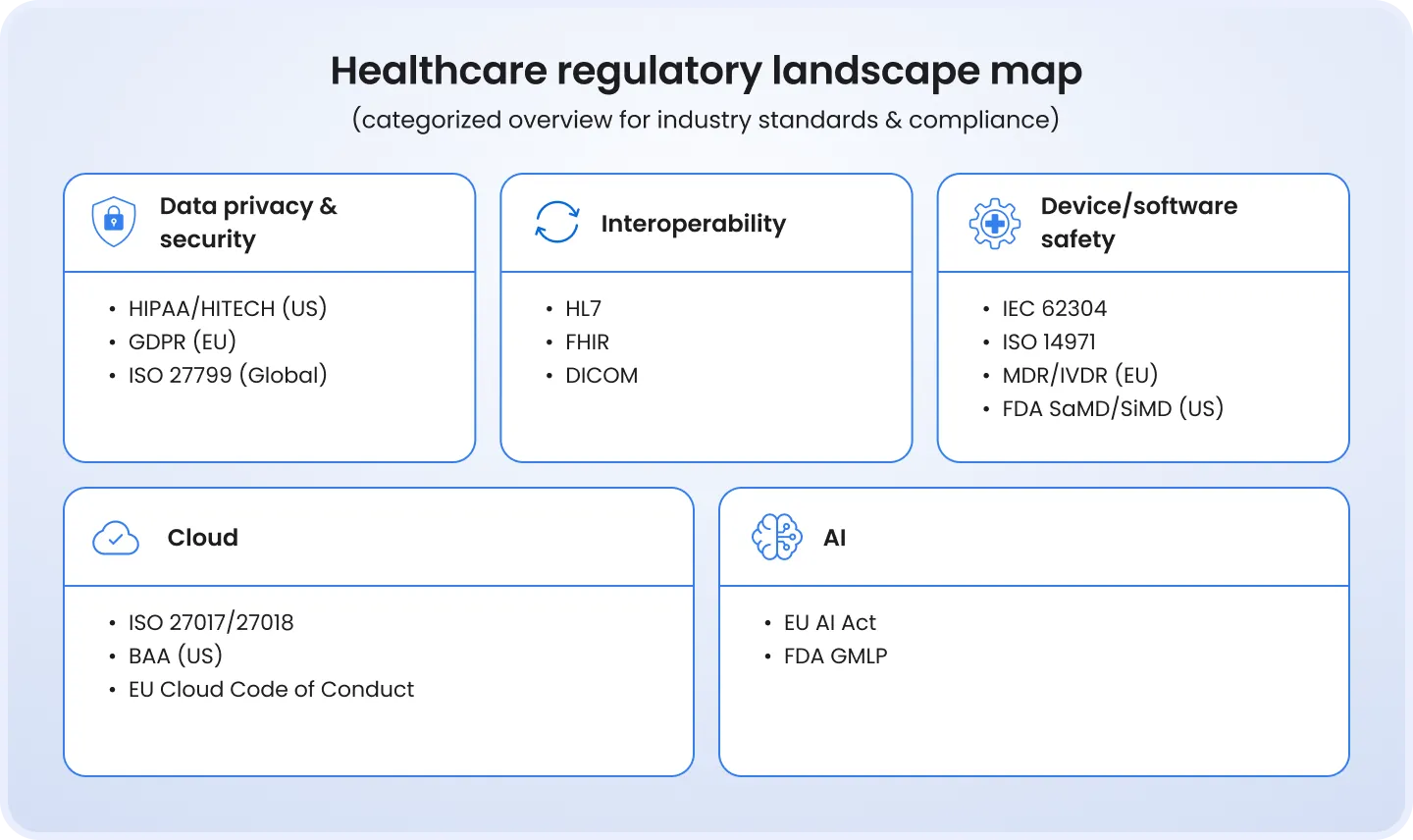
Data privacy and security regulation
Patient health data is the most sensitive data imaginable. Moreover, it's one of the most expensive. According to industry research, on the dark web, a single medical record costs $250–1,000, whereas the price of a stolen credit card rarely exceeds $5. So, it's not surprising that privacy and security laws hit harder in healthcare than in any other domain.
In the United States, the well-known HIPAA (Health Insurance Portability and Accountability Act) has been guarding patient data since the 1990s. It demands absolute control over who can access patient information, how it's stored, and how it's transmitted. The HITECH Act later strengthened these protections, introducing heavy penalties for unreported leaks.
Across the Atlantic, in the EU, the GDPR is on duty. It turns the dial to maximum, giving patients a say in every step of how their data is used, from explicit consent forms to the right to have their records deleted. A single privacy slip-up here can cost companies millions.
On a global level, ISO 27799 (Health Informatics Security), built upon the broader ISO 27001, provides guidelines for implementing security measures to protect health information within IT systems, covering everything from risk management and security policies to physical facility security and encryption standards.
Interoperability and data exchange standards
Across the globe, English serves as a language of international communication, connecting people with different native languages. Seemingly, a uniform language, i.e., a data exchange standard, is needed to enable interoperability and smooth communication between different healthcare solutions.
HL7 and its modern descendant, FHIR (Fast Healthcare Interoperability Resources), are 'English' for digital healthcare systems.
HL7 v2 messaging standards are among the most adopted healthcare data exchange standards globally. It's commonly used for exchanging lab results, prescriptions with pharmacy systems, and other clinical data.
FHIR, in turn, is an API-based standard designed to facilitate interoperability in a variety of healthcare settings, including mobile health apps, wearables, and EHRs. FHIR is gaining traction thanks to its flexibility and ease of implementation. According to the 2025 State of FHIR® Survey Results, 73% of respondents said FHIR is either mandated or is being advised in their country's most important regulation that prescribes the use of standards in electronic health data exchange.
It's also worth mentioning DICOM, which stands for Digital Imaging and Communications in Medicine — the core standard for medical imaging software. This is an international standard for storing, transmitting, and managing medical images and essential metadata. It fosters interoperability and standardization in medical imaging by defining common formats and communication protocols, providing a foundation for X-rays, CT scans, and MRIs from different manufacturers to work together, although full compatibility in practice may require additional IHE profiles.
Medical device and software safety regulations
Taking into account the risks, every aspect of medical device manufacturing and medical software development is strictly regulated.
The IEC 62304 — The Medical Software Lifecycle Standard — defines requirements for the medical software development lifecycle, covering key processes, activities, and tasks from initial planning through maintenance. It serves as the industry's operations manual, helping to ensure safety and efficiency.
ISO 14971 sets out a process for risk identification, analysis, and management when it comes to producing medical devices, including software. With its help, teams identify potential hazards and implement efficient risk mitigation strategies. While ISO 14971 is mandatory under the EU Medical Device Regulation, in the USA, it isn't legally compulsory, though it is widely recognized and referenced.
The Medical Device Regulation (MDR) and In Vitro Diagnostic Regulation (IVDR) are the pillars of medical device software compliance in Europe.
MDR covers any product that diagnoses, prevents, monitors, or treats a medical condition, be it a surgical tool or an AI-based diagnostic platform. It classifies devices based on risk (Class I–III), outlines testing and documentation for each class, and defines post-market surveillance.
IVDR, in turn, governs in vitro diagnostic devices — tools and software that analyze samples of blood, tissue, saliva, etc. It raised the bar for evidence by demanding that manufacturers show scientific validity, analytical performance, and clinical performance before getting the CE mark.
The Food and Drug Administration (FDA) plays a similar role in the U.S. For software, there are two main categories:
Software as a Medical Device (SaMD) is defined as software that performs medical functions without being part of a hardware device (e.g., an app for ECG signal analysis).
Software in a Medical Device (SiMD) is software that operates within a medical device (e.g., firmware in an insulin pump).
Every FDA submission requires a trail of design controls, risk management records, verification and validation reports, and traceability documentation detailed in 21 CFR Part 820 (Quality System Regulation).
Cloud-specific regulations
Healthcare data is quickly moving to the cloud, but clouds aren't naturally compliant — they have to be made that way.
International cloud-specific standards like ISO/IEC 27017 and 27018 set out how cloud providers should handle information security and personal data. They cover encryption, access control, backup system management, and many more.
In the U.S., any cloud vendor hosting protected health information also must sign a Business Associate Agreement (BAA) to comply with HIPAA — kind of a legal handshake guaranteeing security responsibility.
In Europe, the EU Cloud Code of Conduct ensures the alignment of cloud operations with GDPR. That means clear data residency, transparency, and auditability.
AI-related regulations
Artificial intelligence has taken the world by storm, and it's rewriting healthcare. And you know what? Regulators are on a mission to not let it run wild. The EU AI Act, the world's first comprehensive AI regulation, defines AI-based healthcare systems as high-risk. Therefore, such systems must be transparent, explainable, and monitored ongoingly. If an algorithm recommends certain treatment, regulators want to know why it reached that decision and whether it works equally well across demographics.
In the U.S., the FDA's Good Machine Learning Practice (GMLP) guidelines set similar expectations, requiring algorithm training and validation documentation, bias and performance transparency, human oversight, and change-control planning for adaptive models.
How QA actually helps ensure regulatory compliance in healthcare
At first glance, regulators and QA teams might seem to live in different realities. Yet, in truth, they share the same goal — delivering safe, reliable, and efficient healthcare technology to the market. While regulators set protection rules, QA turns them into practical, testable actions, making compliance achievable rather than intimidating.
We'd like to highlight QA activities that directly help meet the core expectations of healthcare regulators.
Verification & validation (V&V)
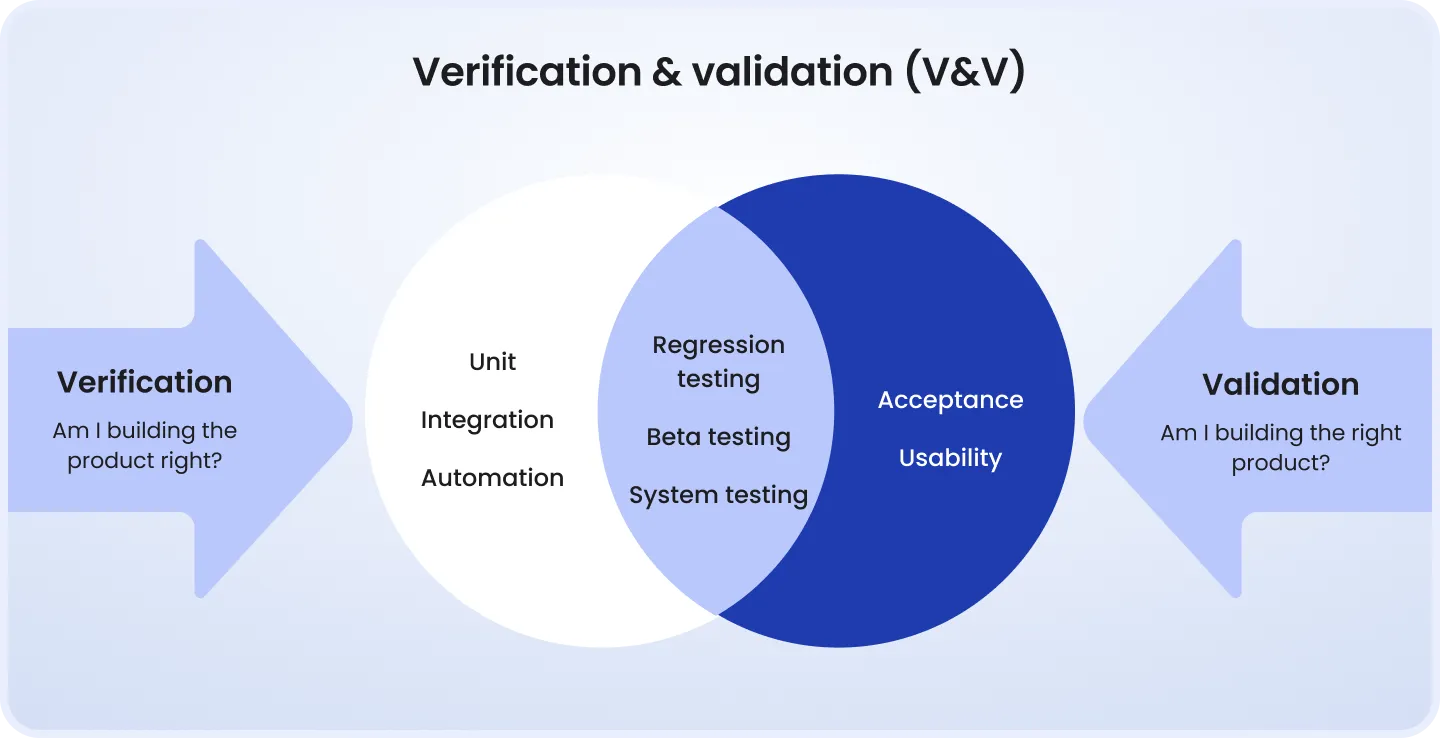
Source: Pcloudy
Verification and validation (V&V) are two distinct but complementary processes in software testing that ensure the quality and correctness of a software product.
Verification has a goal to check if the software is built in line with requirements, specifications, and regulations.
Validation makes sure software fulfills its intended purpose and meets the needs of end-users.
That's of great importance, as FDA 21 CFR Part 820, MDR Annex I, and IEC 62304 require documented evidence that software adheres to defined requirements (verification) and operates as intended in the real world (validation).
Tool and process validation
Regulators care about what you build and how you actually test it. QA validates CI/CD pipelines, test automation frameworks, and requirement management systems to confirm they don't come with errors or compliance gaps. You know, test results are only trustworthy when the tools and processes behind them are reliable.
Requirements-based testing
IEC 62304, ISO 13485, and FDA demand proof that functional and regulatory requirements are properly tested. In order to ensure compliance, QA specialists often leverage requirements-based testing (RBT) that offers a structured, verifiable methodology by linking all requirements to corresponding test cases and test results. This contributes to the traceability that auditors expect to see.
Usability testing
The FDA's Human Factors Engineering Guidance, IEC 62366, and MDR Annex I (Chapter II) define usability as a significant safety factor. That's for a reason, as in healthcare, a perplexing UI or misinterpreted alert could be as dangerous as a bug.
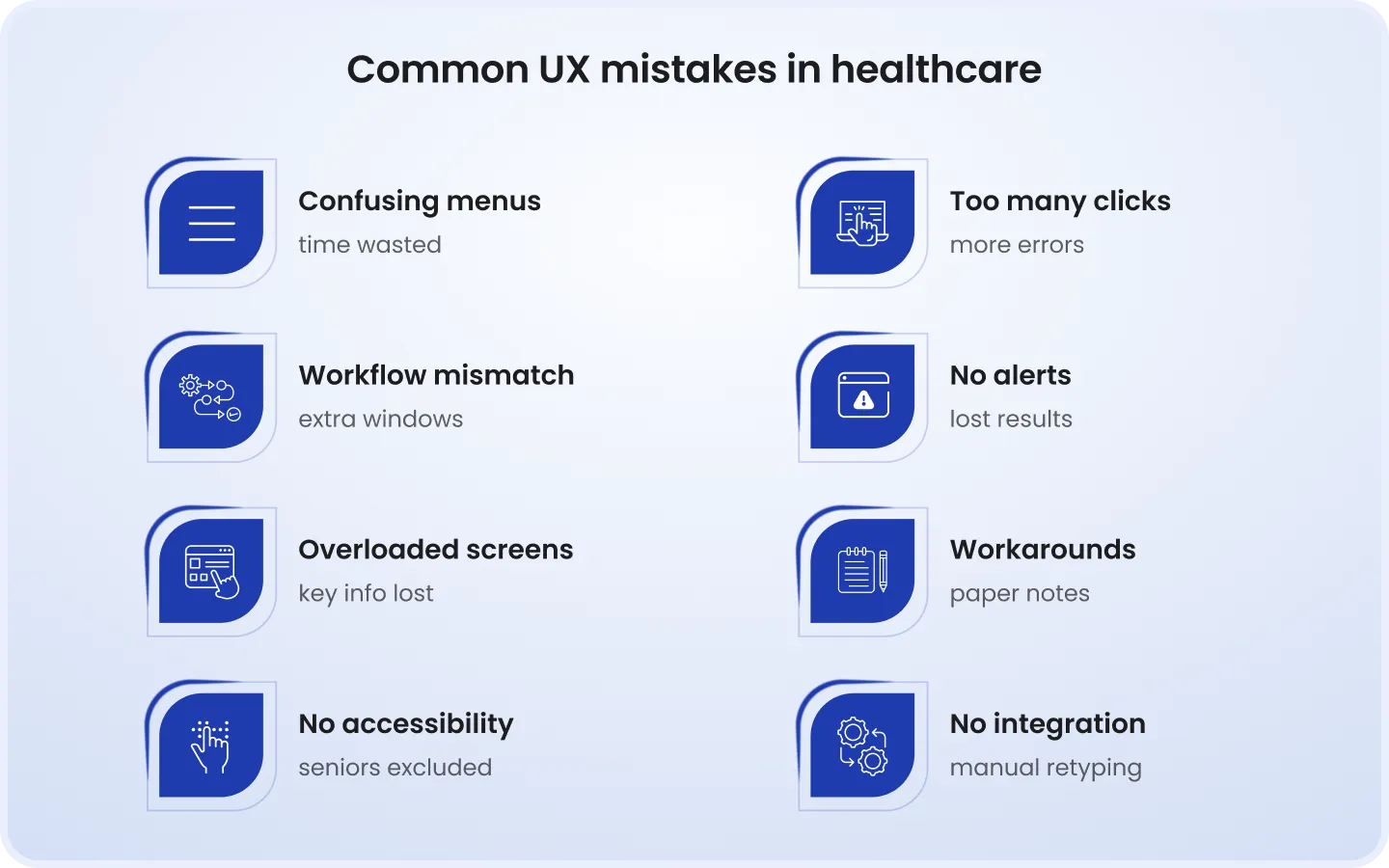
Source: Vilmate
In the course of usability testing, QA teams engage real users to make sure that workflows and dashboards don't confuse them but ensure smooth interactions with a system.
Data integrity testing
Software reliability and efficiency hinge on the quality of data. The study of 2024 defines 14 dimensions of data quality for health information systems: accuracy, consistency, security, timeliness, completeness, reliability, accessibility, objectivity, relevance, understandability, navigation, reputation, efficiency, and value added. Regulators are also serious about data quality. FDA 21 CFR Part 11, the HIPAA Security Rule, and GDPR Article 5 require that data be accurate, complete, and traceable throughout its lifecycle.
Healthcare software testing always pays attention to ensuring data integrity in all operations, whether it's input, storage, processing, or retrieval. It involves checks for synchronization errors, corruption, and missing logs. For regulators, these tests serve as one more proof that the system can be trusted.
Security testing
With regard to the number of data breaches — the HIPAA Journal reports that in 2024, there were 725 incidents in the U.S. only — patient data protection is the highest priority of GDPR, HIPAA, MDR, and FDA.
Taking care of data security, QA teams check access controls, authentication mechanisms, encryption, and the ability to resist known threats. When testing healthcare applications, a plethora of security tests are executed, including penetration testing, vulnerability scanning, security posture assessment, internal security auditing, and others. Altogether, they demonstrate that sufficient data protection measures have been taken.
Performance testing
When people's lives depend on uptime, performance testing is a must. By simulating heavy loads, network failures, and unexpected conditions, QA experts confirm the system remains stable under any stress level and doesn't crash when lives are at stake. The suite of performance tests includes:
Volume testing
Stress testing
Spike testing
Soak testing
Scalability testing
Test artifact development and maintenance
Without proper documentation in place, even a flawless app can fail an audit. In fact, the European Association of Notified Bodies, in its 'Best Practice Guidance for the Submission of Technical Documentation under Annex II and III of Medical Device Regulation (EU) 2017/745', identified two prevalent reasons for delays in reviewing technical documentation: incomplete submissions and poorly structured technical documentation.
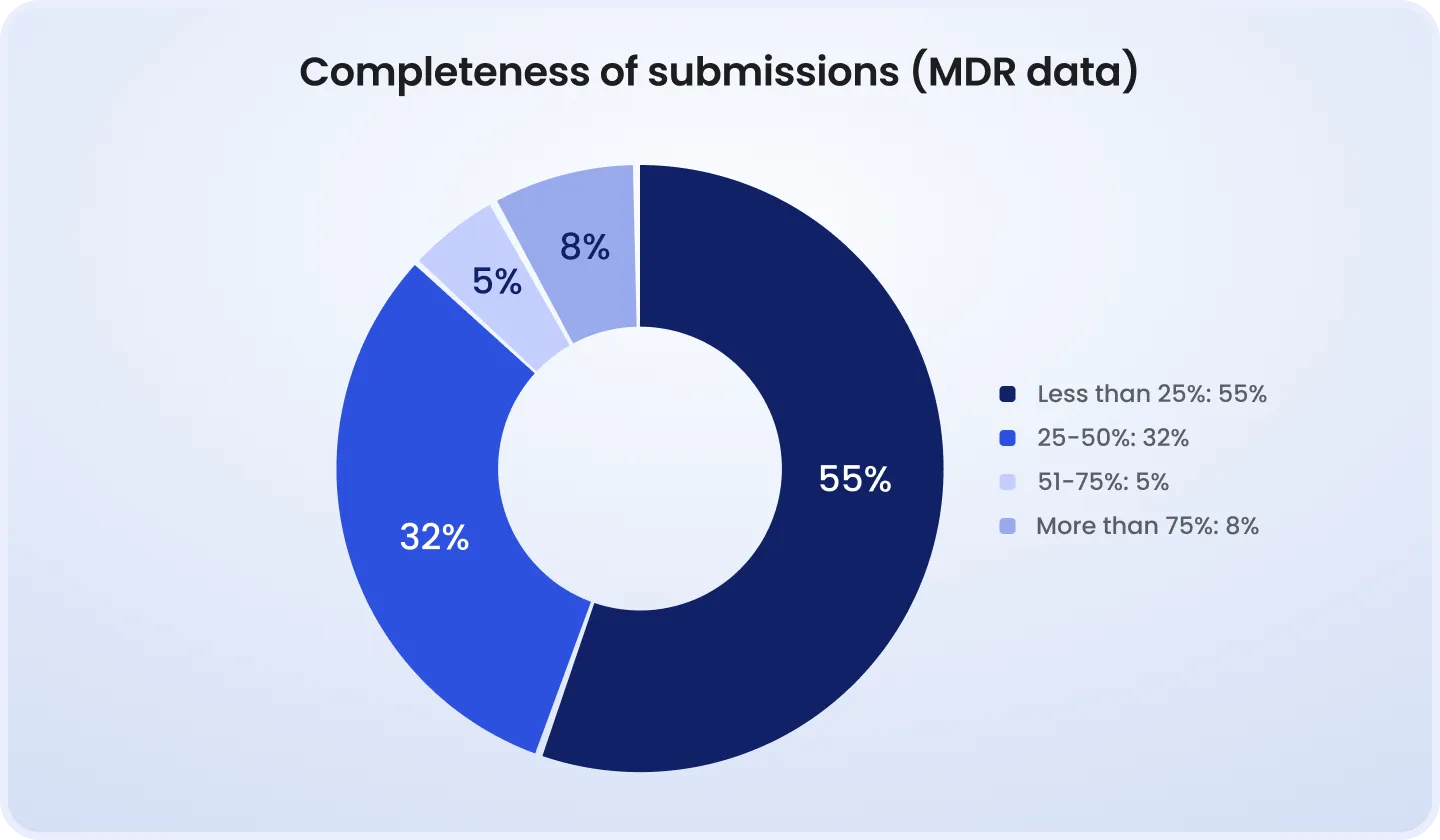
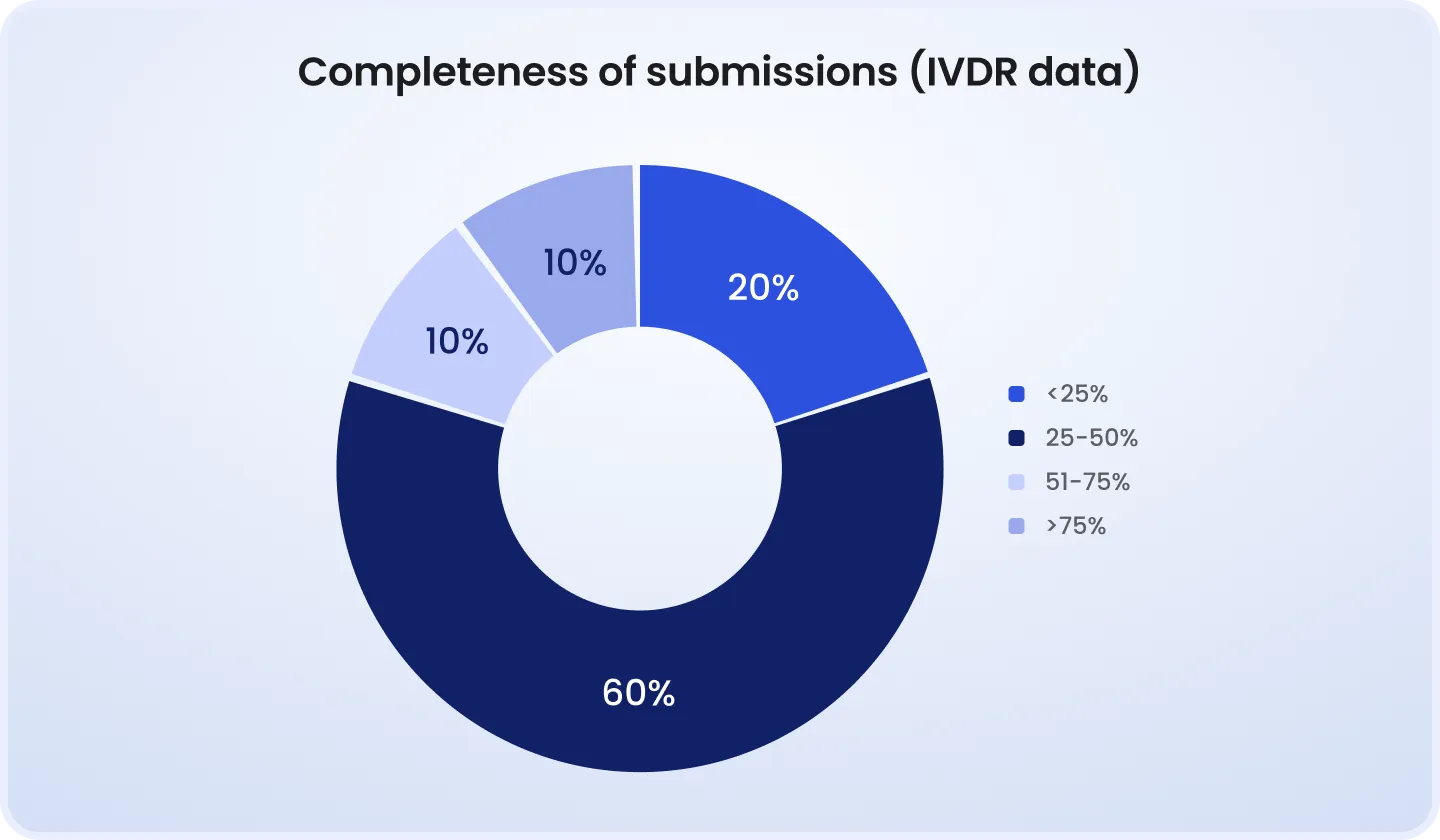
Source: Notified Bodies Survey on certifications and applications (MDR/IVDR)
In the course of medical software testing, QA teams not only carry out tests but also document the QA process. Test strategy, risk mitigation plan, risk assessments, test cases, bug reports, test results — all of these are created and updated so that regulators can see evidence of compliance and the work done to ensure it.
Compliance testing
Cherry on the cake — apart from testing distinct aspects of software operation, QA teams also take a systematic approach to checking healthcare solutions for compliance. The goal of compliance testing is to confirm that software development and QA processes align with the applied laws, regulations, and standards. That's not a one-time or last-minute task — professional providers of healthcare software testing services, like DeviQA, insert regulatory checks into the testing workflow at the project outset.
Checklist for compliance-minded QA
Expertise in compliance-oriented QA requires years of hands-on experience, deep domain knowledge, and, of course, strong testing skills. Obviously, that's not something you can get in a fortnight or even a year. Yet, the DeviQA team has all of these and has created a generalized checklist for those who just begin their journey in this field.
1. Documentation & traceability
Requirement Traceability Matrix (RTM) linking all functional and regulatory requirements to tests and results.
Risk management documentation identifying hazards and mitigation measures in line with ISO 14971.
Design control records aligned with FDA 21 CFR Part 820 or EU MDR Annex I requirements.
Complete and accessible version control and change management logs (if applicable).
Signed off and archived validation and verification reports.
2. Software validation & verification
Verification tests that confirm the software meets design specifications.
Validation activities that confirm the safety and effectiveness of the software in the real world.
Complete and reproducible unit, integration, and system testing evidence.
Regression testing executed to ensure that changes haven't invalidated previous compliance approvals.
3. Security & data protection
Solid encryption of data in transit and at rest.
Validated access control and authentication mechanisms.
Tamper-proof and compliant with 21 CFR Part 11 audit trails.
Well-documented security tests.
Data retention and deletion policies aligned with applicable data protection laws.
4. Data integrity
Data input, storage, and retrieval maintain accuracy, consistency, and completeness.
Validation of synchronization between systems (EHR/EMR platforms, cloud storage, APIs).
Audit logs that record all data changes.
Error handling that prevents data loss or corruption.
5. Usability
Usability based on IEC 62366-1 or FDA human factors guidance.
User interface and labeling complied with MDR/IVDR Annex I or FDA 21 CFR 801.
Clinical scenarios tested for potential misuse or confusion.
6. Interoperability & data exchange
Correctly implemented HL7 / FHIR / DICOM / CDA standards.
Inter-system communication validated for accuracy and consistency.
Thoroughly documented data mapping and transformation processes.
7. Risk & safety compliance
Hazard analysis aligned with ISO 14971.
Risk control verification that confirms effective mitigations.
Post-market surveillance plans (for MDR / FDA).
8. Cloud & infrastructure
Cloud provider that meets HIPAA Business Associate Agreement (BAA) standards (if applicable).
Data storage location aligned with local jurisdictional requirements (e.g., GDPR data residency).
Backup and recovery systems tested for reliability and security.
9. AI & ML
Validation ensuring that datasets used for model training are complete, unbiased, and traceable to their sources.
Model transparency documented in accordance with FDA's Good Machine Learning Practice (GMLP) principles and the EU AI Act.
Implementation of performance drift monitoring to detect degradation or instability in AI model behavior over time.
Making sure that AI-driven recommendations or decisions are interpretable.
Bias testing executed to confirm equal model performance across demographics.
Comprehensive audit trails for every model version, retraining cycle, and parameter adjustment to ensure full traceability.
Human-in-the-loop verification implemented to ensure that critical AI-assisted decisions are overseen by experts.
10. Final audit readiness
Internal QA audit conducted before submission or market release.
Centralized test evidence, approvals, and validation records.
Identified and addressed compliance gaps.
Electronic records and signatures complied with 21 CFR Part 11 or equivalent EU rules.
Common mistakes teams make when trying to ensure regulatory compliance
No mistakes make only someone who does nothing. Errors and failures are a part of gaining experience. Yet, it's always better to learn from the mistakes of others. Therefore, we think it's a good idea to highlight the pitfalls that most frequently trip up healthcare software teams and cost them time, money, extra effort, and occasionally, their product's approval.
1. Treating compliance as a one-time task
Many teams postpone compliance checks until the pre-release stage — a very bad idea. It doesn't work this way, as compliance assurance is an ongoing practice. Regulators expect continuous validation throughout the product's lifecycle.
2. Providing poor traceability and documentation
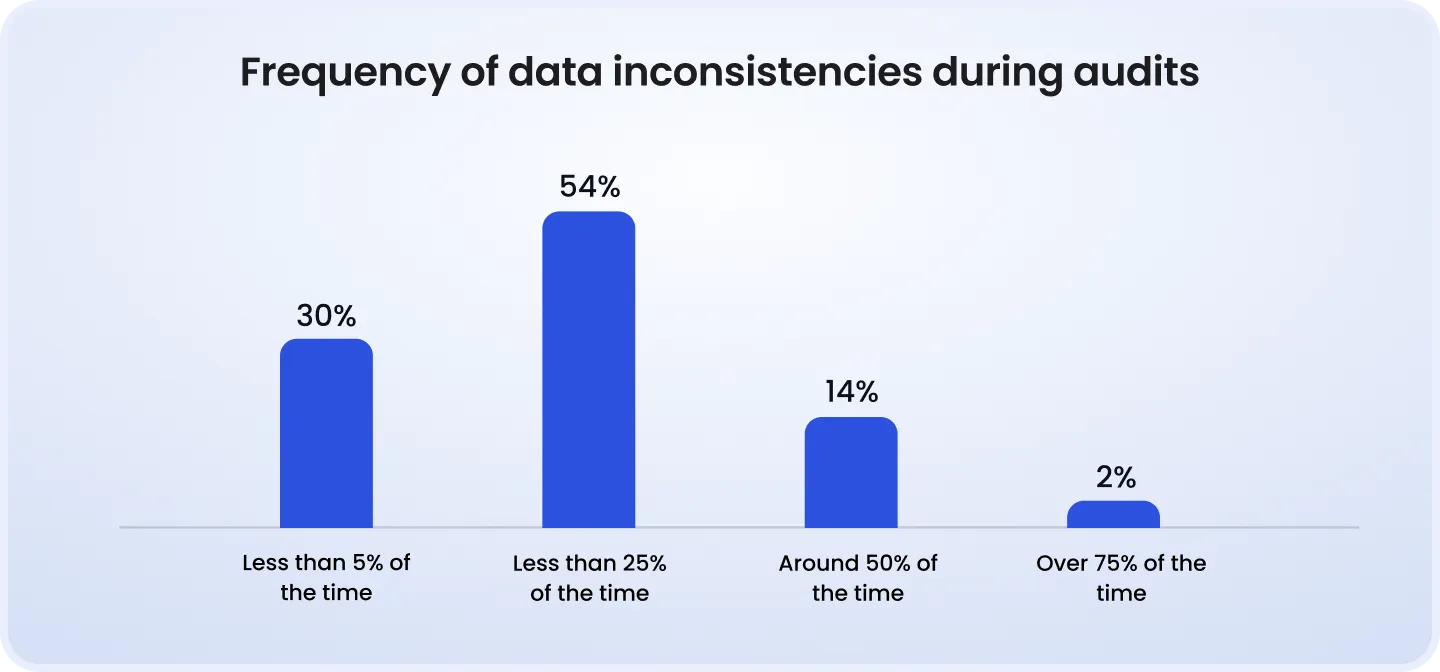
What is the golden rule of regulators? If you can't prove it, it didn't happen. Missing links in your requirements traceability matrix, untracked design changes, or test reports without clear evidence are red flags for auditors. They love traceability and hate loose ends.
Source: Veeva
3. Misinterpreting regulatory requirements
Healthcare regulations are complex and, sometimes, open to interpretation. Misunderstanding, for example, under which class your software falls can completely derail a compliance strategy. Consulting a regulatory affairs specialist early on is the best way for QA teams to align testing efforts with the right standards (FDA 510(k), MDR, HIPAA, etc.).
4. Establishing weak change control
Healthcare products constantly evolve as new features, bug fixes, and patches arrive. But if every change isn't properly tested, documented, and approved, compliance is at risk. Unvalidated updates can cause regulatory nonconformities, especially during post-market audits.
5. Neglecting data security and integrity tests
Data protection seems to be at the core of healthcare application testing and industry regulations. Yet many teams run generic penetration tests without checking compliance with specific frameworks like HIPAA or 21 CFR Part 11. Take it seriously — one missing requirement, and you face a major legal liability.
6. Overlooking usability validation
QA teams sometimes underplay usability validation, forgetting that regulators care as much about user interaction as about software logic because a confusing UI can make a healthcare product unsafe.
Forewarned is forearmed. Remember these mistakes and don't step on the same rake.
Conclusion: Compliance isn't a nightmare but a goal you can achieve with proper QA
Our world was created in a way that many useful things in it are far from being pleasant: cold showers, broccoli, intense workouts, dental checkups, and so on. Regulatory compliance is on the list too. Many teams perceive it as a real headache, and for good reason. It takes time, effort, and nerves.
Yet regulatory compliance is absolutely needed for high-risk healthcare solutions. It protects users from health hazards and lets producers avoid legal troubles. Besides, the devil is not so black as he is painted, especially when you have a skilled QA team that can help you make the process manageable, go through all compliance pitfalls, and ensure full adherence to applied regulations.
Not sure if your QA process covers all compliance requirements and risks? Book a free consultation with the DeviQA team to audit your current testing strategy, identify compliance gaps, and make adjustments.
Build software that works the way you imagined
About the author
Senior QA engineer
Mykhailo Ralduhin is a Senior QA Engineer at DeviQA, specializing in building stable, well-structured testing processes for complex software products.