
Written by: Senior QA Engineer
Mykhailo RalduhinUpdated: 12.10.2026
21 min read
Software teams can now produce changes faster than many organizations can verify them. The result is familiar: automated tests exist, CI/CD pipelines run, and releases happen frequently, yet quality issues still accumulate because testing, deployment, and production feedback remain disconnected.
The 2025 DORA research illustrates the pressure behind this problem. Ninety percent of surveyed technology professionals used AI at work, and more than 80% reported productivity gains. However, 30% had little or no trust in AI-generated code, while higher AI adoption still had a negative relationship with delivery stability.
QAOps addresses that verification gap. It integrates quality assurance into the software delivery pipeline so that every change generates timely, useful evidence about whether it is safe to continue toward production.
What is QAOps?
QAOps, short for Quality Assurance Operations, is an approach that integrates testing, quality controls, environments, production telemetry, and feedback into continuous software delivery.
Instead of treating QA as a separate phase after development, QAOps makes quality a shared responsibility across developers, QA engineers, platform specialists, and operations teams.
A QAOps process typically includes:
early review of requirements and acceptance criteria;
automated checks triggered by code changes;
standardized test environments and data;
quality gates inside CI/CD pipelines;
risk-based regression testing;
performance, security, and compatibility checks;
controlled deployment and rollback;
production monitoring connected to releases;
feedback that reaches the team responsible for the change.
QAOps is not another name for test automation. Automation runs checks; QAOps determines which checks are needed, where they should run, who responds to failures, and how testing evidence affects the release decision.
It is also not a single role or tool. A company does not “have QAOps” because it hired a QA automation engineer or added a testing stage to Jenkins. QAOps is an operating model connecting people, processes, automation, infrastructure, and production feedback.
QAOps in one example
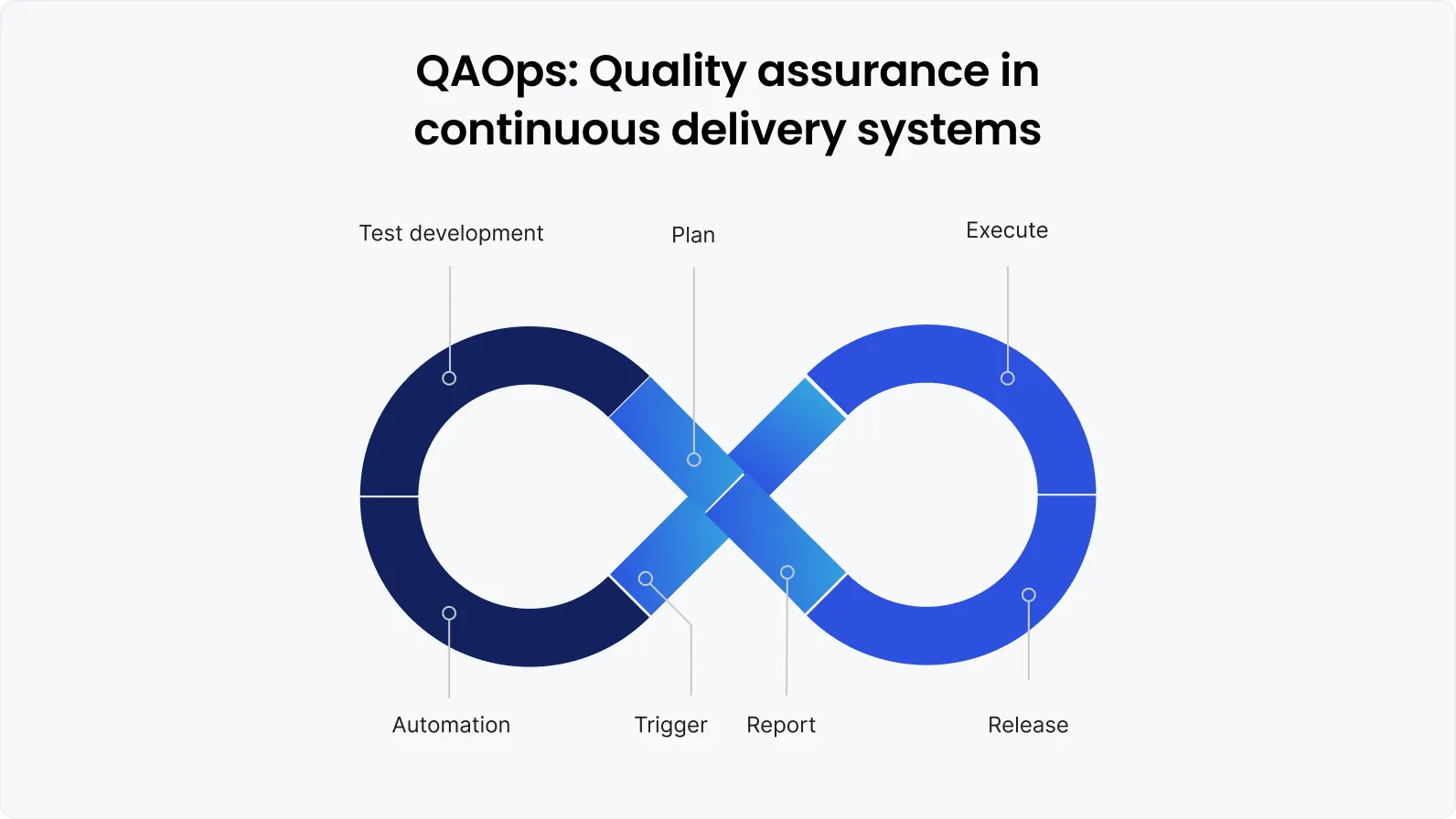
Suppose a developer changes the checkout service.
In a traditional workflow, the feature may be deployed to a test environment and passed to QA after implementation. A tester checks the new behavior, reports defects, waits for fixes, and repeats the test. Related services may be examined only if someone remembers the dependency.
In a QAOps workflow, the pull request can automatically trigger:
Code analysis and unit tests.
API schema and contract checks.
Integration tests involving inventory, payment, and order services.
Security scans for new dependencies and exposed secrets.
Targeted regression tests selected from the affected components.
Deployment to an isolated test environment.
Critical end-to-end and performance checks.
A quality gate based on results and risk.
A staged production rollout.
Monitoring of payment success, errors, latency, and rollback signals.
QA engineers still contribute exploratory testing and risk analysis. The difference is that evidence starts accumulating as soon as the change enters the delivery system rather than after development is “finished.”
Why traditional QA processes struggle
Traditional QA depends heavily on sequential handoffs:
Requirements → development → completed build → testing → fixes → release
This model creates several problems.
Feedback arrives too late
If ambiguity or an architectural limitation is discovered after implementation, the team may need to redesign, recode, and retest the feature. Testing becomes associated with delay even though the underlying problem was created earlier.
Quality belongs to one team
Developers focus on completing features, QA reports defects, and operations handles production failures. Each team can perform its own work correctly while the overall delivery system remains slow and unreliable.
Automation is isolated from release decisions
A regression suite may run nightly, but nobody knows whether the results cover the components changed in today’s release. Failed tests may be rerun until they pass without investigating why they were unstable.
Production feedback does not improve testing
Incidents, customer complaints, slow transactions, and failed integrations may be recorded in different systems. If this data does not update regression coverage or release criteria, the same category of problem can escape again.
Manual coordination becomes a bottleneck
Environment requests, build approvals, test-data preparation, status reports, and deployment sign-offs consume time without necessarily improving quality.
AI-assisted development makes these weaknesses more visible. In DeviQA’s 2026 survey of 4,000 QA professionals, 65% said features reached testing faster, but 64% also saw more features arrive simultaneously. Fifty-five percent reported larger QA queues, and 52% experienced more test–fix–retest cycles.
The problem is not simply insufficient automation. It is a delivery process in which implementation capacity grows faster than verification capacity.
Core principles of QAOps
Quality is shared
QA engineers guide risk analysis and testing, but they do not own quality alone. Developers own testability and component-level checks. Operations and platform specialists contribute environment, deployment, and observability controls. Product owners define acceptable behavior and business risk.
Testing begins before code is complete
QA participates in requirements, design, and architecture discussions. Ambiguous acceptance criteria, missing error behavior, difficult-to-test components, and dependency risks can be addressed before they turn into defects.
Feedback must be fast and actionable
A failed pipeline that only says “regression test failed” provides limited value. Useful feedback identifies the affected test, probable component, relevant logs, environment, commit, owner, and evidence needed to reproduce the problem.
Automation is risk-based
QAOps does not require automating every possible scenario. It prioritizes stable, repeatable, and business-critical checks while preserving exploratory testing for new, ambiguous, or high-judgment areas.
Quality gates use evidence
A release proceeds when defined conditions are met. Those conditions may include test results, security findings, performance thresholds, open-defect severity, change risk, and production readiness.
Production is part of the feedback loop
Deployment is not the end of testing. QAOps uses production metrics, incidents, customer behavior, and operational trends to improve future coverage.
The process improves continuously
Teams track pipeline failures, escaped defects, flaky tests, slow feedback, and recovery time. The goal is not to preserve the original process but to remove sources of delay and uncertainty.
The QAOps process
A mature QAOps process follows a continuous loop rather than a testing phase.
Planning
Requirements review, risk analysis, testability assessment
Clear acceptance criteria and identified risks
Development
Unit tests, static analysis, code review, local checks
Fast feedback before merge
Build
Dependency checks, artifact creation, configuration validation
Reproducible build
Integration
API, contract, database, and service tests
Compatibility between components
Test environment
Automated provisioning, data setup, deployment verification
Consistent test conditions
System validation
End-to-end, exploratory, performance, security, and compatibility testing
Release-level confidence
Deployment
Approval rules, feature flags, canary release, rollback preparation
Controlled exposure
Production
Metrics, logs, traces, synthetic checks, user signals
Real-world quality evidence
Improvement
Incident review, coverage updates, pipeline optimization
Reduced recurrence and faster feedback
Planning and risk analysis
QAOps begins before implementation. The team reviews what is changing, which users and workflows are affected, and what could fail outside the primary scenario.
Useful questions include:
Which services and data structures will change?
Which user roles are affected?
Are external providers involved?
What must remain backward-compatible?
What security or compliance requirements apply?
Which performance thresholds could be affected?
How will the change be disabled or rolled back?
What production signal will confirm that it works?
The answers determine the testing scope and the position of quality gates in the pipeline.
Automated checks close to the change
Fast checks should run first. Unit tests, static analysis, component tests, API validation, and contract tests usually provide quicker and more precise feedback than large UI suites.
Slower system and end-to-end tests still matter, but they should protect selected business journeys rather than reproduce every lower-level scenario through the interface.
Reliable environments and test data
A pipeline cannot provide reliable feedback when environments are inconsistent or data is unavailable.
The World Quality Report 2025–26 found that 60% of organizations struggled with secure, scalable test data. It also reported that synthetic-data use grew from 14% in 2024 to an average of 25% in 2025.
QAOps treats environments and data as engineering capabilities. This may include:
infrastructure as code;
disposable environments for pull requests;
service virtualization;
masked or synthetic data;
automated provisioning and cleanup;
versioned datasets;
containerized dependencies;
controlled access to sensitive information.
Quality gates
A quality gate is a rule that determines whether a change can move forward.
Examples include:
all critical unit and integration tests pass;
no unresolved critical security vulnerability exists;
the flaky-test threshold is not exceeded;
API contracts remain compatible;
response-time percentiles remain within the agreed range;
required regression scenarios pass;
no release-blocking defect remains open;
a canary deployment meets its error-rate target.
Not every gate should block every change. A documentation update and a payment-service modification do not carry the same risk. Mature QAOps implementations make gates proportional to the change.
Production feedback
Monitoring becomes part of the quality process when it is connected to releases and ownership.
Grafana’s 2025 Observability Survey found that 95% of surveyed organizations used metrics and 87% used logs, but only 57% used traces. The gap matters because traces help teams follow a request through distributed services and find where latency or failure was introduced.
QAOps teams monitor technical and business signals such as:
deployment error rate;
API latency;
application exceptions;
failed payments;
checkout completion;
crash-free sessions;
queue delay;
service-level objective breaches;
rollback frequency;
support tickets after a release.
A production incident should lead to a stronger test, gate, alert, or design control where recurrence is preventable.
Why QAOps matters: five business benefits
1. Faster feedback and shorter release cycles
QAOps moves verification closer to the change. Developers learn about defects while the implementation context is still fresh, reducing the time spent reproducing old work or waiting for a separate test phase.
Speed should be measured, not assumed. CircleCI’s 2025 State of Software Delivery report, based on more than 14 million workflows, found a median workflow duration of 2 minutes 43 seconds but an average main-branch success rate of 82.15%, below its 90% benchmark. A fast pipeline that fails frequently still wastes engineering time.
QAOps balances duration with reliability.
2. Better collaboration and clearer ownership
Pipeline results, release risks, and production signals become visible to the whole product team. Developers do not wait for QA to discover basic failures, while testers gain earlier access to design decisions and implementation details.
Shared responsibility does not mean unclear responsibility. Every service, test suite, environment, quality gate, and production alert still needs an owner.
3. More consistent software quality
Frequent checks reduce the time during which a defect can spread across branches or dependent components. Contract testing, automated regression, and staged releases help teams detect issues before they reach the full user base.
Consistency is more valuable than a one-time quality push before a major launch. QAOps builds verification into the routine path of every release.
4. Lower rework and operational cost
Finding a defect earlier usually reduces the amount of code, documentation, data, and coordination affected by the fix. Automated environment provisioning and reusable pipeline components also reduce repeated setup work.
Cost savings should be evaluated against maintenance. An oversized UI suite that is slow and unstable may cost more than the manual work it replaced. QAOps measures the complete cost of feedback, including infrastructure, flaky-test investigation, and developer waiting time.
5. Scalability and adaptability
Shared pipelines, reusable test components, standardized environments, and observable releases allow the quality process to grow with the product.
Scalability does not mean forcing every team into one identical workflow. It means providing common controls while allowing teams to configure risk-specific checks for their services.
QAOps tools and technology stack in 2026
QAOps does not require one tool to manage the entire process. Most organizations combine specialized tools through CI/CD workflows.
Source control and review
GitHub, GitLab, Bitbucket
Track changes and trigger validation
CI/CD
GitHub Actions, GitLab CI/CD, Jenkins, CircleCI, Azure Pipelines
Orchestrate build, test, and deployment
Test management
TestRail, Qase, Xray, Zephyr Scale
Manage coverage, execution, and traceability
Web automation
Playwright, Cypress, Selenium
Validate browser workflows
Mobile automation
Appium, Espresso, XCUITest
Test Android and iOS applications
API and contract testing
Postman, REST Assured, Pact
Validate interfaces and service compatibility
Performance testing
k6, Gatling, JMeter, Locust
Measure capacity, latency, and stability
Security testing
Snyk, Semgrep, OWASP ZAP, Trivy
Detect code, dependency, and container risks
Infrastructure
Docker, Kubernetes, Terraform
Create repeatable environments
Observability
OpenTelemetry, Prometheus, Grafana, Datadog
Connect releases with production behavior
Collaboration
Jira, Linear, Slack, Microsoft Teams
Route feedback and coordinate ownership
Choose tools based on the required evidence and existing technology stack. Adding overlapping platforms without ownership or governance increases tool noise rather than QAOps maturity.
AI-enabled tools can help generate tests, analyze logs, or identify affected areas. However, adoption is still uneven. The World Quality Report found that 43% of organizations were experimenting with generative AI in QA, while only 15% had scaled it across the enterprise.
AI output therefore needs the same QAOps controls as human-created code: review, deterministic checks, traceability, security scanning, and measurable production outcomes.
How to implement QAOps
Step 1: Map the current delivery flow
Document how a change moves from an idea to production.
Include:
requirements and approval;
development and review;
build creation;
environments;
testing stages;
release approval;
deployment;
monitoring;
incident feedback.
Measure waiting time as well as execution time. A five-minute automated suite provides little benefit if a build waits four hours for an environment.
Step 2: Establish a baseline
Record current metrics before changing the process:
lead time to test feedback;
pipeline duration and success rate;
deployment frequency;
defect escape rate;
test flakiness;
environment preparation time;
change failure rate;
recovery time;
manual regression effort.
The baseline allows the team to verify whether QAOps produces an actual improvement.
Step 3: Start with one critical workflow
A full-company transformation is unnecessary at the beginning. Select a service or user journey with clear business importance and visible delivery problems.
Good pilot candidates include authentication, checkout, subscription renewal, payment, account creation, or another frequently changed flow.
Step 4: Define ownership and quality gates
For each control, document:
what it checks;
when it runs;
whether it blocks delivery;
who owns it;
what evidence it produces;
what happens when it fails;
when the rule should be reviewed.
This prevents pipeline failures from becoming “someone else’s problem.”
Step 5: Build a balanced automation portfolio
Prioritize unit, component, API, and integration tests before expanding expensive UI coverage. Automate stable, repeatable, business-critical behavior while reserving manual testing for exploration, usability, unusual risks, and new functionality.
Risk-based regression is more sustainable than trying to run every automated test after every commit.
Step 6: Standardize environments and test data
Automate environment provisioning where possible. Define how test data is created, isolated, refreshed, protected, and removed.
Environment failures should be reported separately from product defects so the team can measure infrastructure reliability.
Step 7: Connect production signals to releases
Tag telemetry with release, build, feature flag, service, and environment information. Set thresholds for canary rollout, escalation, and rollback.
The Capgemini report found that 94% of organizations reviewed production data, yet almost half struggled to turn it into quality improvements. Collecting data is not enough; QAOps must define who acts on each signal.
Step 8: Review and improve the system
Hold regular reviews of:
escaped defects;
false pipeline failures;
slow checks;
unstable environments;
ignored alerts;
manual approvals;
recurring incidents;
tests that no longer protect meaningful risk.
For a staged implementation plan, see our guide to creating a QAOps roadmap.
QAOps roles and responsibilities
QAOps works best with clear ownership across existing roles.
Product manager or owner
Defines business outcomes, acceptance criteria, and risk priorities
Developer
Builds testable code and owns unit and component checks
QA engineer
Designs coverage, exploratory testing, and release-risk evaluation
SDET or automation engineer
Builds reusable automation and pipeline integrations
Platform or operations engineer
Provides environments, delivery infrastructure, and observability
Security specialist
Defines security controls and remediation policies
Engineering manager
Removes organizational barriers and tracks delivery outcomes
A dedicated QAOps engineer may coordinate these activities, but the approach should not depend on one person. That would recreate the silo QAOps is intended to remove.
Our article on building a QAOps team examines the required roles and skills in more detail.
QAOps metrics
A QAOps dashboard should show whether feedback is becoming faster, more reliable, and more useful.
Pipeline duration
How quickly a change receives automated feedback
Pipeline success rate
Reliability of the delivery workflow
Test pass rate
Outcome of executed checks
Flaky-test rate
How often tests fail without a product defect
Defect escape rate
Problems reaching production
Change failure rate
Deployments causing incidents, rollback, or remediation
Mean time to recovery
Speed of restoring normal service
Automated coverage of critical flows
Protection of business-relevant behavior
Environment provisioning time
Availability of test infrastructure
Test-data preparation time
Efficiency of data setup
Release rollback rate
Frequency of unsuccessful deployments
SLO compliance
User-facing reliability and performance
Rework rate
Effort spent correcting recent changes
Coverage percentage alone is insufficient. A team may automate 90% of its documented test cases while leaving its highest-risk integration almost untested.
Metrics also need context. A rising defect count may indicate deteriorating quality, better detection, broader testing, or a temporary migration. Use trends and contributing factors rather than rewarding teams for isolated numbers.
Common QAOps implementation challenges
Flaky automation
Unstable tests reduce trust in the entire pipeline. Quarantine should be temporary, failures should be assigned owners, and flakiness should be tracked as engineering debt.
Slow feedback
Large sequential suites can turn continuous testing into a queue. Use parallel execution, appropriate test layers, caching, risk-based selection, and targeted checks.
Environment inconsistency
Configuration drift and shared data create failures that are difficult to reproduce. Infrastructure as code and isolated environments improve repeatability.
Tool proliferation
Too many overlapping tools fragment evidence and ownership. Standardize interfaces, reporting, and responsibility before expanding the stack.
Excessive blocking gates
If every warning prevents a release, teams will search for ways around the pipeline. Gates should reflect severity, confidence, and business risk.
Automation without cultural change
A technically advanced pipeline cannot compensate for unclear requirements, defensive teams, missing ownership, or ignored production feedback.
No connection to business outcomes
Counting tests or deployments does not explain whether users receive a better product. QAOps metrics should connect delivery behavior to incidents, reliability, customer journeys, and rework.
The organizational differences are explored further in our comparison of QAOps vs traditional QA.
QAOps success stories
Spotify: verification must scale with development velocity
Spotify does not label its complete delivery system “QAOps,” but its engineering practices illustrate the same principles: continuous verification, shared ownership, release controls, observability, and production feedback.
In September 2026, Spotify reported that its monthly merged changes had more than doubled year over year, from roughly 8,100 to 17,000. Its engineering analysis of quality at higher development velocity found no distinct pattern of incidents directly caused by AI-authored code. The larger issue was that change volume grew faster than some verification controls.
Spotify responded by strengthening review, testing, rollout, observability, failover, rollback, and longer-term quality signals. The lesson is directly relevant to QAOps: accelerating code generation creates value only when the verification system can keep up.
Spotify has also automated parts of its app-release workflow while retaining explicit human decisions. Its 2026 release engineering case study describes a release-conductor service that advances builds only after required conditions are met, including successful automation, manual sign-off, and the absence of blocking defects. Spotify reported that this reduced the average release cycle by about eight hours.
Etsy: replacing release gatekeeping with shared controls
Etsy’s experience is an earlier example of the organizational problem QAOps addresses.
The company’s app-release process once depended heavily on release managers who tracked changes, coordinated testing, sent updates, and made release decisions. This created a single point of failure and made the process difficult for engineers to follow.
Etsy built an internal system called Ship to coordinate release state, create candidates, trigger testing, send targeted notifications, and automate app-store submission and staged rollout. As described in Etsy’s engineering account of its release process, engineers remained responsible for testing their changes, while release drivers handled decisions that should not be fully automated.
The useful lesson is not that every company needs an internal release platform. Etsy separated repeatable coordination from human judgment. Automation handled status, scheduling, notifications, and routine actions; people remained responsible for risk, show-stopping defects, and final control.
What are QAOps services?
QAOps services help an organization design, implement, or improve an integrated quality and delivery process.
The scope may include:
assessing the current QA and release workflow;
designing a QAOps roadmap;
selecting and integrating tools;
building test automation;
implementing CI/CD quality gates;
creating test environments and data processes;
adding performance and security checks;
connecting production observability with releases;
defining ownership and metrics;
training internal teams.
External support is most useful when a company has isolated automation but lacks the architecture, skills, or capacity to turn it into a reliable delivery system.
DeviQA combines QA engineering expertise with DevOps services and solutions to help teams integrate testing, delivery automation, infrastructure, monitoring, and continuous improvement around their existing product workflow.
See what's possible for your QA
FAQ
What does QAOps stand for?
QAOps stands for Quality Assurance Operations. It describes the integration of quality assurance with automated delivery, infrastructure, and operational feedback.
Is QAOps only test automation in CI/CD?
No. Automated testing is one component. QAOps also covers early risk analysis, environments, test data, quality gates, release controls, observability, ownership, and continuous process improvement.
Does QAOps eliminate manual testing?
No. It reduces repetitive manual work while preserving exploratory, usability, accessibility, and risk-based testing that requires human judgment.
Can a small team use QAOps?
Yes. A small team can begin with automated smoke tests, clear ownership, one reliable pipeline, and basic production monitoring. The process can expand as the product and release frequency grow.
When should a company adopt QAOps?
QAOps becomes particularly useful when testing delays releases, automation is disconnected from CI/CD, environments are unreliable, production defects recur, or development output grows faster than QA capacity.
What is the first step in implementing QAOps?
Map the current delivery flow and establish baseline metrics. Identify where work waits, where failures are detected, and which handoffs create the most rework. Then choose one critical workflow for a pilot.
How is QAOps success measured?
Measure pipeline speed and reliability, escaped defects, change failures, recovery time, flaky tests, environment availability, coverage of critical risks, and production service levels. Success means better evidence reaches the team sooner without creating an unreliable release process.
About the author
Senior QA engineer
Mykhailo Ralduhin is a Senior QA Engineer at DeviQA, specializing in building stable, well-structured testing processes for complex software products.