
Written by: Chief Operating Officer
Anastasiia SokolinskaPosted: 16.07.2026
15 min read
Most engineering teams that land on this question already have skin in the game. You have an existing test suite — maybe 300 WebdriverIO tests, maybe 600 — a CI pipeline that runs eight times a day, and a team that's split on whether to migrate or stay put. "Just run a PoC" advice ignores the migration cost, the dual maintenance burden, and the fact that your QA lead is already stretched thin.
The right framework for your team depends on five specific variables — and this guide walks you through each one with enough technical specificity to make the decision this sprint.
Why this decision is harder than it looks
The standard comparison articles frame Playwright vs WebdriverIO as a speed contest. Playwright wins on benchmarks, WebdriverIO has a richer ecosystem, pick your fighter. That framing is wrong — and it leads teams to make migrations they later regret.
The actual decision involves at least four constraints that most articles never mention: your mobile testing scope, your compliance posture, your existing suite size, and whether your team runs BDD workflows. Get any one of those wrong and the "faster" framework costs you more than it saves.
One more thing before we get into architecture: WebdriverIO v9 changed the protocol story in a way that almost nobody has updated their analysis to reflect. The speed gap is narrower than it was in 2023. That changes the calculus for a significant subset of teams.
Migrating a live test suite is an engineering decision, not just a tooling one. Talk to a DeviQA engineer before you commit to a direction.
Book a strategic QA consultation
Architecture fundamentals — what actually differs under the hood
The cleanest way to understand the performance and behavior differences between these two frameworks is to understand how each one talks to the browser.
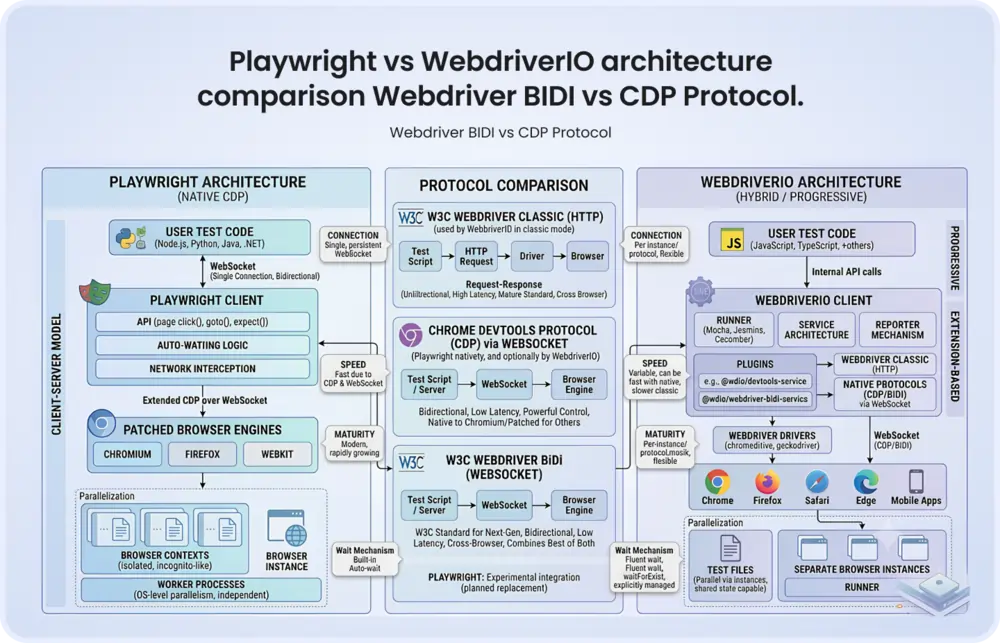
WebdriverIO uses the W3C WebDriver HTTP protocol as its default transport: your test code sends an HTTP request to a WebDriver server (chromedriver, geckodriver), the server executes the command, and the response comes back. Each action — click, type, assert — is a discrete round-trip. On a local network, that round-trip carries 50–200ms of overhead per action. Across a cloud grid like BrowserStack or LambdaTest, it's higher.
With v9, WebdriverIO adopted WebDriver BiDi as its default protocol. BiDi opens a persistent bidirectional connection between the test runner and browser, eliminating the per-action HTTP overhead for supported commands. This is the update that changes the speed narrative — but BiDi support is still incomplete. Console log interception, network request interception, and DOM event monitoring now work natively. Complex multi-domain flows and some CDP-exclusive capabilities do not yet have BiDi equivalents.
Playwright uses the Chrome DevTools Protocol over a persistent WebSocket connection. There's no per-action HTTP round-trip. The browser session stays open for the lifetime of the test, and commands execute inside that session with sub-millisecond transport overhead. Beyond transport, Playwright's auto-wait implementation polls against a full set of actionability conditions — visibility, stability, enabled state, and hit-testability — before each interaction. That's why Playwright tests flake significantly less than equivalent Selenium or WebDriver-based tests on dynamic SPAs.
The architectural difference is real, but BiDi has meaningfully reduced it. The decision should not hinge on "WebDriver is slow" anymore — it should hinge on the other constraints below.
Performance and CI cost — real numbers, not vibes
Speed matters when you're running thousands of tests per day. Here's what the numbers actually look like.
Playwright runs 30–50% faster than WebdriverIO on equivalent test suites using standard WebDriver as the transport baseline. With WebdriverIO v9 BiDi, that gap shrinks — estimates put it closer to 15–25% on suites that are fully BiDi-compatible. That's still meaningful at scale.
The more significant advantage Playwright holds is parallel test density. Playwright's browser context model shares a single browser process across multiple isolated contexts. Each context has its own cookies, storage, and session state, but they all run in the same browser process. On a mid-range CI runner (4 cores, 8GB RAM), you can run 2–3× more parallel Playwright tests than you can with WebDriver-based tooling, which spins up a full browser process per worker.
Translate that into CI cost: if your current WebdriverIO suite runs 5,000 tests per day across cloud runners, and Playwright cuts your per-test compute time by 20% while doubling your parallel density, the infrastructure cost drops materially — and so does the flakiness-driven rerun rate. Teams that migrate from WebDriver-based tooling to Playwright report roughly 40% fewer flaky test failures, which means fewer ghost reruns consuming runner minutes without surfacing real bugs.
Here's a rough comparison at scale:
500 tests
~12 min
~9 min
WDIO: 4 / PW: 8–10
~15–20% reduction
2,000 tests
~45 min
~28 min
WDIO: 4 / PW: 8–10
~25–35% reduction
5,000 tests
~110 min
~60 min
WDIO: 4 / PW: 10–14
~35–45% reduction
Estimates based on 4-core CI runner, TypeScript test code, Chrome browser, ~3 actions per test average. BiDi-compatible tests assumed for WDIO column.
The flakiness tax is the line item most teams don't budget for. On a 2,000-test suite with a 10% flake rate, you're rerunning 200 tests per CI run. At 8 runs per day, that's 1,600 phantom test executions consuming compute hours and delaying pipeline feedback. Playwright's auto-wait implementation eliminates most of that category of flakiness — not by retrying, but by not acting until the element is actually ready.
Developer experience — setup, TypeScript, and debugging
Playwright's setup is genuinely fast. npm init playwright@latest gives you a playwright.config.ts, browser binaries, example tests, and a GitHub Actions workflow file. The entire process takes under five minutes on a clean repo. Here's a realistic config:
// playwright.config.ts
import { defineConfig, devices } from '@playwright/test';

export default defineConfig({
  testDir: './tests',
  workers: process.env.CI ? 4 : 2,
  retries: process.env.CI ? 1 : 0,
  use: {
    baseURL: process.env.BASE_URL || 'https://app.example.com',
    screenshot: 'only-on-failure',
    trace: 'on-first-retry',
    video: 'retain-on-failure',
  },
  projects: [
    { name: 'chromium', use: { ...devices['Desktop Chrome'] } },
    { name: 'firefox', use: { ...devices['Desktop Firefox'] } },
  ],
});
No @types/* hunting. TypeScript types ship with @playwright/test and require zero additional configuration.
WebdriverIO's interactive npx wdio wizard is thorough, but that thoroughness has a cost: new teams face a series of plugin-selection decisions — framework (Mocha/Jasmine/Cucumber), reporter, services (chromedriver, appium, devtools). Each choice is sensible, but the surface area creates decision fatigue and a wider range of configuration drift across teams.
// wdio.conf.ts
import { Options } from '@wdio/types';

export const config: Options.Testrunner = {
  runner: 'local',
  specs: ['./test/specs/**/*.ts'],
  maxInstances: 4,
  capabilities: [{
    browserName: 'chrome',
    'goog:chromeOptions': { args: ['--headless'] },
  }],
  framework: 'mocha',
  reporters: ['spec'],
  mochaOpts: { ui: 'bdd', timeout: 60000 },
  baseUrl: process.env.BASE_URL || 'https://app.example.com',
};
The debugging gap is where Playwright pulls ahead most clearly. Playwright's Trace Viewer captures a full timeline of every test step: network requests, DOM snapshots at each action, console output, and screenshots — all accessible through a local web UI. No plugin installation. No reporter configuration. It's there by default when you set trace: 'on-first-retry'. A debugging session that takes 45 minutes in WebdriverIO (log reading, locating the failing selector, cross-referencing with screenshots) takes 8 minutes with Trace Viewer.
Here's the same login test in both frameworks to make the selector and wait strategy differences concrete:
Playwright (TypeScript):
// tests/auth/login.spec.ts
import { test, expect } from '@playwright/test';

test('user can log in with valid credentials', async ({ page }) => {
  await page.goto('/login');
  await page.getByLabel('Email').fill('user@example.com');
  await page.getByLabel('Password').fill('securepassword');
  await page.getByRole('button', { name: 'Sign in' }).click();
  await expect(page.getByRole('heading', { name: 'Dashboard' })).toBeVisible();
});
WebdriverIO (TypeScript):
// test/specs/login.spec.ts
import { browser, $, expect } from '@wdio/globals';

describe('Authentication', () => {
  it('user can log in with valid credentials', async () => {
    await browser.url('/login');
    await $('[aria-label="Email"]').setValue('user@example.com');
    await $('[aria-label="Password"]').setValue('securepassword');
    await $('button=Sign in').click();
    await expect($('h1=Dashboard')).toBeDisplayed();
  });
});
Playwright's getByLabel and getByRole selectors test against accessibility attributes by default — the same attributes a screen reader uses. WebdriverIO's CSS/XPath selectors are equally capable, but they require more explicit selector strategy decisions and lack the built-in ARIA-first bias.
Mobile testing — where WebdriverIO holds a structural advantage
This section ends the decision for a large class of teams. Say it plainly: if your QA org tests both web and native mobile apps, WebdriverIO with Appium is almost certainly the right call.
The reason isn't just feature parity — it's operational architecture. WebdriverIO's Appium integration means your React Native or iOS/Android tests run under the same framework, same reporters, same CI pipeline, and the same wdio.conf.ts configuration surface. A QA lead reviewing test results sees one dashboard, one failure report format, one set of CI notifications. That operational simplification has real value in a team of 10–15 engineers.
Playwright does not support native mobile app testing. It supports device emulation — viewport resizing, touch event simulation, user-agent spoofing — which covers responsive web testing adequately. It is not a substitute for Appium-based real device coverage on native iOS or Android apps.
The concrete implication: a team with an existing Appium suite under WebdriverIO that migrates to Playwright splits their testing infrastructure in two. Two frameworks, two reporter configurations, two CI pipeline branches, two sets of selector strategies to maintain. That's not a theoretical cost — it's two separate debugging contexts every time a test fails on a mobile build.
Compliance and enterprise constraints — the non-technical veto
No comparison article in the current SERP covers this, so pay attention.
WebdriverIO runs on W3C WebDriver — a specification maintained by a formal standards body. In enterprise procurement processes and regulated-industry tool approval workflows (fintech, healthcare, government contractors), a framework backed by a W3C standard can unlock an approved-tool list in a way that CDP-based tooling cannot. This is not theoretical. Compliance teams in financial services and healthcare routinely require tools to demonstrate standards-body backing as part of vendor assessment.
Playwright is backed by Microsoft and has strong enterprise adoption across a wide range of companies. But Chrome DevTools Protocol is not a W3C standard — it's a Google browser API. In a regulated-industry procurement context, that distinction can be a hard stop regardless of how much faster Playwright runs.
If your procurement team or compliance officer asks which framework has a standards body behind it — that's WebdriverIO.
BDD with Cucumber — a migration pain most articles skip
Teams running Cucumber-based BDD in WebdriverIO have a non-trivial migration problem that nobody in the current SERP spells out.
Playwright has third-party Cucumber integration via @cucumber/cucumber wired to Playwright's browser API. It works, but it's not a first-class citizen — the Playwright team doesn't maintain the integration, and the debugging experience through Trace Viewer is degraded. WebdriverIO ships with first-class Cucumber support as a framework option in its wizard.
The real migration friction isn't code — it's process. Your .feature files, your step definitions, and the product owner or BA workflow that depends on reading Gherkin scenarios in a shared repository are all coupled to WebdriverIO's BDD infrastructure. Migrating those to a third-party Cucumber-Playwright bridge is manageable technically, but it creates process friction for non-engineering stakeholders who don't care about frameworks.
If Cucumber is central to your QA workflow — not just a nice-to-have but a cross-functional requirement — that weights the decision toward WebdriverIO.
The decision framework — a constraint-first checklist
Stop here if you want the answer fast. Map your situation to the constraints below. Each row gives you a direct recommendation, not a "it depends."
Starting fresh with a TypeScript-first web app
Playwright
Existing WebDriver/Selenium suite, evaluating migration
Evaluate WebdriverIO v9 BiDi before committing to Playwright — the speed gap may not justify the migration cost
Web + native mobile testing under one framework
WebdriverIO + Appium
Regulated industry (fintech, healthcare), W3C compliance requirement
WebdriverIO
CI flakiness and speed are the primary pain
Playwright
BDD / Cucumber as a cross-functional workflow
WebdriverIO (first-class) vs Playwright (third-party, manageable)
Polyglot team — Java, Python, Ruby alongside JS
Playwright (multi-language bindings) — WebdriverIO is JS/TS only
Existing Appium mobile suite, evaluating web framework
WebdriverIO — splitting web and mobile adds dual infrastructure cost
Team priority is Trace Viewer-quality debugging out of the box
Playwright
The architecture, CI speed, and developer experience comparisons matter. But they're secondary to these constraint questions. Answer the table first — it will shortcut the rest of the evaluation.
Migration calculus — what it actually costs to switch
This is the section the other articles don't write, because it requires knowing what migration actually involves.
What transfers cleanly from WebdriverIO to Playwright:
TypeScript business logic and utility functions
CSS selectors and XPath (though Playwright's accessibility-first selectors are the better long-term pattern)
Page Object Model structure
CI pipeline shape (both support GitHub Actions, GitLab CI, Jenkins)
What doesn't transfer:
WDIO service configuration and plugin wiring (requires full rewrite in Playwright fixtures)
Cucumber feature files and step definitions (require rewrite for the Playwright-Cucumber bridge, plus stakeholder process changes)
Appium mobile suite (requires maintaining a parallel WebdriverIO instance — there is no Playwright equivalent)
Custom WDIO reporters (Playwright has its own reporter API, not compatible)
Rough effort estimates: A 500-test WebdriverIO web-only suite with no mobile dependency and no BDD migrates to Playwright in approximately 2–4 weeks of SDET time. That estimate assumes a senior engineer comfortable with both frameworks, an existing Page Object structure, and no significant custom service plugins.
Add Appium dependencies and that timeline roughly doubles — and the ROI case weakens considerably, because you're not eliminating dual infrastructure, you're creating it.
A partial migration strategy is technically valid: run Playwright for all new feature coverage while maintaining WebdriverIO for legacy flows. This is a common interim pattern. It is also a debt accumulation pattern — dual maintenance burden, fragmented reporting, and a cognitive switch cost for engineers working across both suites. Plan an exit from the partial migration within 6–9 months or the short-term choice becomes a long-term liability.
Here's a GitHub Actions configuration showing both the Playwright CI setup with sharding and a legacy WebdriverIO suite running in parallel — the coexistence pattern:
# .github/workflows/test.yml
name: Test Suite
on: [push, pull_request]

jobs:
  playwright:
    name: Playwright (sharded)
    runs-on: ubuntu-latest
    strategy:
      matrix:
        shard: [1/4, 2/4, 3/4, 4/4]
    steps:
      - uses: actions/checkout@v4
      - uses: actions/setup-node@v4
        with:
          node-version: '20'
      - run: npm ci
      - run: npx playwright install --with-deps chromium
      - run: npx playwright test --shard=${{ matrix.shard }}
      - uses: actions/upload-artifact@v4
        if: always()
        with:
          name: playwright-report-${{ strategy.job-index }}
          path: playwright-report/

  webdriverio-legacy:
    name: WebdriverIO legacy suite
    runs-on: ubuntu-latest
    steps:
      - uses: actions/checkout@v4
      - uses: actions/setup-node@v4
        with:
          node-version: '20'
      - run: npm ci
      - run: npx wdio run wdio.conf.ts
One more pattern worth including for teams building combined API + UI coverage in Playwright:
// tests/checkout/checkout-flow.spec.ts
import { test, expect } from '@playwright/test';

test('order placed via API appears in UI dashboard', async ({ page, request }) => {
  // Seed order state via API — skip the UI creation flow
  const orderResponse = await request.post('/api/orders', {
    data: { productId: 'prod_123', quantity: 2 },
    headers: { Authorization: `Bearer ${process.env.API_TOKEN}` },
  });
  expect(orderResponse.ok()).toBeTruthy();
  const { orderId } = await orderResponse.json();

  // Verify in the UI
  await page.goto(`/dashboard/orders/${orderId}`);
  await expect(page.getByText('Order confirmed')).toBeVisible();
  await expect(page.getByTestId('order-status')).toHaveText('Processing');
});
This fixture-based approach — seeding state through the API and asserting in the UI — cuts test execution time and eliminates UI-creation flakiness. It's one of Playwright's practical advantages that benchmarks don't capture.
DeviQA's take — what we see in the field
Three patterns come up consistently when engineering teams arrive having already made a framework decision:
The mobile blindspot. Teams evaluate Playwright, run a PoC on their web suite, see the speed improvement, and commit to full migration — without accounting for their React Native app. Six months later they're maintaining a Playwright web suite and a separate WebdriverIO Appium suite, with two reporting stacks and no unified view of test coverage. The migration solved the web speed problem and created an infrastructure problem.
The BiDi gap in the analysis. Teams that did their framework evaluation in 2022 or 2023 still carry the assumption that WebDriver HTTP is WebdriverIO's architecture. With v9 BiDi, that's no longer the full story. Several teams have initiated Playwright migrations based on a speed gap that has since narrowed — only discovering this mid-migration when the ROI math changes.
The BDD undercount. Engineering-led evaluations often treat Cucumber as a test code problem — "we can rewrite the step definitions." But the .feature file workflow is a cross-functional agreement, not just a code artifact. Product managers and BAs who write acceptance criteria in Gherkin have a stake in framework decisions that don't show up in SDET-led PoCs.
The right decision depends on which of these applies to your org. Most teams benefit from a half-day constraint audit before committing to a migration path.
Not sure which framework fits your stack? DeviQA's engineers have migrated test suites across both Playwright and WebdriverIO — including mixed mobile-web environments and BDD workflows. Get a free 30-minute technical assessment and walk away with a clear recommendation for your specific constraints, not a generic features list.
Book a strategic QA consultation
About the author
Chief Operating Officer
Anastasiia Sokolinska is the Chief Operating Officer at DeviQA, responsible for operational strategy, delivery performance, and scaling QA services for complex software products.