
Written by: Chief Operating Officer
Anastasiia SokolinskaUpdated: 01.12.2025
8 min read
Did you know that nearly 70% of software projects fail to meet their original goals due to poor quality assurance? Or that 60% of defects in software are introduced during development and could be avoided with robust testing processes?
At first glance, it seems like a smart financial move: juniors cost less and can handle the same tasks, right? But the reality is far more nuanced, and the numbers don’t lie, hiring senior QA engineers actually saves money in the long run.
Let’s break it down with real examples and results we’ve seen over the years.
3 reasons why you should hire a senior QA engineer
The primary issue leading to a decline in overall project quality was that less experienced engineers were tasked with handling the same workload but:
a) took significantly longer, and
b) delivered work of lower quality.
They were unable to cover the necessary functionality with test cases → which resulted in fewer automated tests → and ultimately led to delayed releases.
As the technical debt grew, they had to compromise on quality by reducing the test coverage. Unfortunately, the less experienced engineers also struggled to maintain parallel execution of tests, which caused test runs to take much longer.
These results prove that experience drives quality. Let’s see how senior QA engineers make the difference.
1. Stop fires before they start
A junior QA finds bugs at the end. A senior QA, like a master builder, reviews the plans and materials before construction even begins.
They sit in on design discussions, analyze user flows, and identify risky assumptions before they become expensive mistakes. Instead of reacting to bugs, they prevent them, saving you weeks of rework and thousands in costs down the line.
2. Build a faster, stronger team
A senior QA isn’t just a solo contributor, they’re a force multiplier.
They mentor junior testers, improve testing frameworks, and collaborate closely with developers to make testing part of the development rhythm, not an afterthought. Over time, this builds a faster, more confident team that ships higher-quality releases with fewer delays.
3. Protect your brand and save money
When buggy software reaches users, it’s not just a technical issue, it’s a business one. Every crash, complaint, or bad review damages trust and costs money.
A senior QA ensures that your product performs smoothly in the real world. They catch the edge cases that automated tests miss, anticipate how users might break things, and protect your brand before your customers ever notice a problem.
Experience matters: The real cost of junior vs. senior QA
Back in 2018, our company began working with a client to streamline their QA processes. Over two years, two of our senior QA engineers fully established processes, built automation from scratch using WDIO+TS (the gold standard for its time). By 2020, the client enjoyed:
90% automated test coverage,
Comprehensive manual test case coverage, and
Stable releases with minimal delays or post-release issues.
However, in the latter half of 2020, the client decided to replace our senior engineers with two in-house junior engineers. The reason? To improve collaboration with the development team while reducing costs.
Four years later, the results told a sobering story: the client returned to us grappling with significant challenges, including a surge in quality complaints and nearly every other release being delayed by 1 to 12 days. We began with a thorough product assessment and can share key metrics from our engineers' report.
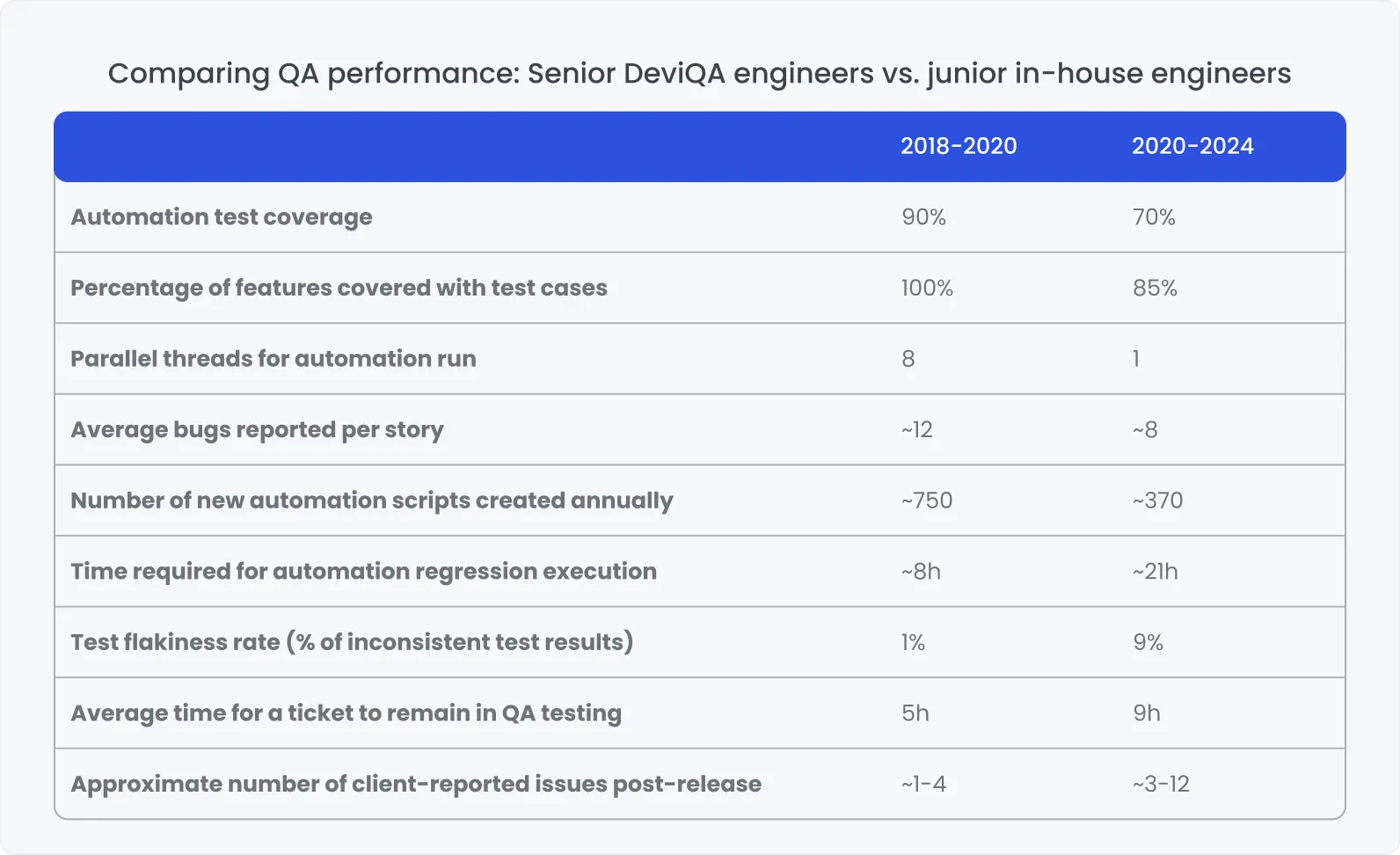
If you're involved in development, you can imagine the challenges the client faced. However, allow us to explain in more detail.
Consistent automation testing for reliable software releases
The true cost of QA hiring decisions: Another case study in business impact
Let’s break this down with a concrete example.
Productivity and reliability compared
A senior QA engineer is capable of writing approximately three end-to-end (E2E) tests per day, achieving an impressive 90% test coverage. By comparison, a Junior QA Engineer manages just 1.4 E2E tests per day, resulting in a more modest 70% test coverage.
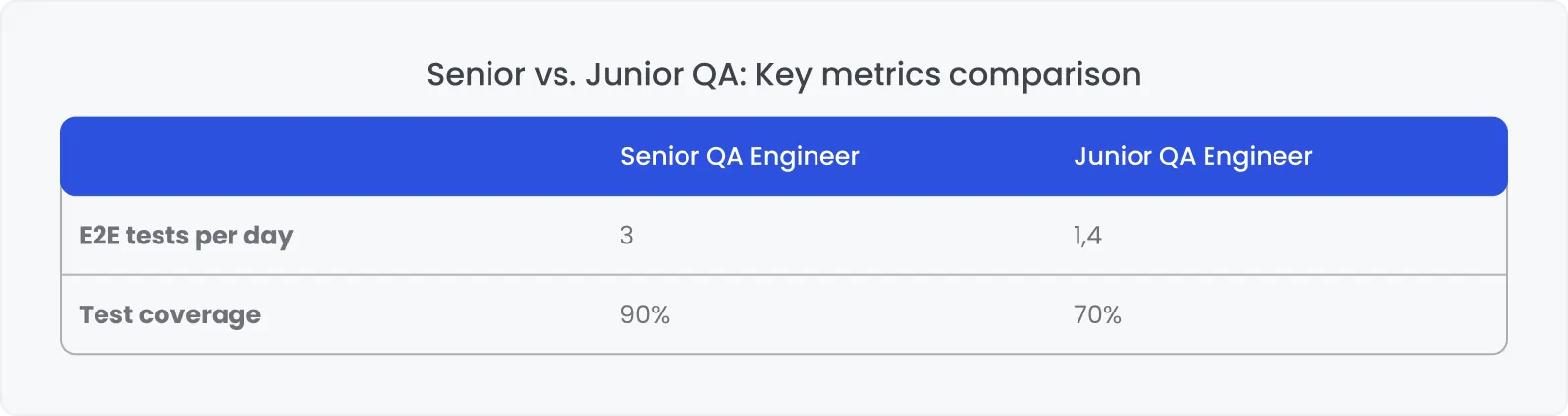
At first glance, this difference might seem manageable. After all, the Junior QA Engineer costs about half as much as the Senior QA Engineer and delivers roughly half the output—it appears balanced on paper.
However, the real distinction becomes clear when we examine test reliability. The Senior QA Engineer maintained a test flakiness rate of just 1%, ensuring the tests were highly stable and dependable. Meanwhile, the Junior QA Engineer’s flakiness rate was a staggering 9%, making their tests far less reliable.
1. Manual testing and test coverage gaps
When it came to manual testing, the Senior QA Engineer was significantly more efficient, writing test cases faster and ensuring all new features were covered. In contrast, the Junior QA Engineer often struggled to keep up, resulting in a 20% drop in test case coverage.
This inefficiency had downstream effects: tickets handled by the Junior QA Engineer spent considerably more time in the "testing" column, causing delays that rippled through the development process.
2. The bigger picture: Business impact
The most significant consequence? Post-release bugs tripled. These issues not only impacted product quality but also eroded client satisfaction—arguably the most critical metric for any business.
So, was the cost-saving decision to rely on less experienced QA Engineers worth it? The answer is a resounding NO. While the initial financial savings may have seemed attractive, the long-term cost of fixing poor-quality work, both in monetary terms and in damaged reputation, far outweighed the short-term benefit.
3. Lessons learned
This case proves a point many teams learn the hard way: saving money on QA rarely saves money at all. When quality drops, the cost shows up elsewhere, in delayed releases, rework hours, lost customers, and frustrated teams.
Over the years, we’ve seen this pattern repeat across industries. The companies that succeed long term are the ones that:
Involve QA early in the development cycle.
Rely on experienced engineers to design efficient test automation.
Treat quality as a continuous process, not a one-time checkpoint.
That’s what senior QA engineers bring predictability, accountability, and speed. They don’t just execute tasks; they build systems that scale, spot risks before they spread, and help your developers deliver cleaner code with less back-and-forth.
At DeviQA, we’ve helped hundreds of teams move from reactive testing to proactive quality management. The result: faster releases, lower maintenance costs, and fewer production incidents.
If you want QA to become a competitive advantage rather than a cost center, start by investing in senior expertise, it’s the difference between firefighting and future-proofing your product.
Team up with an award-winning software QA and testing company
Trusted by 300+ clients worldwide
FAQ: Senior QA engineers and their impact on software quality
1. What does a senior QA engineer do differently from a junior QA engineer?
A senior QA engineer focuses on preventing issues rather than just finding them. They participate in early planning, design reviews, and architecture discussions to identify potential risks before development even begins. They also guide automation strategy, mentor junior testers, and help establish scalable QA processes that ensure long-term product stability.
2. How does hiring a senior QA engineer save money?
Although senior QA engineers have higher hourly rates, they dramatically reduce rework, post-release bugs, and production downtime, all of which are costly. Their ability to design efficient test automation and catch defects early can save thousands of dollars per release cycle, improving your ROI in the long run.
3. When should a company hire a senior QA engineer?
You should hire a senior QA engineer when:
Your product has reached an active growth or scale-up stage.
Your QA team struggles to keep up with release cycles.
Bugs are slipping into production too often.
You’re planning to introduce or expand automation.
In short, when quality becomes a business-critical factor, that’s when you need senior QA leadership.
4. Can a senior QA engineer help improve team productivity?
Absolutely. Senior QA engineers are mentors by nature. They introduce better workflows, reduce test flakiness, and align QA with development processes. As a result, the whole team becomes faster and more confident, shipping releases with fewer blockers and higher quality.
5. How do senior QA engineers impact customer satisfaction?
Reliable software builds trust. Senior QA engineers ensure each release is stable, polished, and consistent, which means fewer user complaints, better reviews, and stronger brand reputation. Their work directly contributes to customer retention and satisfaction, key indicators of product success.
6. What’s the ROI of investing in senior QA expertise?
Companies that hire experienced QA professionals typically see:
Up to 3x fewer post-release bugs
20–40% shorter testing cycles
Reduced flakiness rates (1–2% vs. 9–10%)
Significant cost savings on maintenance and rework
About the author
Chief Operating Officer
Anastasiia Sokolinska is the Chief Operating Officer at DeviQA, responsible for operational strategy, delivery performance, and scaling QA services for complex software products.