
Written by: Chief Operating Officer
Anastasiia SokolinskaUpdated: 01.12.2025
9 min read
When automation is rushed or poorly structured, it often creates more problems than it solves. Many teams fall into the trap of chasing quick wins without laying the right foundations, and the consequences surface later in the development cycle.
Rapid onboarding without a plan: SDETs spend up to 40% of their time maintaining existing scripts rather than creating new ones, a key reason why rushed automation often fails to realize ROI. Engineers may start automating everything immediately, but without a strategy, scripts become inconsistent, hard to maintain, and prone to failure.
A false sense of success: Early increases in automated test numbers or bug reports can look like progress, but without clear coverage goals, critical gaps remain.
Long-term instability: “State-of-the-art AI-based frameworks now promise to resolve more than 80% of flaky test failures automatically, a necessity as 73% of QA professionals cite instability as a top challenge”. Without proper design, the automation effort quickly collapses under the weight of flaky tests, rework, and wasted resources.
The result? Higher maintenance costs, slower releases, and an ROI that never materializes. Poor practices turn test automation into a liability instead of an accelerator. In fact, despite the investment, 72% of teams report struggling with test flakiness and high maintenance costs due to rushed or poorly structured automation.
That’s why following proven QA automation best practices is no longer optional in 2026, it’s the only way to build automation that is stable, scalable, and cost-effective.
Best practices for sustainable test automation
Strong practices create the base for sustainable test automation. They help reduce risks, improve coverage, and keep testing aligned with long-term product goals.
Foundational practices
Automation in 2026 is no longer about simply “catching up” with bugs. It’s about embedding quality everywhere. The foundation for success lies in aligning automation with modern development practices, while consistently applying best practices for automation testing to avoid instability and wasted effort.
Embrace a "Shift everywhere" strategy: Move beyond the traditional "Shift-Left" approach to include testing throughout the lifecycle. From design to post-deployment, quality checks should be present at every stage.
Shift-Left testing: Introduce testing as early as possible, unit, component, and API tests, to identify defects when they are cheapest to fix.
Shift-Right testing: Extend testing into production with observability-driven testing, monitoring, and even automated chaos experiments. These practices reveal issues that only surface in real-world conditions. These approaches are not just trends, they are recognized test automation best practices that ensure quality remains visible at every stage of the software lifecycle.
Integrate testing into CI/CD pipelines: Continuous testing must be part of your DevOps and QAOps strategy. Tools like Jenkins, GitHub Actions, and GitLab CI can orchestrate automated test runs on every commit, ensuring developers receive immediate feedback.
Adopt containerization and Infrastructure as Code (IaC): Use Docker, Kubernetes, and IaC tools to provision clean, consistent, ephemeral environments for every run. This eliminates “it works on my machine” issues and scales parallel execution.
Prioritize testing strategically: Automate repetitive, high-risk scenarios and reserve manual and exploratory testing for complex, user-facing experiences where human judgment adds the most value.
The impact of AI on test automation
2026 is the year where AI shifts from “experimental” to core enabler of automation. Analysts anticipate that 80% of enterprises will integrate AI-augmented testing tools, up from just 15% in early 2023, a six-fold increase in market penetration.
When used effectively, AI reduces test creation time, lowers maintenance overhead, and improves accuracy, reinforcing the importance of automation best practices in 2026 where AI becomes a standard, not an experiment.
Leverage AI for test generation and optimization: AI and LLMs can convert requirements, user stories, or even mockups into automated test cases. Predictive models also highlight high-risk areas to prioritize.
Adopt self-healing automation: AI-powered tools repair failing scripts by recognizing context and updating locators automatically, dramatically reducing maintenance.
Implement Visual AI and anomaly detection: Move beyond brittle pixel comparisons. AI-driven visual validation mimics human perception, catching real UI/UX issues while ignoring acceptable dynamic changes.
Combine AI with human expertise: AI handles bulk test generation and repetitive work, while human testers provide creativity, critical analysis, and domain-specific insight. Together, they form a balanced QA ecosystem.
Evolving tools and techniques
The toolset of 2026 reflects speed, scalability, and inclusivity. Selecting and combining the right frameworks ensures robust, future-proof automation.
Choose a modern toolset: Selecting modern frameworks is one of the most important best practices in test automation, ensuring teams can maintain speed, scalability, and reliability even as applications grow in complexity.Use frameworks like Playwright, Cypress, or AI-enhanced Selenium. For performance, rely on k6 or JMeter, and for device coverage, integrate cloud-based testing farms.
Embrace "Code-Optional" platforms: Low-code/no-code tools empower non-technical stakeholders to contribute while still allowing engineers to build complex scenarios.
Utilize Behavior-Driven Development (BDD): With frameworks like Cucumber, create modular, reusable tests that align business and technical stakeholders around shared, readable scenarios.
Adopt robust test data management: Treat test data as version-controlled assets. Manage them independently to ensure repeatability, reduce inconsistencies, and safeguard sensitive information.
Organizational and cultural practices
The success of automation depends as much on people and processes as it does on tools. Organizations that fail to adapt their culture risk undermining their automation investments.
Transform the QA role to Quality Engineering: QA professionals must evolve from tactical testers to strategic quality engineers, designing frameworks, analyzing data, and coaching teams on quality ownership.
Prioritize security and compliance testing: With regulations tightening, security testing must be embedded from day one. Automated scans and compliance validations are essential in DevSecOps pipelines.
Measure outcomes, not just bugs: Elite DevOps and QA teams leveraging automation achieve 208x faster deployment frequencies, 2,400x shorter lead times, and 7x lower change failure rates than low performers, as identified by the DORA metrics”. Replace vanity metrics like bug counts with outcome-driven metrics. Use DORA metrics: Deployment Frequency, Lead Time for Changes, Change Failure Rate, Mean Time to Recovery to measure quality’s business impact.
Foster a culture of quality: Quality is everyone’s responsibility. Encourage cross-functional accountability, run blameless post-mortems, and celebrate achievements in reliability and stability.
Steps to build stable and scalable test automation
To avoid pitfalls, it’s crucial to adhere to a structured sequence of actions when automating an application and striving to enhance its stability:
Step 1. Plan
Develop current project documentation. We understand that deadlines become tighter every year. However, it is essential to provide at least a minimal set of documents. This can significantly reduce errors and accelerate the process. The minimal documentation set includes:
Project overview: Clearly defined objectives, goals, and expected outcomes.
Project plan: Key stages, deadlines, and milestones.
Architectural and technical description: Core components of the system, their interactions, and detailed technical implementations.
Test plan: A strategy outlining how and what will be tested.
Test scenarios and cases: Specific scenarios and test cases that will be utilized.
Step 2. Develop/Stabilize
Ensure the application is stable. During development and testing, the team must maintain a high level of feature quality. The overall functionality should be stable. Without this, automation is pointless, as the scripts will fail to execute properly. Some additional tips:
Thorough unit testing: Ensure comprehensive unit tests are in place to validate the functionality of individual components before moving to automation.
Bug triage process: Implement a bug triage process to prioritize and address defects systematically, ensuring critical issues are resolved before automation begins.
Version Control: Maintain version control of code to ensure any changes can be tracked, reviewed, and, if necessary, reverted.
Step 3. Automate
Implement automation & improve. Do with a clear plan. The good news is that this plan should be provided by the hired engineer. A competent engineer will identify potential issues during the project familiarization stage and develop a plan that addresses all risks and meets client requirements.
Let’s visualize this in a graph. It’s a good idea to remember it every time you’re tempted to ‘fix everything faster’ and overlook the golden rules.
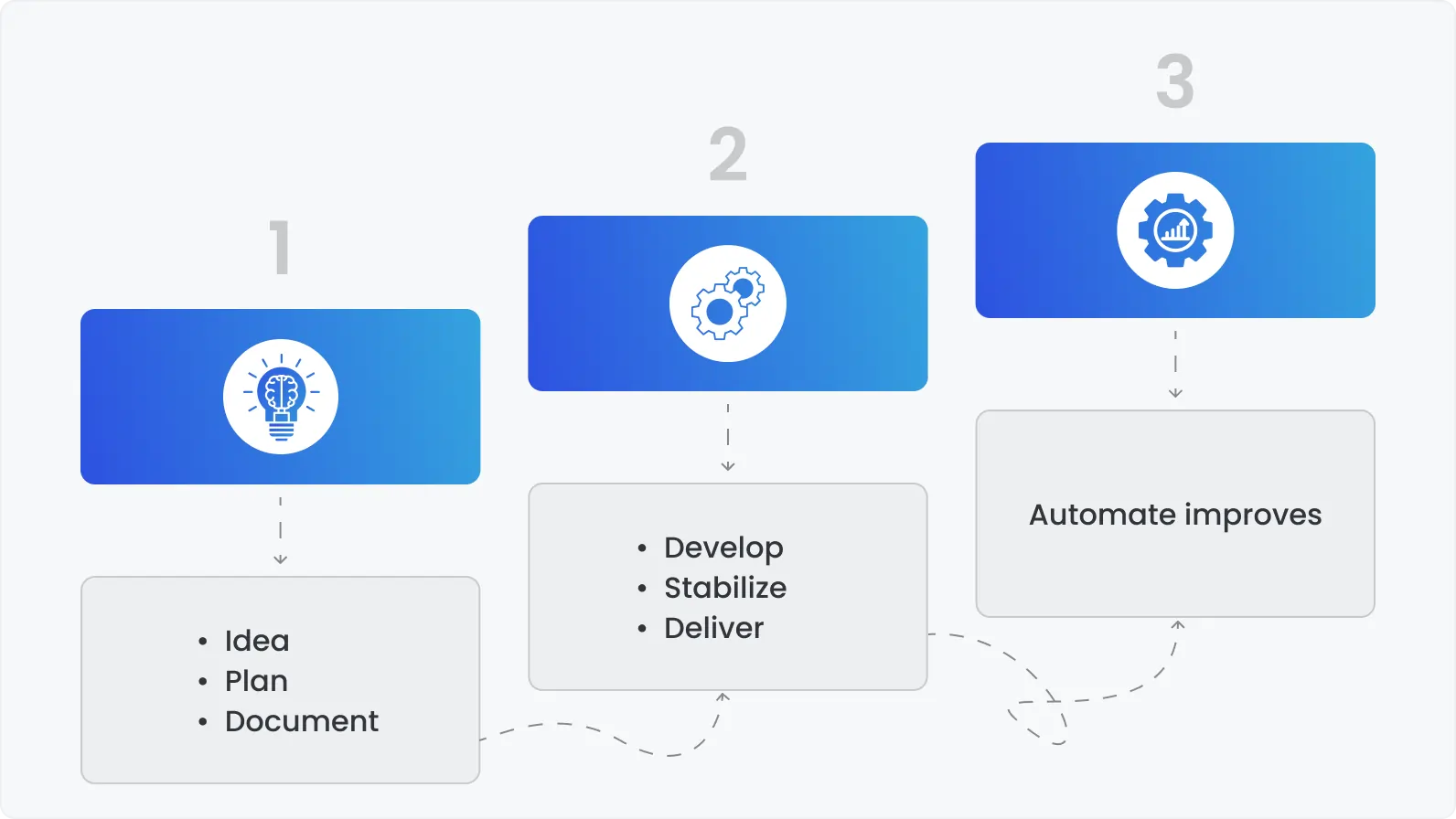
3 essential steps to build stable and scalable test automation
Some additional tips:
Prioritize test cases: Prioritize automation for high-risk areas and frequently executed test cases to maximize impact.
Modular test scripts: Develop modular and reusable test scripts to make maintenance easier and reduce redundancy.
Integration with CI/CD: Integrate automated tests into the CI/CD pipeline to catch issues early in the development process.
Test data management: Establish a robust test data management strategy to ensure that test scripts have access to the necessary data in a controlled environment.
Regularly review & update scripts: Continuously review and update automation scripts to accommodate changes in the application and to improve test coverage.
Reporting & analytics: Implement comprehensive reporting and analytics to track test results and identify trends, bottlenecks, and areas for improvement.
Post-deployment testing: Set up automated post-deployment tests to verify that the application works correctly in the production environment.
Conclusion
In 2026, automation works when it’s done with structure and focus. Key takeaways:
Plan first. Automation without a roadmap wastes time.
Test across the lifecycle. Catch issues early and monitor in production.
Use AI smartly. Cut maintenance with self-healing and targeted coverage.
Pick tools that scale. Modern frameworks, CI/CD, and cloud environments.
Make quality a team effort. Metrics and accountability matter more than bug counts.
Done right, automation saves time, reduces costs, and keeps releases stable. Done wrong, it becomes a liability.
Ready to see how QA automation best practices can reshape your testing process? Get in touch with our team to start building automation that actually delivers.
Consistent automation testing for reliable software releases
About the author
Chief Operating Officer
Anastasiia Sokolinska is the Chief Operating Officer at DeviQA, responsible for operational strategy, delivery performance, and scaling QA services for complex software products.